


Source : the age
More than 200 million people use Canva without paying a cent, making birthday invitations and school posters and the slides for Monday’s meeting on a Sydney-built website that turned design software into something anyone can use.
For a decade, those free users were the company’s greatest asset, a marketing machine that cost almost nothing to run. Artificial intelligence has turned them into a bill and that bill has upended the most valuable private company Australia has ever built.
Every request they make now runs on computers someone has to pay for. This month, in large part because of it, Canva cut $10 billion from its own valuation.
“Historically, the cost to create a design cost us essentially nothing,” co-founder Cliff Obrecht told Stripe’s John Collison on a Sydney stage on August 19. “The cost of goods to serve a user has gone from cents per month to many, many more cents.”
The problem runs wider than three founders in Sydney. Canva is the most valuable private company Australia has built. About 5500 people work there, most holding shares, and Australian venture funds, wealthy investors and superannuation money sit on its register waiting on a float. What happens next decides whether the biggest success story in Australian technology banks its winnings, or becomes a cautionary tale about a company that had its moment and let it pass.
This is becoming a national test, too: Canva is among the closest things Australia has to a technology champion, better capitalised and further into AI than almost anything else here. If it cannot make the economics work with 265 million users and $US1.5 billion in the bank, the odds facing every other Australian company trying the same thing are worse.
Software firms typically keep 80 to 90 cents of every dollar because, once the product exists, the next customer costs almost nothing. AI has effectively broken that maths. At Canva’s scale, Obrecht said, paying users now have to subsidise the free ones.
So the company slowed its biggest ever launch to protect profits, cut its revenue growth forecast from 30 per cent to 20, and has since cut the cost of running AI by about 90 per cent. “We knew this transition would mean balancing our near-term growth with investing in the enormous opportunity ahead, and we’ve always been willing to make those long-term decisions,” chief executive Melanie Perkins told this masthead.
Still, the valuations started falling.
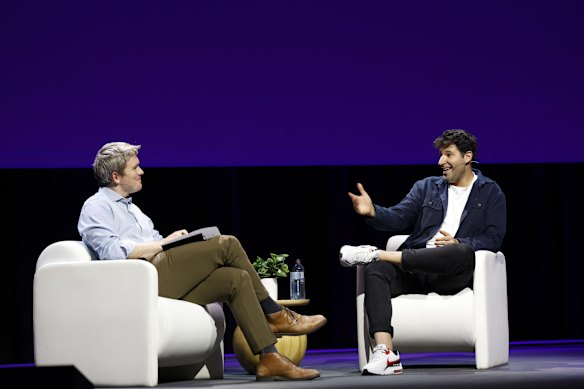
Supplied 19th August 2026
This month two of Canva’s biggest Australian backers, venture capital firms Blackbird and Airtree, cut the value of their stakes by 17 per cent, to $US34.9 billion. An independent valuer set the price of shares handed to staff at $US31 billion, down from $US38.9 billion a year ago. Share broker Hiive has been quoting stock at a price valuing the company at $US30 billion, nearly 30 per cent below the last official figure.
Canva says that internal price is a conservative tax calculation, not a real sale price, and that listed rivals have fallen much further: Adobe is down about 23 per cent over the past year, HubSpot 45 and Figma 68. That argument cuts both ways, however. If the comparables are what set the price, a strict reading of them would have marked Canva down further than the 17 to 20 per cent, not less.
In September 2021, Canva raised money at $US40 billion. Five years on, it’s looking possible that was its apex.
The open door
The origin story is a great one, told countless times now in keynote speeches and in magazine cover stories. Melanie Perkins was tutoring students in Perth, watching them struggle with Photoshop, when she and future husband Obrecht borrowed $50,000 to build a school yearbook tool out of her mother’s living room. More than 100 investors turned them down. Then it worked, faster than anything in Australian corporate history: $US165 million in 2015, $US6 billion by 2020.
By September 2021 it was $US40 billion, with everything a company needs to float. Fast growth, profits, a product in millions of homes, and a founding story that tugged at the heartstrings. It had a local template too, in Atlassian, which listed on New York’s Nasdaq in 2015.
Canva did not go. It ran private share sales instead, in 2022, 2023, 2024 and 2025, letting staff and early backers cash out without the company facing a daily share price. No decision has been made on another this year. A float once expected in 2027 has reportedly been shelved, and Canva has not committed to firm timing, saying it will list when it makes sense and that with more than $US1.5 billion in the bank it is in no rush.
A float is not just a payday, it recycles money. Early backers hand capital back to the funds and super members who gave it to them, and those investors put it into the next generation of companies. Staff who cash out become the angel investors and founders of the ones after that. Atlassian’s 2015 listing seeded a decade of Australian start-ups that way.
The company’s rise has been remarkable, and its investors are careful not to sound like they are second-guessing people who built something extraordinary. As US venture capitalist Rory O’Driscoll put it on the 20VC podcast this month, asking whether Canva should have floated earlier is really asking whether the early investors should have got out while the founders stayed.
There is self-interest in the deference. Venture funds exist to pass on returns to their investors, everyone in the industry knows it, and wanting your money back after 12 years is not disloyalty. But Canva decides who gets into its next round, and no fund wants to be the one that annoyed the founders.
Perkins and Obrecht have pledged away most of their fortune and are not going anywhere.
The wait is weighing on Canva’s backers too. Airtree raised its first $60 million fund in 2014 and still has not wound it up. Last week it asked investors to extend that fund again, to July 2028, hoping Canva floats or offers an exit before then, news site Rampart reported. Co-founder Daniel Petre, who no longer runs the firm day to day, emailed its chief executive after the meeting to complain about how the Canva stake had been handled.
Airtree co-founder Craig Blair told this masthead the firm had backed Canva since 2014 and kept doing so “because they’ve consistently delivered on the big goals they’ve set”. It says Canva has never blocked it from selling, that it has not sought liquidity outside the share sales Canva itself has run, and that Fund 1 has already distributed more than five times what its investors put in.
Blackbird, which owns about 10 per cent of Canva, is weighing whether to shift part of its holding into continuation funds so its investors can take profits without waiting. Co-founder Rick Baker said the plan was still to hold to a float.
But about 5500 staff did not sign up for a lifelong project. Within a fortnight, Canva will hand them shares priced off that $US31 billion figure. Many hold options they were told could make them millionaires on a float that keeps moving further away.
Not everyone inside is patient. On Blind, a forum where posters are verified as employees but stay anonymous, a Canva staffer of four years wrote in April that the real decisions had shrunk to a small circle around the founders, pointing to constant changes of direction on mobile and AI as proof.
“Over the past 12 to 18 months, there’s been a noticeable shift toward a much more top-down, founder-mode style of operating,” the worker wrote. “In theory, that can work. It can create speed, clarity and conviction. In practice, it has increasingly felt like decision-making has collapsed into a very small inner circle, with much of the rest of the organisation left to execute rather than think.
“Over the past 12 to 18 months, there’s been a noticeable shift toward a much more top-down, founder-mode style of operating.”Anonymous Canva employee
“From a talent perspective, some of the strongest people I’ve worked with, genuinely thoughtful, product-minded, high-agency people, are either leaving or slowly disengaging. Not because they can’t perform, but because there’s less and less room to. They get routed around, overridden, or boxed in by layers of management whose main strength often seems to be proximity to leadership rather than clarity of thinking.”
A former employee chimed in to say that was why they quit. The post went up four months before the valuation fell.
People close to Canva say the co-founders have always been closely involved and have lately spent more time with the teams on its highest-priority work. They would be more worried, they said, if the company was not willing to change course when the evidence pointed somewhere better.
Questions of strategy
Canva says more than 98 per cent of America’s 500 biggest companies have someone using it, a figure that executives repeat constantly.
“We’ve just closed our strongest quarter yet for enterprise sales, and our B2B business is now generating more than $500 million in revenue,” Obrecht told this masthead.
That is $US500 million a year, counting every business customer from 25 seats up, against total revenue of about $US4 billion. Selling to business is roughly an eighth of the company.
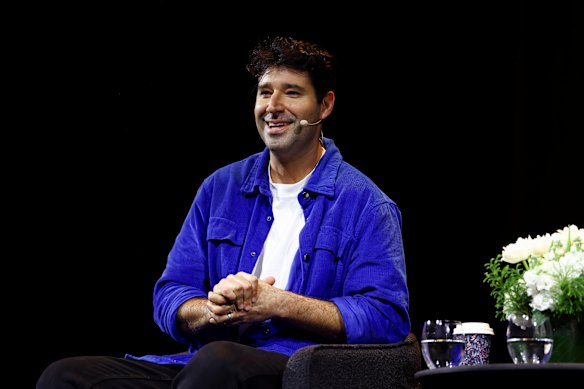
Jason Lemkin, the American software investor who founded the industry conference SaaStr, paid for Canva for eight years and says his use drifted to nothing without him ever deciding to leave. Thumbnails went to one tool, video editing to another, and his team’s AI assistants now produce marketing material without going near Canva. “Canva and Notion did nothing wrong at all. Nothing,” he said on the same 20VC podcast. They just stopped being needed. He reckons Canva is worth about $US12 billion.
O’Driscoll thinks that is far too low: a company growing 25 per cent a year and generating cash would normally trade at several times $US12 billion, he said. The only reason Canva doesn’t is that investors are not yet sure it survives the shift to AI at all. His reading is Canva is cheap, and definitely not finished.
An intentional pause
Canva’s answer is that the pause was a choice, not a stumble.
“While it’s never easy to intentionally slow things down, it was the right decision for the long-term,” Obrecht told this masthead. “The outsized demand proved we have a world-class product, but the economics weren’t yet ready for our unique scale. We’ve got those underlying numbers right, and now we’re ready to get it out into the world and accelerate growth.”
Obrecht and Perkins have done this before. In 2017 Canva stopped releasing new features for two years to rebuild its editor. “It meant putting new features on hold, but it ultimately enabled thousands of engineers to work on Canva at the same time,” Perkins says now.
The research arm now employs 140 people, and is about to launch an image-generating model built in house in five months that the company says is as good as Google’s and runs five times faster and 20 times cheaper. Owning the model helps fix the sums Obrecht was complaining about.
Obrecht says staying private is the right move at least for now. He would rather float when markets are calm, he told this masthead before the April launch, because the price would be fairer. Canva’s revenue grew 25 per cent last quarter, he said, against 13 per cent at Salesforce and Adobe.
O’Driscoll has a simple test for Canva. The only way you prove you are not dying, he said, is by growing.
This month, 200 million people will keep making birthday invitations on Canva for nothing. The next year will prove if that’s still the best marketing – or just the biggest bill – for Australia’s most important private technology company.
The Business Briefing newsletter delivers major stories, exclusive coverage and expert opinion. Sign up to get it every weekday morning.


