source : the age
To submit a letter to The Age, email letters@theage.com.au. Please include your home address and telephone number. No attachments, please include your letter in the body of the email. See here for our rules and tips on getting your letter published.
At last decentralisation is being raised as a solution to manage Melbourne’s burgeoning housing crisis. Access to good-quality, affordable housing is fundamental to society, but the short-term solutions of the Victorian government only compromise our long-term future. The Whitlam government began a program of decentralisation, developing cities like Albury-Wodonga. If these policies had not been abandoned by the Fraser government, Melbourne would be a much more liveable city today. With Melbourne’s population set to grow to more than 10 million by 2101, the priority should be to secure quality of life, the environment, jobs and prosperity for future generations. Decentralisation is complex, long term, expensive and difficult to implement, but the prospects of infinite growth are simply unsustainable, and show poor regard for future generations. If planning encompassed all of Victoria, redirecting growth towards regional cities rather than just its capital, it could ultimately restore Melbourne’s status as the world’s most liveable city.
Bryan Long, Balwyn
Climate resilience must play a factor
It is helpful to understand the nuts and bolts of Melbourne on track for megacity status: How will it cope? But equally important is understanding the sustainable-living implications of where we are heading. Climate change is no longer a future problem. Melbourne is already experiencing hotter, drier and more volatile conditions, with growing risks from extreme heat, drought, flooding, water scarcity and declining urban tree canopy and biodiversity. These risks become more significant as it moves towards a population of up to 10 million. Greater density and development will intensify pressure on water, energy, open space, sporting facilities and urban cooling. The question is whether our planning framework is adequately integrating climate resilience into the decisions shaping this future. Climate, biodiversity, water and urban forest policies mean little if they do not influence statutory planning and development decisions.
Paul Caine, Glen Huntly
Looking outside growth for answers
The word ″cope″ in the heading ″Melbourne on track for megacity status: How will it cope?″ (28/8) is revealing. I could cope with becoming overweight. But it would force me to spend much of my budget on new clothes, and damage my health. Being able to cope is not a criterion for wisdom. The same goes for urban planning. The infrastructure needed to cope with Melbourne’s historic growth has blown the government’s budget. And the congestion on our roads in our schools and hospitals, and the loss of green spaces have lessened our well-being. I cannot see us even reducing the infrastructure backlog – just to maintain services, not improve them – while Melbourne keeps growing. When will the penny drop that ″growth″ is not a solution? It is one of the drivers of so many problems. As Monash University’s Dr Taylor says, ″There has to be more to planning than just growth.″
Ian Penrose, Kew
THE FORUM
Perils of AI
The article “Gates warns global leaders on risks of AI” (28/8) highlights the profound risks of this technology to us all. Why then are our parliamentarians so enthusiastic about it? Where are the safeguards? Have they knowledge of how to control it unbeknown to Bill Gates? His comment, “We don’t have to adapt to it because it can adapt to us”, says it all.
Christine Baker, Rosanna
AI guardrails
The article ″Albanese tells Queensland to toe the line on AI″ (26/8) on emerging bipartisan support for AI is encouraging, but allowing more data centres is not an economic strategy by itself. Australia should welcome AI investment on clear conditions. Data centre operators must pay for the electricity infrastructure they require, bring additional clean and reliable power into the grid, protect Australian data and provide local training and employment.
The greater challenge is what happens beyond the data centres. AI will remove routine tasks from administration, recruitment, accounting, law and customer service. It may not eliminate entire occupations immediately, but it could quietly remove the entry-level jobs through which people gain experience.
Government should require transparency and human review when AI affects hiring, pay or dismissal. Workers displaced by technology should receive practical retraining, income support and temporary wage insurance while moving into new fields.
Australia should neither stop AI nor subsidise it blindly. We should adopt it confidently while ensuring the companies receiving the productivity gains also carry the infrastructure, environmental and social costs.
Daryl Keeley, Hawthorn East
Glacial action
The Himalayas are sometimes referred to as “the third pole” because of the huge amount of ice storage. But because of rising global temperatures, Nepal has lost about a third of its glacial coverage over the past three decades.
With rising temperatures there will be more glacier collapses and with them the sickening devastation being seen. Over time reduced water flows from glacial melts will also result in water shortages for the billions who live downstream in Nepal and India. That will inevitably result in massive numbers of climate refugees, desperate for a more liveable environment.
Nepal has contributed almost nothing to the climate crisis, less than 0.1 per cent of global emissions a year. Meanwhile Australia, as the world’s second-largest exporter of fossil fuels, is a major contributor. And we’re still arguing about net zero and whether we should develop our renewables sector? Where is our humanity?
Peter Cook, Essendon
What of our stance?
As reporter Nick O’Malley reports, “whatever the proximate cause, there is broad agreement that climate change is the catalysing force” behind the mudslide in the Himalayas (″A terrifying mass of ice, mud, water, debris and rock: How disaster unfolded″, 28/8). It is heartbreaking enough to watch this tragedy unfold, but particularly galling to know that in the midst of escalating climate catastrophes, the Albanese government is preparing to approve yet another coal mine extension and has backpedalled to allow coal and gas to power hyperscale data centres. With the Pacific Islands Forum next week, and Climate and Energy Minister Chris Bowen soon to preside over negotiations at this year’s global climate conference, COP31, Australia’s stance matters. How will a nation that remains one of the world’s largest exporters of polluting coal and gas, be viewed by Pacific nations and the wider international community?
Amy Hiller, Kew
More than talk needed
How many years have we been talking about climate change and the effects of not taking charge to make changes? Instead we keep taking and abusing the planet.
In recent years we have experienced devastating fires, floods, landslides, drought, volcanos erupting. All causing loss of human lives, wildlife, livestock and environmental devastation. The latest in Nepal. Governments talk, nations sign agreements but nothing happens. Most of us have children, grandchildren, family. Is this the world we want them to live in? Why should they be responsible for what impotent governments are not doing?
Jane Taylor, Newport
Laughed, and cried
I shall miss my daily dose of humour from the pen of Cathy Wilcox. Cathy’s cartoons have made me laugh, cry, ashamed and guilty, and always, always thought-provoking. Enjoy smelling the roses Cathy, breakfast will not be the same without you.
Veronica Paskins, Somers
Making sense
Farewell Cathy Wilcox and thanks for the art. Your work made sense of the tragic and ludicrous times we live in. Your insightful and fearless representations brought a smile to my face in the mornings and helped me get through the day. It will be harder to read The Age knowing you won’t be there.
Rohan Wightman, Brunswick
The sad farewell
Unlike your other cartoons Cathy Wilcox, your farewell one on Friday left me quite sad. All the best for the the future and thanks for giving me so much pleasure.
Ron Mather, Melbourne
Nailed the issues
Thank you Cathy Wilcox – the best and bravest cartoonist in Australia. You nailed it every time, whatever the issue, be it Gaza, the climate crisis, the femicide epidemic, or the need for real tax reform.
You’ll be sorely missed.
Anne Lewis, Northcote
Giving thanks
Cathy Wilcox thanked readers in her last cartoon (28/8), but I think we must all thank her.
Her incisive wit has helped many of us come to terms with so many fraught issues for nearly four decades. She will be missed by so many of us. Thank you for the laughs, the often cryptic, clever responses, but more especially, thank you for forcing us to delve a little more into issues from a different perspective.
Sally Davis, Malvern East
A great privilege
For so long, Cathy Wilcox encouraged readers to grapple with such a wide range of issues and helped us to deal with potential outcomes. Her drawings were either so deceptively simple or made us read the text over and over. Thank you Cathy, it has been the greatest privilege to read your creations.
Judith Hudson, Elwood
A day ruined
Oh no! My day is ruined. Cathy Wilcox is heading off to wherever brilliant, incisive, hilarious cartoonists go when they ″take a break″. Her dyslexic cow meditating is coming with me in my mind’s third eye as I head into a yoga class. Thank you and best wishes.
Jane Ross, San Remo
Decentralised, again
Interesting that decentralisation is being discussed again after a long hiatus. In the 1970s, I worked on a decentralisation scheme run by Victoria, NSW and the Whitlam government in a rare spirit of co-operation. The growth centres for Victoria were Portland, Ballarat, Bendigo, Albury-Wodonga and the Latrobe Valley. The population of Melbourne was a shade under 2 million. After the Fraser government took office in 1975 the scheme was allowed to fade away. It seemed an odd decision coming from a Western District farmer in coalition with a rural-based party.
Ken Turnbull, Maldon
Joy of words
I cannot conceive of a world where people cannot read or write, and yet even in this day and age, such people exist. Getting lost in a fantasy world of literature is surely one of the greatest gifts one can have.
Marie Nash, Balwyn
Trump’s lochjaw
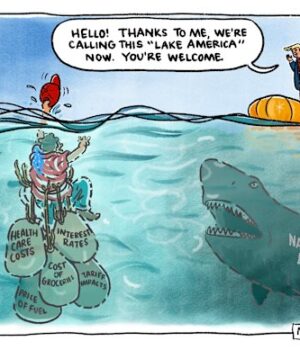
The Donald Trump may be losing his grip, renaming Lake Ontario as Lake America, when clearly he intended it to be Lake Trump.
James Ogilvie, Kew
AND ANOTHER THING
Wilcox
Cathy Wilcox has been the best at ″the best job in the world″. She will be sorely missed.
Betty Rudin, Wandin North
Mornings will not be the same without Cathy Wilcox. Her cartoons have made me think, laugh and usually nod my head and say, “Spot on Cathy, you’re a treasure.“
Les Cooper, Anglesea
Cathy Wilcox’s cartoons were part of my morning. No one else could capture my thoughts on life and the state of the world so simply and so beautifully. Enjoy your well-deserved break, Cathy.
Anne Wood, Birregurra
Cartoonists like Cathy Wilcox are a gift to society who thankfully can’t, and won’t, be muzzled.
Bernd Rieve, Brighton
How deeply distressing to find Cathy Wilcox is parking her pencils. I will truly miss her insightful and amusing work.
Paul Dover, Canterbury
Trump
Donald Trump has renamed Lake Ontario Lake America. He has no need to attack Canada, as most Canadians have died laughing.
Mike Francis, Fitzroy
No matter how often Donald Trump demands, I will still come from Woorinen North.
Barrie Bales, Woorinen North
Furthermore
Brand new road near Kyneton, built from base up, was finished a few weeks ago. Now after some rain it has potholes. Something is wrong with our road construction technique. Please fix it.
Michelle Leeder, Trentham
I don’t mind paying taxes (or a levy) for government projects, but I do mind my contribution being spent inefficiently.
Kevan Porter, Alphington
A robot can run faster than Usain Bolt, yet Bolt knew how and when to stop!
Tom Stafford, Wheelers Hill
Finally
The scariest book to read in 2026 is 1984.
Graeme Rose, Wangaratta