Source : the age
You need only look at what happens inside the empty room above the Appizza restaurant in Sydney’s Darlinghurst, where the Concrete Waves collective has laid down a springy wooden dance floor, to see that breaking is alive in Australia.
It’s a Saturday night and DJ Naiki cues up a fresh track before dozens of B-boys and B-girls battle for the top spot across nine gruelling rounds. Some spin on their heads, others pull off midair flips. Many move with such fluidity that they resemble sheets of satin rippling in the wind.
But in the past two years this vibrant community hasn’t been limited to battling one another.
Instead, breakers from several of Australia’s biggest cities have told this masthead their community has faced widespread derision, becoming collateral in the global pile-on that gathered pace in the weeks following Raygun’s nil-point-scoring Olympic debut performance in 2024.
Raygun, whose real name is Rachael Gunn, became a self-described “meme” for her kangaroo pose, and a victim of online hate. The announcement of her coming Netflix documentary, Untold Raygun: Breaking Badly, has left the Australian breaking community braced for more attention when it lands on September 1.
Trolls harass B-Girls
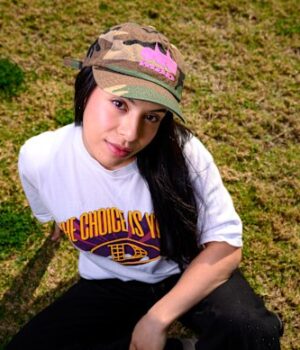
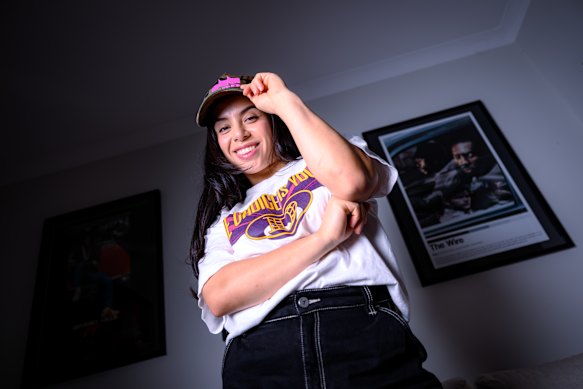
Geraldina Hnitko, a B-girl from Sydney’s west known as G-Clef, and “a couple other young kids who were also just learning how to break at the time” formed a crew called Flowtality in 2011 when she was just 13.
“A lot of us had Filipino heritage, including myself, and we were roughly around the same sort of area, western Sydney, kind of Blacktown area,” the now 29-year-old says. “Our focus isn’t always just about winning battles; it’s about winning the hearts of the audience.”
However, Hnitko says the period following the Olympic performance was a “sombre” time for the Australian breaking community – particularly for B-girls.
“Immediately after Raygun went viral, the public went looking for answers and started searching for footage of other Aussie girls online,” she says. “A lot of us started getting criticised online all of a sudden.
“We were kind of being mocked a bit, and it was, well, ‘Who’s this Aussie white girl from Australia trying to do breaking … Is this what Australian breaking is about?’ And it’s like, no, we have so much more to offer.”
Hnitko says Australian B-girls felt “ridiculed”; some no longer wanted to break.
“We can’t just have our whole breaking scene just reduced to one single Olympic performance,” she says. “Because it went so viral, and if you’ve got the general public that aren’t a part of our culture and maybe haven’t even seen breaking before, this is what their impression is going to be.
“It put our scene back, you know, especially for B-girls.”
Gunn said she had “enormous respect for the Australian breaking community” and people dedicated to growing the sport and culture.
“I recognise that the attention surrounding the Olympics created a difficult and unprecedented period for many people, myself included,” Gunn said in a statement to this masthead.
“I would never want anyone within the breaking community to experience ridicule, bullying or feel discouraged from participating in something they love.”
In late August 2024, a group of about 10 Australian B-girls held a Zoom meeting where they documented instances of alleged abuse and collated a report for AUSBreaking, the country’s peak breaking body.
Titled Impact of Raygun’s Olympic performance on the B-girl community, the report, seen by this masthead, alleges a “devastating impact on the Australian B-girl community, B-girl harassed by media and left exposed to public criticism”.
It includes examples of hateful comments such as, “You and Rachael should stay away from breakdancing. You both are so bad. Australians obviously doesn’t [sic] know what breakdancing is.”
AUSBreaking did not reply to a request for comment when contacted by this masthead.
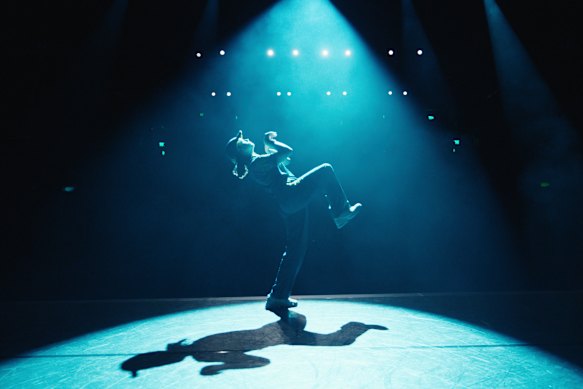
Netflix sold doco as telling B-girls’ story
In September last year a producer approached Hnitko – along with several other Sydney dancers – to feature in Netflix’s Untold sports documentary series. “We actually had arranged for me to film initially,” she says. “It didn’t go ahead due to logistical reasons.”
According to Hnitko, a producer told her the documentary would shine light on the impact that Gunn’s performance had on female breakers.
“It’s going to be interesting to see how that goes,” Hnitko says. “My understanding when I was having initial chats with one of the producers was: obviously it’s going to be centred on Raygun. But they said they wanted to tell the Australian B-girl story and understand everything that happened alongside the whole Raygun saga.
“My hope is that the documentary will showcase the greater impact and everything that happened behind the scenes … although with the trailer out, it seems to focus mostly on Raygun.”
Gunn said: “The documentary tells my personal story and gives me the opportunity to speak about an experience that had a profound impact on my life. It isn’t intended to speak on behalf of the entire Australian breaking community or diminish anyone else’s experience.
“I remain incredibly grateful for what breaking has given me and I genuinely hope the Australian breaking community continues to grow and that more people, particularly young girls and women, feel encouraged to participate.”
The synopsis for Gunn’s documentary states that “nobody, least of all Rachael Gunn, expected to be an Olympian”.
It continues: “But as Raygun’s performance at the 2024 Paris Olympics went viral overnight, so did an avalanche of memes, misinformation and conspiracy theories questioning how she ever got there.”
There’s no mention or preview of interviews with those in the breaking community.
‘Students started disappearing’
Long before the breakers in Australia found their communities in suburban halls and suburban PCYCs, black and Latin dancers on the streets of New York’s Bronx in the early 1970s would unfurl a square of cardboard and battle.
Come the 1990s, that culture had trickled south, when Jami Blomeley decided to open his breaking studio in Ballarat, Victoria. He began travelling around regional Victoria in 2013 to teach breaking at dance schools, from Geelong to Torquay and Castlemaine.
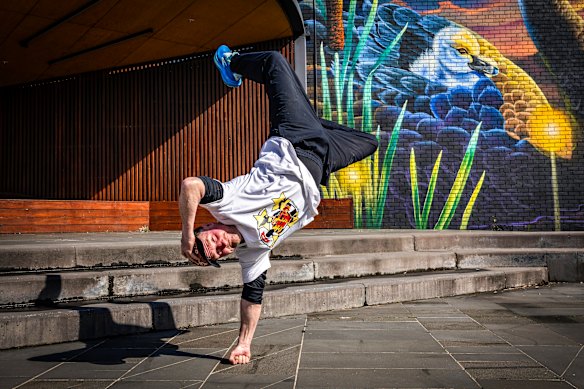
Blomeley claims that days after the Olympics “our students started disappearing”. (These and other claims are anecdotal.)
“Our girls’ class did not want to do breaking any more. They just wanted to do hip-hop instead … they did not want to announce themselves as being a breaker.”
One primary school boy and former student of Blomeley was teased on the school bus in the weeks following the Olympics. “They all knew he was a breaker … he was basically greeted with the name Skippy, even just by his own friends,” he says. “But they probably didn’t realise how much of an effect that would have on somebody. He was an obliterating mess.”
A former B-girl student started identifying as a basketballer instead of a breaker, Blomeley says, because “it was just so hard to keep defending yourself”.
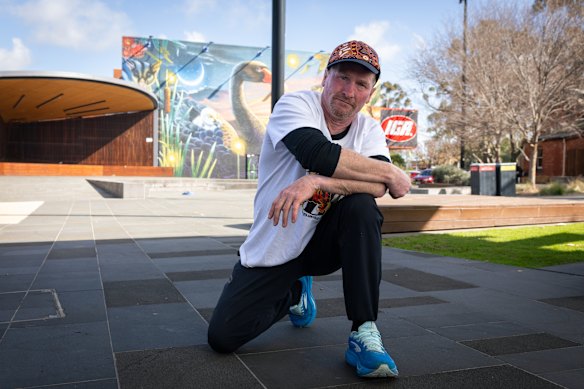
Then, Blomeley claims, classes he’d teach at schools went from four a week to one as students’ interest in breaking waned.
“[I was travelling to] teach three or four hours [a week] to maybe teaching for one hour and then eventually nought,” he says.
“For our biggest promotion in midyear August [that runs free across four weeks]… we anticipated about 110 kids to turn up … and that was a week after the Olympics. I thought I might get double, so I put on three extra staff members ready to go. Can you guess how many people turned up on the opening day? We had zero.”
When asked for comment, Gunn said: “I don’t think it is appropriate for me to speculate on, or accept responsibility for, claims about individual experiences, participation levels or the performance of particular classes without evidence establishing those links.”
Community still ‘flourishing’ despite online perception
When Michael Fox was growing up in suburban Wantirna, Victoria, he taught himself to break in primary school.
“I started breaking at nine years old,” says the now 36-year-old, who runs Melbourne Break Dance – Australia’s largest breakdance studio.
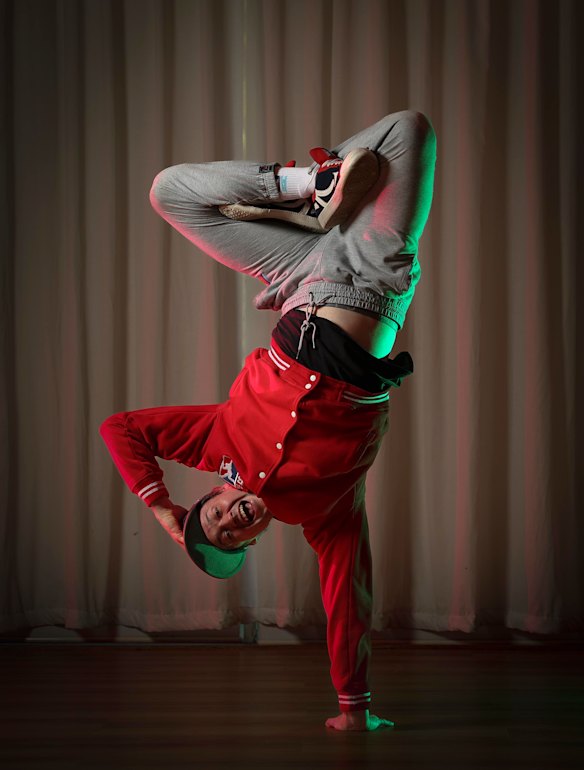
Eddie Jim
Fox says the investment that the breaking community received ahead of the Olympics was limited compared with other countries. “China decided to go all-in, and their Olympic coaches, who are world champions, flew out there and trained their people for it,” he says. “The Australian Olympic team was just trained by people who are passionate [and] aren’t being paid.
“It wasn’t a level playing field for us at all.”
Like Blomeley, Fox claims his classes experienced a drop-off in student interest following the Olympics. He believes the negative backlash against Gunn’s performance is deterring people from the art.
“The general public is bullying people out of doing the sport because they associate breaking in Australia with Raygun’s dance moves.”
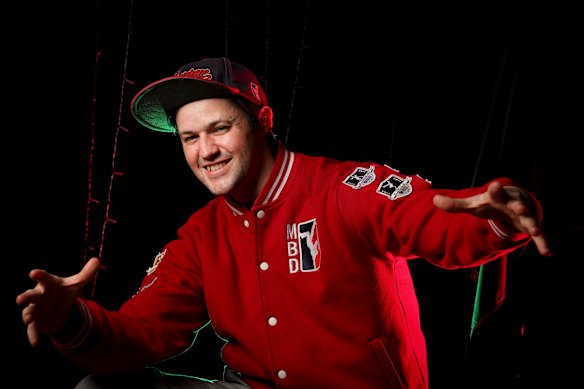
Meanwhile, on the Gold Coast, breaker Chris Cielo says his local scene is strong – despite being smaller. “I have been putting on jams for the community for over 10 years,” he says.
Cielo believes Australia’s breaking scene before and after the Olympics remains the same.
“The culture is still flourishing and growing,” he says. “The level of talent we are seeing out of the youth is next-level. It’s a shame that the outside world now has this perception of breaking as a somewhat viral meme … but through education, people will eventually see the real stuff and the beautiful culture behind it that actually helps connect people.
“There is no doubt that with the dynamic moves and energy behind the dance, it’s always gonna be loved – no matter what the online public perception is.”
Start the day with a summary of the day’s most important and interesting stories, analysis and insights. Sign up for our Morning Edition newsletter.