Source : Perth Now news
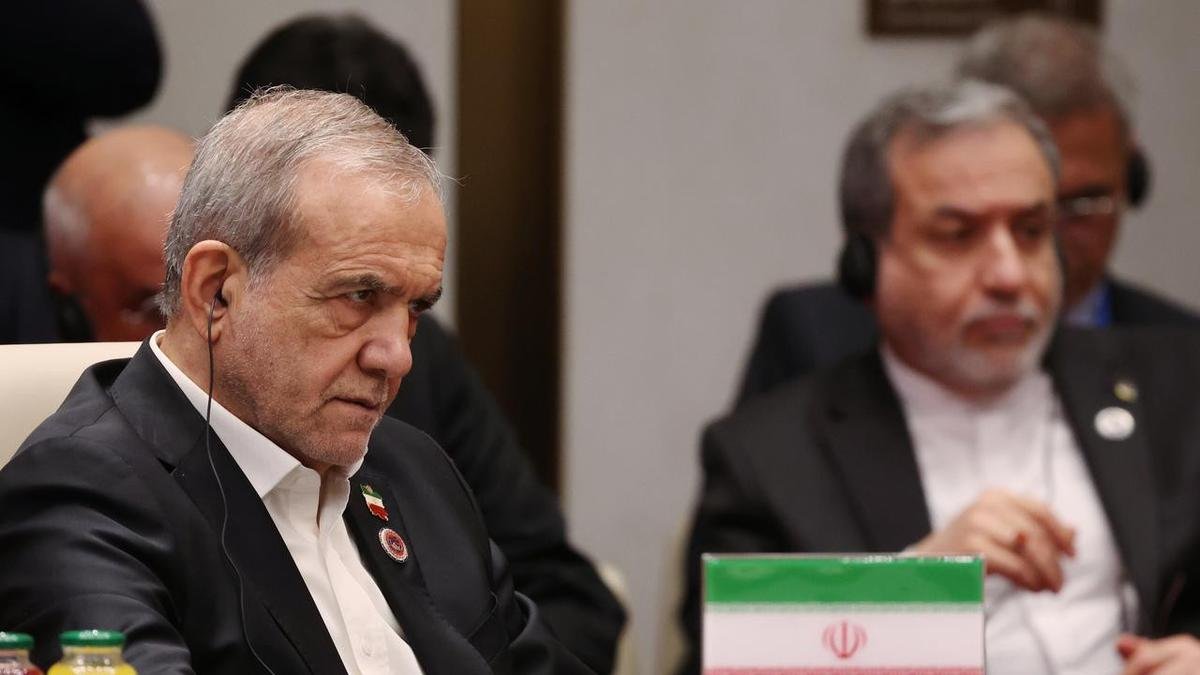
Iranian President Masoud Pezeshkian has accused the United States of reneging on a June agreement with Iran, while offering to reciprocate if the US honours its commitments.
“If the US returns to its obligations in the aforementioned memorandum of understanding, the Islamic Republic of Iran will immediately reciprocate,” Pezeshkian said at a summit of the Shanghai Co-operation Organisation (SCO) in the Kyrgyz capital Bishkek, according to Iran’s IRNA news agency.
Pezeshkian said that about three months of negotiations mediated by Pakistan and Qatar had led to the interim agreement, known as the Islamabad Memorandum of Understanding.
However, he accused the US of soon abandoning its commitments.
“The US commitment to the document signed by the president of that country lasted less than two weeks, and that country’s excessive demands and reneging on its commitments began, which still continues,” Pezeshkian said, according to IRNA.
He said Iran had responded proportionately to what he described as US violations of the June memorandum.
In the memorandum, Iran agreed to clear the Strait of Hormuz of mines and allow ships to pass while the US agreed to end its naval blockade, lift sanctions, issue waivers for Iranian oil exports and begin work on a reconstruction package for Iran.
Diplomatic efforts to bring the war to an end are at an impasse.
Last month, a 60-day deadline set out in June’s preliminary agreement for the two sides to reach a final peace deal, including on Iran’s nuclear program, expired.
Regional powers launched a fresh diplomatic push last week, with delegations from mediators Pakistan, Qatar and Oman travelling to Tehran for talks.
But major points of contention remain unresolved, including the Strait of Hormuz shipping route.
The strategic waterway was open before the war.
But Iranian attacks and controls on shipping through the strait, combined with a US naval blockade of Iranian ports, is severely disrupting the global oil trade.
US President Donald Trump recently declared “economic warfare” on Iran, with his administration promising to sanction countries that still do business with Iran.
There was also a renewed military escalation in the Gulf over the weekend, with the two sides exchanging attacks for the first time in about a month.
FM @araghchi attends the 26th SCO Summit in Bishkek alongside President @drpezeshkian. #SCO https://t.co/D7WiRNhWa4 pic.twitter.com/9HCEQTevm5— Government of the Islamic Republic of Iran (@Iran_GOV) September 1, 2026
Meanwhile, Iran’s armed forces said they have deployed air defence units at more than 3800 locations across the country.
“Many of these sites are in difficult-to-access areas. Iran is a country with diverse geographical conditions, and air defence forces are stationed in deserts, on coasts, on islands and in mountainous areas,” an Iranian general told state television.
About 160 Iranian air defence personnel have been killed in military conflicts with the US and Israel since October 2024, according to Second Brigadier General Mohammad Sadeghian.
He also expressed cautious criticism of imported weapons systems, saying Iran had concluded that it should increasingly rely on domestically produced air defence systems.
The US and Israel have targeted Iranian radar systems, air defence batteries and air bases during the war.
At times, reports suggested that Iran’s forces had been able to do little to counter the air strikes.
Claims about Iran’s military losses and its battlefield successes are difficult to independently verify.
with AP