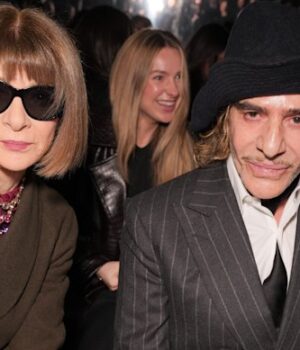
Source : the age
John Galliano – the fashion world’s theatrical ringmaster par excellence – has always enjoyed his contradictions, and champions.
The one-time head designer of one of France’s most storied fashion houses, Christian Dior, Galliano once quipped: “Fashion is above all an art of change.”
Yet for all his headline-grabbing and famously fantastical runway shows, he was perennially looking one way: backwards. Historicism was a hallmark of his craft. His 1997 haute couture debut for Dior, after all, celebrated the opulence of 1930s opium dens in Shanghai.
Then came this week, when he announced on social media that he would be stepping back from the highly anticipated – and controversial – planned retrospective of his work, which was to be the centrepiece of next year’s Met Gala.
The one year Galliano has tried, for decades, to leave behind, has finally caught up with him, in a way it arguably hasn’t before.
This was 2011, when a French court handed Galliano a total of €6000 ($13,565 now) in suspended fines, after he was found guilty of “public insults” based on origin, religion, race or ethnicity. This, after he was caught on film, hurling antisemitic rants at people in a Parisian bar. Among other moments of racism.
Many of fashion’s most illustrious figures have tried to rehabilitate Galliano’s image over the years.
Supermodel Kate Moss famously chose Galliano to design her wedding dress for her 2011 nuptials, telling Vogue she wanted “a classic Galliano, those chiffon Thirties kind. I’ve lived in his dresses for years, and they just make me feel so comfortable.”
But it’s arguably Vogue’s global editorial director Anna Wintour who has acted as his rehabilitator-in-chief, reportedly smoothing the way for him to nab lucrative fashion roles, after Dior fired him.
And then, the Met Gala.
“She’s wanted this for years, and she seemed to have gotten her way,” says Amy Odell, host of the Back Row with Amy Odell podcast, and author of Anna: The Biography, about Wintour.
Speaking with host Samantha Selinger-Morris on The Morning Edition podcast, Amy Odell says the cancellation of Galliano’s retrospective is about far more than Galliano’s own troubled history, revealing that the wider fashion industry is now being reigned in after years of tolerating egregious behaviour.
Click the player below to listen to the full episode, or read on for an edited extract of the conversation.
Selinger-Morris: Can you just remind listeners of what John Galliano actually did? It’s about 15 years ago now … you have called Galliano previously, “the industry’s most famous antisemite”, not without good reason. What did he say and do? And what does it say about the fashion industry that he was chosen then for this in the first place?
Odell: There were two incidents, one of which was filmed and released by The Sun newspaper. In that video, Galliano was saying, “I love Hitler.” I believe that’s a direct quote. And, “Your forefathers would be gassed and dead,” something like that. And there was another incident at a café in Paris where he was drinking, and he was saying racist and antisemitic things to another couple.
One of the people involved in that incident is named Philippe Virgitti, and he appears in the John Galliano documentary, John Galliano: High and Low, which Anna Wintour had a hand in pulling together. Condé Nast is a producer on that, and she sat for an interview for that. But that also seemed like a way for her to rehabilitate John Galliano’s career following these horrific incidents.
Anyway, Virgitti spoke to Kevin Macdonald, who did that documentary, and he said he didn’t think John Galliano was sorry. He never apologised to him. And he testified at the hate crime trial in Paris. And he said at that trial that he didn’t think Galliano was racist. And he said in the documentary that he regretted saying that, basically, and that he does believe that Galliano is racist because he never apologised to him.
Selinger-Morris: So is this cancellation of John Galliano a rebuke of Anna Wintour? She’s always been his champion. And it has to be said that it was a very unusual choice to have him celebrated with a Metropolitan Museum retrospective because it’s only twice before in the history of the Met Gala that a living designer has been chosen to be the focus of a retrospective: that was Yves Saint Laurent in 1983 and Rei Kawakubo in 2017. So is this something of a public recognition that her taste doesn’t matter, or it’s off?
Odell: I think she’s made some extremely tone-deaf moves, particularly around the Met Gala, and this may be the biggest. And the Met could not risk the donors pulling funding and pulling donations. And it also – I don’t think it could risk the … how should I say this? – I mean, I don’t think it could risk that round of backlash.
And I don’t know at this time, the story just broke really hours ago. But what was Vogue hearing aside from the stuff that we’ve been reading in the press? Were they hearing from celebrity publicists who were saying, “We can’t have our clients go”? How do you attend the event if it becomes the “Antisemitic Pro-Hitler Met Gala”? How do you attend as a celebrity? What good does that do you?
Listen to the full podcast episode in the player above.
Hear the story behind the headlines on The Morning Edition podcast, every weekday from 5am on Apple, Spotify or your favourite podcast platform.