

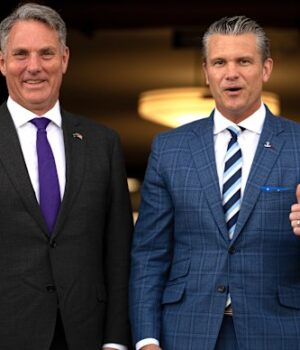
source : the age
Hello and welcome to our live coverage of national news for Thursday, September 3. Here’s what is making headlines today.
Defence Minister Richard Marles has described the operation of big AI firms in Australia as an extension of Australia’s military alliance with the US.
Marles was speaking in Washington, DC, after meeting with his counterpart, Secretary of War Pete Hegseth.
Earlier in the week, Marles and junior tech minister Andrew Charlton met with AI labs wanting to invest in Australia. This masthead reported that tech executives gave early assurances to build data centres away from heavily populated areas; Marles said this was a critical condition.
“I actually think from a national security perspective, having Australia as a place from which frontier labs/tech companies operate is in a national security sense a kind of an extension of what we are doing with the alliance,” he said, after discussing US force posture in Australia with Hegseth.
“Our continent and our country can offer a lot here.”
Meta released its most powerful artificial intelligence model yet, with its chief AI officer saying its capabilities are edging closer to top competitors.
Developers will be able to access and pay for Muse Spark 1.3, an updated version of its most advanced model, the company said. It will soon roll out the update to users of Meta’s social media platforms, like Instagram and Facebook, as well as Meta AI.
“This is our biggest jump so far on model performance,” Meta’s chief AI officer Alexandr Wang said in an interview, pointing to advancements in the model’s coding and agentic capabilities, or ability to complete tasks on behalf of human users. Wang said the update put Meta on par with recently released AI models from its rivals OpenAI and Anthropic.
Wang said Muse Spark 1.3 is “competitive” with Anthropic’s model, Claude Fable 5.1, and “better than” OpenAI’s GPT-5.6 Sol, particularly when it comes to coding, though OpenAI will soon be releasing a new, even more advanced model known as Astra. In his opinion, Meta’s model outperforms “any of the current Chinese models out there.”
Treasurer Jim Chalmers says improving productivity in Australia’s economy will be a “two-decade problem”, not one that can be fixed in a year, after fresh data on the June quarter released by the ABS yesterday indicated a decline.
“For us, it’s been there for decades. The difference between this government’s approach and our predecessors’ was that we take it seriously enough to have a big, broad productivity package in the budget, which will cut compliance costs by more than $10 billion a year, a national competition policy to boost GDP, [and] all of our efforts on AI and teaching and training,” he told ABC Radio National.
“This is all about trying to shift the productivity challenge, which has been a huge problem in our economy for some decades now, and will take time to turn around.”
Weak productivity levels can limit a nation’s economic capacity.
A specialist team of drone operators will be deployed to Nepal to assist with the ongoing search and rescue effort after flash floods devastated the Nepal-China border last week.
The team will include members of Fire and Rescue NSW and the Queensland Fire Department and is set to depart to Nepal in the coming days.
Australia has also committed a further $3 million in humanitarian assistance to Nepal, bringing its total support to $11 million.
The number of Australians still missing in Nepal and Tibet remains at 38.
Iranians and their Arab neighbours feared a return of war on Wednesday after the biggest exchange of fire between Tehran and Washington since July, with US forces striking Iran’s southern coast and Iran firing at American bases across the region.
The US threatened more devastating strikes. Iran accused Washington of hitting a wedding party, killing four people and wounding dozens. Its health minister later said 18 people in total had been killed and 108 injured in the latest wave of US strikes.
The US military said it struck air defences, radar systems, maritime assets, mine-laying capabilities and communications sites on Tuesday. Iran reported hits on multiple targets near the Strait of Hormuz.
Washington says that despite Iranian attacks, it is guiding ships through the strait: Energy Secretary Chris Wright said more than 17 million barrels of oil exited on Monday.
Hello and welcome to our live coverage of national news for Thursday, September 3. Here’s what is making headlines today.


