Source : the age
Darren Klemm remembers a time when volunteers didn’t bother warning the public about every little spot fire.
“We’d go to fires out at the back of Cullacabardee, and just not tell anyone anything. You know, roads would get closed, but it was just the way it was and people got on with it too,” he says.
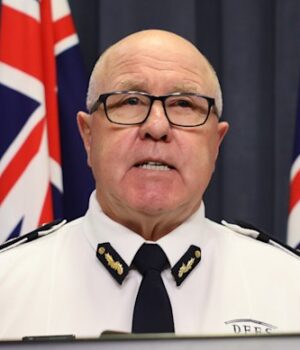
However, now in his ninth year as Western Australia’s Department of Fire and Emergency Services Commissioner, Klemm says in 2026, constant updates are non-negotiable.
“The growth is unbelievable, and the expectation from community about what they’ll get told and when they get told it has grown exponentially,” he says.
“We’re always going to find it hard to keep up with that thirst – because the more that you give, the more that is expected.”
Klemm is used to being the bearer of bad news. In his time as commissioner, he says the way he has gone about delivering warnings, wash-ups and incident details has changed immensely.
He has seen a transition from giving updates on the old AM radio, to massively scaling up of the state’s emergency’s website, which provides minute-by-minute information on bushfires, floods, cyclones and HAZMAT warnings.
Now, he says, the public want information, they want it now – and it’s his job to deliver it.
“They want to be warned, and they want to inform themselves. That’s what we want as well,” Klemm says.
Sitting down with this masthead in his Cockburn office at the beginning of the state’s bushfire season, Klemm is a long way from his hometown in Wagin and where he grew up in the Wheatbelt.
“We’re getting overlapping [fire] seasons between the north and the south … and now, the flooding that we’ve had, it seems to be every year now.”
DFES Commissioner Darren Klemm
At an early age, Klemm remembers he always had to be doing something. Not content with university or sitting around inside, he was a prolific footballer – a midfield rover – and was eventually picked up by the South Australian National Football League.
It is there, he says, where he picked up his love of firefighting.
“Some guys I was playing footy with, a lot of them were in the fire brigade,” Klemm says.
“I mean, there was just always something going on. That was motivating and stimulating.”
He spent three years working as a firefighter in South Australia before picking up and moving back home with his wife, and taking up with the agency that would become his home for the next two decades.
“FESA, as it was called then,” he laughs.
Klemm is coy about his meteoric rise through the agency, but attributes much of his success due to his time on the ground, actually doing the job. When he was tapped by outgoing commissioner Wayne Gregson in 2017, he had to sit on the news for a month before it was formally announced.
He says it didn’t hit him until he walked into the office on his first day, and realised the weight on his shoulders. Every cyclone, bushfire, rescue – it was all in his control.
“The state’s emergency framework is not just about bushfire and cyclones – it’s every emergency,” Klemm says.
“Those are the things that people see the most because they happen every year.
“But then we have things like the pandemic, things like hazardous materials [incidents], and now AUKUS. They all have to be operated.”
And in his time, Klemm has already had to navigate a series of some of the state’s worst catastrophes.
There was flooding at Fitzroy Crossing that wiped out dozens of homes and a major arterial bridge, and Cyclone Seroja, which flattened Kalbarri – a coastal town that had up until that point been out of the reach of the state’s major cyclone events.
And, in 2021, Wooroloo, where nearly 100 homes went up in flames as a bushfire tore through the hills suburb.
As commissioner, Klemm says he didn’t like leaving people in the lurch.
“If you think about the experience for the community – we come and the fire’s put out, but then they’re left with a home that might be damaged, and then who’s there to help them do that? Who can they see in government that’s going to help them?” Klemm says.
So he and the agency began the arduous task of bringing recovery in-house.
The change meant DFES was able to deploy its own crews to help people in Fitzroy Crossing who lost everything in 2022, and Klemm says his team’s work had made the transition “seamless”.
“It first really started in Wooroloo – we were really clear with the community that once the fire was put out, we weren’t just going to leave,” he says.
It’s a method he and the agency had begun to deploy more regularly, and Klemm says this upcoming bushfire season will be no different.
“We’re getting overlapping seasons between the north and the south … and now, the flooding that we’ve had, it seems to be every year now,” he says.
“Things are changing, and you know any firefighter will tell you that we have difficulties at night now, where that never used to be the case.”
Klemm doesn’t mince words about the upcoming bushfire season in WA – it is set to be challenging, and difficult.
While the agency has the resources to mitigate the impact, he warns, locals have to play their part too.
“I’m not sure everybody in the eastern states quite understands how big WA is,” he says.
“The risks are everywhere.
“Just because you live in the western suburbs doesn’t mean you might not be adjacent to [bushland].
“I dare say there’s a lot of people that go down south on holiday, and it’s particularly difficult down there.
“That’s why we have Emergency WA – people can go there and do their plans and actually educate themselves to make sure they’re making the best decisions for themselves, and not relying on someone putting a comment on social media, which may or may not be correct.”