Source :- THE AGE NEWS
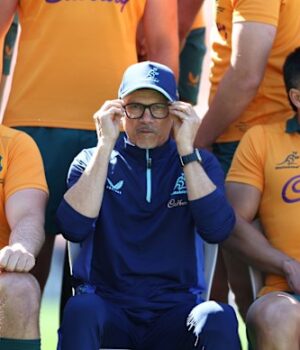
Peering into a laptop during a virtual press conference after a win over Argentina on Sunday morning, Wallabies coach Les Kiss was explaining why he’d been so persistently funky with selections – and substitutions – during his first five weeks in charge.
In a run of four Tests against Japan and Argentina, Kiss made an average of eight changes to his starting team for each game. And then when games were underway, the coach responded to injuries and substitutions by sometimes rearranging several positions at a time.
“There’s a combination we’ve never seen before – or will see again,” Stan commentator Sean Maloney said when looking at a backline of Kalani Thomas, Ryan Lonergan, Len Ikitau, Isaac Henry and Joseph-Aukuso Suaalii.
Injuries informed some of that jigsaw – and we learned Lonergan is a tidy No.10 – but Kiss said there was a method to the madness.
“Some of the things we’re trying to work on is to make ourselves a bit future-proof,” Kiss said. “So we become adaptable in those spaces.”
There was a risk to Kiss’ strategy. Changing half of the team each week could have exposed the team to a lack of cohesion against sides with proven capacity to beat big nations.
And things definitely spluttered at times, but not enough to bring on disaster. Three wins and a draw from four Tests is no small feat, and there is credit due, particularly to the forwards, who have swiftly become the centre of the Wallabies’ game.
There also needs to appreciate the difficulty of doing it all mostly on the road – particularly in Argentina.
As he did ahead of the Mendoza Test, Kiss also indicated to the laptop that the time had come for the experimentation phase to end, and the start of a more settled team phase to start.
There is just over one year until the 2027 Rugby World Cup, and history tells us World Cup winners are usually playing together in a discernible combination in the year prior.
“I was just talking to the coaches earlier. We feel that some of the decisions we’ve made over these four or five weeks, we got a lot of good information from it,” Kiss said.
“That’ll certainly narrow the mindset in terms of how we go forward for sure. It was important that this whole group knew we were going to back them. They knew that we were going to challenge them in many different ways … we’ll get a lot of pay from that down the road.”
Next up is a clash with the Springboks in Perth on September 27. The Boks will be coming out of the four-Test series against the All Blacks battered, but also battle-hardened.
Kiss has some tough calls to make about who makes his discernible combination. There are surplus options in the back row, front row and centres. That depth is a bonus. More worryingly, the back three has become a mess, with only Max Jorgensen a certain pick.
Perhaps the most concerning part for Kiss and the Wallabies, in both the form seen in the four Tests and the selection picture for the future, is the wobbly game management from the halves and fullback.
The Wallabies have at times looked unstoppable with the ball, when rolling downhill in the rival half. The power and pace of forward runners, via Lonergan’s sharp service, is on par with any side in the world.
But the Wallabies have also struggled to play with composure when on the back foot, and be smart and efficient when exiting their own half. Time and again, errors in getting to a good kick and playing down the other end have resulted in the Wallabies putting themselves under pressure.
Worryingly, those errors even came in batches. Pablo Matera’s second, go-ahead try in Mendoza came after four botched exits in a row.
No matter how good your defence or your ability to win turnovers, the modern game is now like the NFL: if you spend too much time in your half, you’ll concede points.
Tom Wright’s chronic impulsiveness from fullback is also manna from heaven for rivals hoping for unearned access to the red zone.
“The problem is at times we’re probably not just managing the game away from our third of the pitch enough times,” Kiss said. “We’re just probably three steps forward in controlling the game and then suddenly one or two steps (back), we’re back on our back foot again.”
The problem Kiss faces is that the simple solution – picking the best game manager – could be off the table for the Boks’ clash.
Carter Gordon has shown himself to be the most reliable option for steering the Wallabies around. But at the ground where one of his mentors, Quade Cooper, suffered a ruptured Achilles tendon in 2022, Gordon hobbled off with an ankle injury and went for scans.
That’s usually a precursor to bad news, meaning Kiss may need to turn back to Declan Meredith or Ben Donaldson to be the game manager to meet the Springboks.
After five weeks under Les Kiss, the Wallabies have shown they have depth, forward power, a mostly strong set piece, and the belief to defend for long periods and win turnovers.
They’ve also shown they have the tendency to shoot themselves in the foot. When you’re playing South Africa and New Zealand, you can’t give them any help.
 Iain Payten is a senior sports reporter for The Sydney Morning Herald.Connect via X or email.