Source : PERTHNOW NEWS
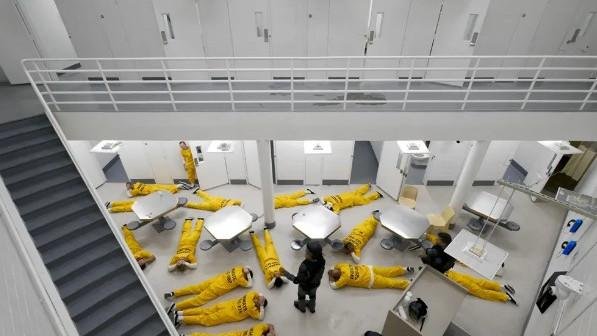
Take a group of ordinary people, randomly make half of them prisoners and the other half guards, lock them inside a fake prison and see what happens.
What could go wrong? Quite a lot, as it turns out.
More than 50 years after the Stanford Prison Experiment became one of psychology’s most infamous studies, Netflix is giving the controversial concept the reality treatment.
The streaming giant is billing its new series as a “modern reimagining” of the 1971 experiment, with 30 people entering a “real prison” for two weeks.
If that premise sounds slightly unhinged, it helps to know what happened the first time.
What is the Stanford Prison experiment?
In 1971, Stanford University psychologist Philip Zimbardo and his team transformed the basement of the university’s psychology building into a makeshift prison.
They recruited 24 college-aged men and randomly assigned them to be either prisoners or guards.
The “guards” were given uniforms and instructed to maintain order and create a sense of powerlessness among the prisoners, but were told not to be cruel.
The “prisoners”, meanwhile, were unexpectedly arrested by real Palo Alto police, booked, fingerprinted and strip-searched before entering the mock jail.
It was supposed to last two weeks.
It lasted six days.
The experiment descended into emotional distress, humiliation and punishment, with some participants suffering breakdowns and outsiders raising concerns about what was unfolding.
Zimbardo himself was not exactly watching from the sidelines either. In his own account, he positioned himself as the prison’s “super-intendent”, raising questions about how much researchers influenced the behaviour they were supposedly observing.
The experiment was eventually terminated.
Why is it still so controversial?
The Stanford Prison Experiment became famous for the idea that environments and positions of power could dramatically change how ordinary people behave.
But decades of scrutiny have made that conclusion far less straightforward.
Researchers have criticised the experiment as unscientific and unethical, arguing the guards were influenced by instructions and expectations from researchers rather than spontaneously becoming cruel because they were handed authority.
It also became part of a much broader reckoning over how human research participants should be protected. Stanford itself accepts an experiment like it would not be permitted today.
Which brings us, naturally, to reality television.
Netflix wants to try it again
Netflix plans to put 30 participants inside a real prison for two weeks for its modern version of the experiment, Variety reported.
And that raises a fairly obvious question: Have we learned from one of psychology’s most notorious experiments, or simply decided it makes excellent television?
There are significant differences between a modern television production and an academic experiment conducted in 1971. But the premise still raises questions about oversight, responsibility and duty of care.
There is also the reality TV factor.
Participants know they are making television. They know cameras are watching. They know the original experiment became infamous.
So how much of their behaviour will be driven by the environment, and how much will be driven by knowing millions of people could eventually be watching?
The original Stanford Prison Experiment was supposed to teach us something about power.
More than five decades later, Netflix may be about to find out what happens when you add cameras, contestants and a global audience.
What could possibly go wrong?