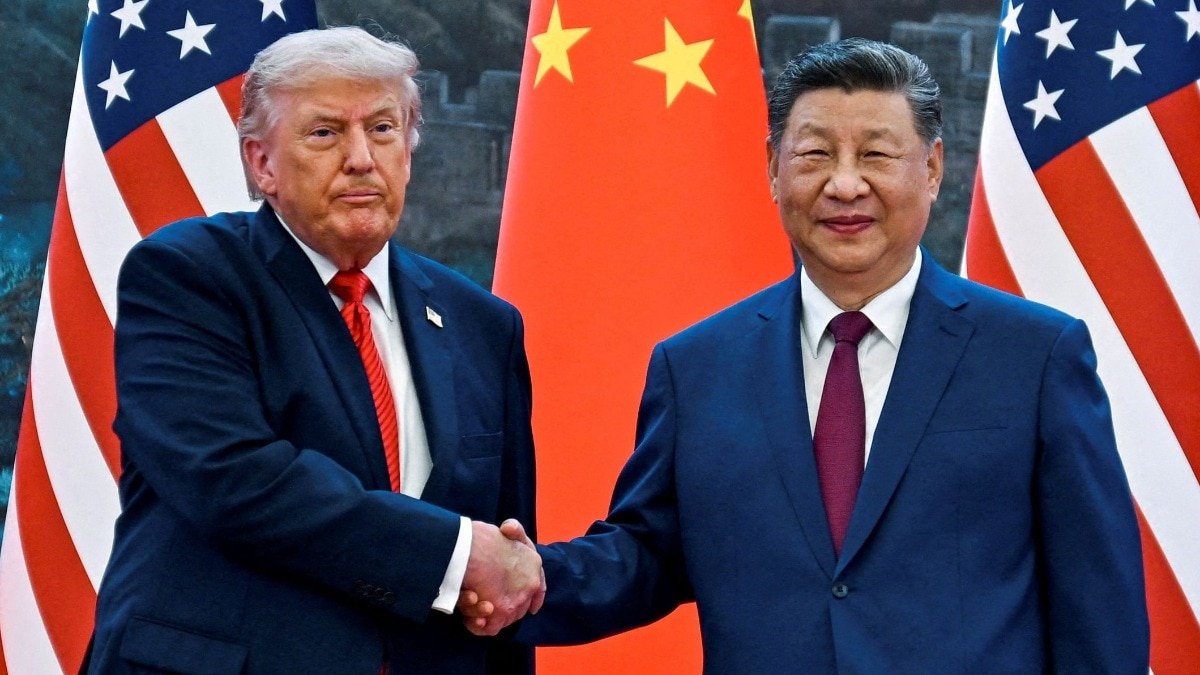
Source : INDIA TODAY NEWS
Chinese President Xi Jinping is on a three-day visit to Washington. Just two weeks ago, he was in New Delhi. Xi’s bilateral meeting with PM Narendra Modi on September 12, on the sidelines of the 18th Brics Summit, came as New Delhi and Beijing cautiously rebuilt ties after years of friction. The Chinese president will on Thursday sit across the table from US President Donald Trump, discussing Taiwan, trade, technology, and the Iran war.
advertisement
The newly passed Lindsey O Graham Sanctioning Russia and Iran Act of 2026 would also be a talking point among the major issues shaping the meeting between the leaders of the world’s two superpowers. China faces the risk of 100% US tariffs because of that.
New Delhi will be one of the strategic backdrops to the meeting between Xi and Trump, say experts.
For China, improving ties with India also means stabilising relations with a country that has simultaneously deepened its strategic relationship with the US. For New Delhi, the Modi-Xi thaw opens another diplomatic channel with Beijing even as India maintains defence and security ties with the US. And for Washington, India’s position matters because the US-China contest is increasingly playing out across the wider Indo-Pacific.
In that sense, Xi’s journey from New Delhi to Washington creates a geopolitical triangle.
FROM MODI TO TRUMP, THE SIGNIFICANCE OF XI’S TWO MEETINGS
Xi is meeting Trump for the second time this year. Earlier in May, the two Presidents had met in Beijing. According to Reuters, Xi and Trump are expected to discuss major bilateral issues, while Trump’s earlier visit to Beijing in May had established the reciprocal nature of their summitry.
Taiwan is likely to be among the most sensitive subjects.
Reuters reported that Xi is expected to press Trump to halt US arms sales to Taiwan, invoking the 1982 US-China joint communique. Beijing regards Taiwan as its territory and has repeatedly described the issue as a core diplomatic concern.
The meetings also come against a wider economic and technological contest involving tariffs, rare earths, artificial intelligence (AI) and trade. The UK-based Financial Times (FT) newspaper reported that extending the existing trade truce is among Xi’s key objectives, alongside discussions on AI, the Iran war and major US agricultural and aviation purchases.
But alongside the immediate US-China agenda is the broader regional context, including Beijing’s evolving ties with New Delhi.
WHY XI JINPING WENT TO NEW DELHI TWO WEEKS BEFORE WASHINGTON
Xi Jinping’s presence at the Brics summit in New Delhi was significant in itself. It would not be wrong to say that whether Xi would attend the Brics summit was a major part of the discussion until he arrived.
It was the Chinese president’s first visit to India since the 2020 Galwan clashes and came after a period in which bilateral ties had been badly strained.
The two Asian countries have since taken steps towards stabilising the relationship, including renewed diplomatic engagement and greater economic interaction. At their September meeting, Xi said China and India had “significant responsibilities” as major Global South countries and argued that there was scope for both sides to support each other’s development.
But the timing of the visit matters. Jabin T Jacob, professor at Shiv Nadar University, argued in his The Indian Express op-ed that Xi’s presence in New Delhi had a significant US dimension.
“For India, this [meeting with Xi in the Brics] was about sustaining the thaw in bilateral ties for domestic economic reasons and about signalling to the US that it had other friends around the world and could influence those friends. For China, however, Xi’s turning up in New Delhi — after skipping the 2023 G20 summit India hosted — was less about India and primarily about signalling to the US less than two weeks before he embarks on a state visit to Washington,” Jacob wrote in the newspaper.
This interpretation suggests that New Delhi was also seemingly a part of the diplomatic choreography surrounding Xi’s trip to Washington.
CHINA MONITORS INDIA’S STRATEGIC CHOICE
There is a deeper reason Beijing has an interest in India’s relationship with Washington. “China wants to shape India’s strategic choice. It wants an India that does not see China as a threat. It also wants India to not side with the US by default because of China,” Yun Sun, director of the China Program at the Stimson Center, told the FT.
This argument is significant because it places the India-China thaw within a broader strategic calculation. The US policy in recent decades has been to back India as a strategic counterweight to China.
Beijing does not need India to become a Chinese ally for the relationship to matter. Preventing a further consolidation of India-US strategic cooperation can itself be valuable for China.
This is relevant because India has emerged as an important US partner in the Indo-Pacific while simultaneously maintaining its own relationships with Russia, Iran, China and the wider Global South.
US WAS IN THE ROOM IN NEW DELHI’S BRICS WITHOUT BEING THERE
The US factor was also visible in the language surrounding the PM Modi-Xi meeting.
Writing in the South China Morning Post, Nayan Seth, a Washington-based policy research analyst, noted that “Washington ‘loomed large’ in the background of the Modi-Xi meeting despite its absence from the room”.
Beijing’s readout after the meeting said PM Modi had assured China’s Xi that India followed an “independent foreign policy” and that India-China relations were “not influenced by any third party”. This was seen as an apparent reference to Washington by geopolitical experts. However, India did not endorse Beijing’s interpretation in its statement.
The difference between the two readouts is striking and revealing. The Indian statement placed greater emphasis on border peace and the management of bilateral differences. The Chinese statement went further into questions of India’s foreign-policy positioning and referred to issues including Taiwan and Tibet.
THE INDIA-CHINA RELATIONS THAW HAS LIMITS
The India-China rapprochement should not be mistaken for a strategic realignment.
The border situation remains unresolved. Trade remains heavily tilted towards China, and disagreements persist over Pakistan, economic security, and China’s policies in India’s neighbourhood.
In the Brics summit, India was trying to balance strategic autonomy with maintaining workable ties with Washington, but China’s statement was more willing to use Brics, the Global South, the Shanghai Cooperation Organisation (SCO) and the G20 as part of a wider argument about the international order.
That makes the New Delhi meeting of Xi significant because both Beijing and Washington have to account for India’s independent positioning.
THE HIDDEN INDIA FACTOR IN WASHINGTON
So, is India the hidden factor in Trump-Xi talks?
Not in the sense of being formally discussed. The immediate negotiations remain centred around trade, technology, Taiwan, Iran and broader strategic stability of the US-China relationship. But India’s importance lies elsewhere.
Xi has just met PM Modi after years of strained ties. China has openly signalled that it wants India to view China differently and not automatically move closer to the US because of China. Washington, meanwhile, has built a substantial strategic relationship with New Delhi that survives even amid recent disagreements.
The symbolism of Xi’s itinerary is therefore hard to miss — New Delhi first, Washington next were deeper optics.
The two meetings are separate. But for India, they form part of the same larger contest over how the world’s major powers navigate a changing balance of power, and how much strategic space New Delhi can create between them.
– Ends
SOURCE :- TIMES OF INDIA