

Source : Perth Now news
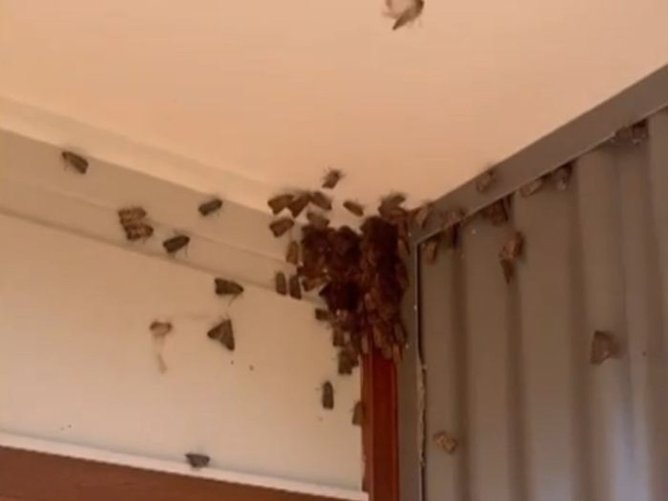
Sydney suburbs and parts of the NSW south coast are playing host to an unusual visitor, with swarms of endangered bogong moths gathering around homes, balconies and street lights as they make their annual trip south.
Authorities and wildlife experts have urged residents to leave the insects alone, stressing the sudden influx is a natural part of one of Australia’s great migrations and not a cause for alarm.
Residents across Sydney, including the Hawkesbury, the North Shore and the Sutherland Shire, have reported seeing far more moths than usual in recent days.
Social media has also filled with videos of the insects clustering outside houses and circling lights in suburban streets.
Homes across New South Wales have been plagued by moths in unbelievable scenes.
While the sight has unsettled some locals, the moths are simply moving through on their way to the NSW alpine region, where cooler conditions help them escape the hottest part of the year.
“Before anyone reports a moth-related crime spree, please be reassured that these little travellers are a natural part of Australia’s migration cycle,” Hawkesbury Police Area Command said in a social media post.
“While they may seem to have launched a co-ordinated takeover of the Hawkesbury this week, they are simply passing through on their annual journey.”
Each spring, bogong moths leave breeding grounds across inland Queensland, NSW and parts of Victoria and travel vast distances towards the Australian Alps.
There, they shelter in cool alpine caves and rocky crevices through the warmer months before making the return trip to breed.
Scientists have found the species can travel up to 1000 kilometres, using natural cues including the night sky and Earth’s magnetic field to help guide the journey.
Their route is not fixed, which helps explain why some years bring noticeable numbers into Sydney streets while other seasons pass with barely a mention.
Strong winds and bright city lighting can both pull the moths off course.

Once drawn into suburban streets, they often circle homes, shopfronts and street lights instead of continuing inland towards the mountains.
That has led to renewed calls for residents to switch off unnecessary outdoor lighting where possible so the insects are not trapped in built-up areas.
Bogong moths are harmless to humans, but their disappearance would be felt far beyond city neighbourhoods.
The species is a major food source for the critically endangered mountain pygmy-possum, which emerges from hibernation in spring and relies on the moths to rebuild strength and raise its young in alpine areas.
That connection has become more urgent in recent years as bogong moth numbers have plunged.

Conservation groups and researchers have linked the decline to prolonged drought, climate pressures, habitat change and agricultural impacts across the moths’ breeding grounds. The species is now recognised internationally as endangered.
Adults are usually about 2.5 to 3.5 centimetres long, with grey-brown wings marked by darker streaks and spots.
Researchers also point out that bogong moths move nutrients from inland breeding areas into alpine environments, making them important not only as prey but as part of a much larger natural system.
Residents are being asked to limit unnecessary outdoor lighting overnight and allow the moths to move through naturally on their long-established migration route.


