

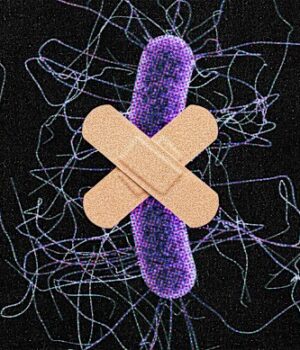
source : the age
Examine, a free newsletter covering science, is sent every Tuesday. You’re reading an excerpt – sign up to get the whole newsletter in your inbox.
In the brutal arms race between drugs and bugs, serendipity has often been on humanity’s side.
In 1928, Alexander Fleming left a petri dish unsealed and later found it overgrown with a green fuzz that had partly killed his culture of Staphylococcus aureus. He’d discovered penicillin.
That was the opening salvo in what would become an evolutionary battle between medical researchers and their pathogenic microbial enemies that have rapidly evolved to outfox antibiotics and kill more than 1.2 million people each year through drug-resistant infections.
But recently, an unexpected discovery by scientists at Monash University has unveiled both a new weapon against bacteria and an unexpected defence.
“Bacteria are evolving in ways that we’re not anticipating – it’s creating another level of superbug,” says Professor Dena Lyras, director of the Monash Biomedicine Discovery Institute, who focuses on a hospital-haunting bug that can unleash deadly diarrhoea.
Hidden yet horrid
Nearly a century after Fleming’s accidental discovery, bacterial researchers found themselves once again flummoxed in the lab.
Lyras and her colleagues were trying to grow Clostridioides difficile, a bacterium that commonly infects the gut after antibiotic treatment in humans.
“Every hospital has a problem with C. difficile. And it’s sort of a bit hidden. But we have elderly patients who become very sick and die of it,” Lyras says.
The researchers’ lab-raised bacterium grew fine, but it couldn’t make spores, which in this species is key to reproduction and infection. The researchers were stumped.
“Gosh, they’re tough, I tell you … You irradiate them for 200 hours and they still aren’t 100 per cent dead.”
Professor Dena Lyras on “ultimate superbug” spores
They investigated the batch and discovered the liquid medium they were growing the bacteria in contained a type of substance called a cephamycin.
They had inadvertently discovered a spore-busting antibiotic – that cephamycins could help treat C. difficile and other spore-forming nasties such as anthrax.
“A lot of spores are made in the patient as they’re infected. We discovered a group of antibiotics that actually stopped sporulation in its tracks,” Lyras says. “It was fantastic.”
It wasn’t long, of course, before the bacteria fired back.
“In about 10 per cent of the strains that we examined, this sporulation-blocking strategy didn’t work. We wondered why it wasn’t working – and that’s where we discovered this subset of strains that have this new resistance gene.”
Like an ‘armoured truck’: The new discovery
Some bacteria have a “normal” form – where they grow, eat, reproduce and, in C. difficile’s case, gleefully infect people’s colons – and a “spore” form. These spores are extremely hard to kill.
“Spores are the survival version of the cell,” Lyras says. “They’ve got their DNA packed in the middle, and then they’ve got layers of stuff around them like an armoured truck, tightly packed without that much water. So it’s just really tough.”
What Lyras and her colleagues have now reported in Nature Communications is an antibiotic resistance gene arising in the spore form of bacteria – not the normal form – for the first time.
“We hadn’t anticipated that; it’s not been described before, and it’s making that cell type tougher, stronger, more likely to survive in the environment. That’s going to have repercussions in a hospital where you can’t kill these spores off,” Lyras says.
“Gosh, they’re tough, I tell you. You’ve got to have like half an hour of contact with bleach to kill them. You irradiate them for 200 hours and they still aren’t 100 per cent dead.”
In the resistant bacteria, a new gene codes for a protein that can continue making spores, even when hit by antibiotics.
The spores can survive hospital-grade disinfectants and hot laundry temperatures.
Because they’re already Terminator-tough, spores taking on a drug-resistant gene create the “ultimate superbug”, like a seed that can lie dormant in soil for years before sprouting, Lyras says.
The spores can persist for as long as two years in hospitals.
Off the back of the findings, Lyras asks: “Do we need to rethink our strategies that we’re using to clean the hospitals, to clean the beds, to clean the surfaces, to clean the sheets, to clean the toilets and the sinks?”
CSIRO’s predicted global impact of antimicrobial resistance by 2050
- Deaths from infections that were previously treatable with antibiotics will exceed 10 million
- Antimicrobial resistance (AMR) will result in up to 7.5% global decrease in livestock production
- A decline in global GDP of between 3.8-5%
- An increase in 28.3 million people in extreme poverty
- Global real exports shrinking by 1.1%
- Global healthcare costs increase from $300 billion to >$1 trillion per year.
Dragon blood and doom
The new discovery underscores the urgency of finding new ways to kill infectious bacteria.
Some scientists are looking at the antimicrobial elixir that is honey and bug-killing compounds found in Komodo dragon blood, while others have used AI to uncover more than 12,000 antibiotic compounds in ancient microbes called Archaea.
Copper is also of interest because the metal ions punch holes in microbial membranes. One recently published 10-year study estimated the installation of copper-infused resin on counter tops, sinks, tray tables and bedside rails in a Texan hospital had prevented 78 C. difficile infections.
Another promising approach is engineering viruses called bacteriophages to attack and kill superbugs.
The problem is that much of the blue-sky research that uncovers new antibiotic molecules is underfunded. Converting one of these compounds into a useful drug is then enormously expensive and time-intensive.
There’s also little incentive for big pharmaceutical companies to bring new antibiotics to market.
Antibiotics might be used just once and even then, the mantra is to not overuse them lest you contribute to the antibiotic resistance problem. New drugs are also often quickly out-evolved.
That’s why antibiotics are the “opposite of a profitable blockbuster drug”, according to Professor Mark Blaskovich at the Institute for Molecular Bioscience, University of Queensland.
Experts have urged the government to set up a “Netflix” style agreement that would see regulator payments pour into pharmaceutical companies, like a subscription, in return for access to a stream of new antibiotics.
But, for now, this is a field intensely vulnerable to the science funding crisis. Last week, Liam Mannix reported 75 jobs would be slashed as the Hudson Institute of Medical Research closes due to the “slow strangulation” of the research sector by flat state and federal funding.
In four years, goes one estimate, 10 out of Victoria’s 14 independent research institutes will have to close. Much of the pioneering work to tackle the thorny issue of antimicrobial resistance occurs at these kinds of agile, independent research centres.
Cutting back on science now could deliver bacteria the ultimate advantage.
The Examine newsletter explains and analyses science with a rigorous focus on the evidence. Sign up to get it each week.
 Angus Dalton is the science reporter for The Sydney Morning Herald.Connect via X or email.

