

source : the age
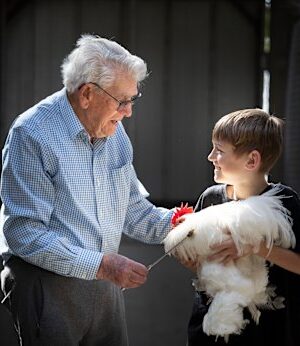
As an elder statesman of poultry-fancying, Alf Woods is mentoring someone in the craft, and you could say his protege is a chick off the old block.
Woods, who has been a poultry competitor for almost 90 years, is cock-a-hoop that his 10-year-old great-grandson, Blair, is egg-cited by the hobby.
“It’s a passing of the baton to a younger person, and I think it’s great,” Woods said.
Blair’s first competitions this year including winning best junior at the Pekin Bantam Club of Victoria’s annual show at Ballarat, and Woods said Blair had been ready “to take on the big boys” at his first Melbourne Royal Show.
But those dreams have shattered like a broken egg.
In August, organisers announced that the show’s poultry competitions and exhibitions were cancelled for 2026 due to the surge of H5N1 bird flu cases around Australia.
Fanciers were dismayed, but agreed the move was necessary to protect birds from the deadly virus.
Blair had tended, and registered to compete, with his five Pekin bantams – gifts from his “Pa”, Alf.
Woods, who first competed with chooks at then-named Royal Melbourne Show in 1939, aged 11, was himself aiming to bring 19 entries, including Old English Game fowl, to the 2026 show at the Melbourne Showgrounds.
Woods, who turns 99 on October 26, said he felt terrible he couldn’t attend, but he understands.
“If one bird at the royal [show] got the disease, they could kill every bird in the royal.”
At home in Greenvale in Melbourne’s outer north, Woods keeps his birds in covered pens that protect them from possible infection from wild birds.
Woods, has missed only a few Melbourne Royal shows in his life, including the shows cancelled during World War II and the COVID-19 pandemic.
“It’s a great experience,” he said. “I don’t mind if I win or don’t win a prize. I talk to my old friends and the new friends coming along. I just love talking to people.”
Michael Holmes, of Wangaratta, the head of the show’s poultry committee and a competitor for 45 years, said “a lot of people are disappointed” and it was “an empty feeling” not competing.
But he said cancelling poultry was the right move for our biosecurity and “hopefully, we’ll get going again next year”.
Tony Milton, from Healesville, said he was disappointed not to be bringing his Rhode Island reds and Sebright breeds to be judged against the Australian standard.
But he said it was “better to err on the side of caution”.
According to the Department of Energy, Environment and Climate Action (DEECA), there have been no detections of H5N1 bird flu in poultry in Australia.
Among non-poultry birds, 220 positive cases of the flu have been detected in 32 local government areas in Victoria, across 21 different species.
A poultry housing requirement for flocks of 50 or more birds is in place in Victoria for coastal and southern municipalities to help reduce contact with wild birds.
The Victorian government recommends poultry owners outside the specified areas also prevent contact between birds and poultry with wild birds, in combination with other biosecurity measures.
Start the day with a summary of the day’s most important and interesting stories, analysis and insights. Sign up for our Morning Edition newsletter.


