source : the age
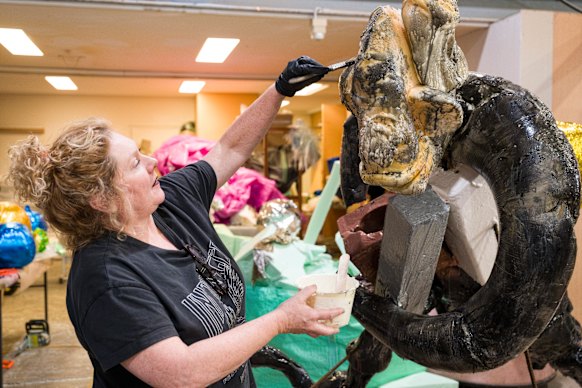
Justene Williams is in the middle of setting up her major exhibition at the Queensland Art Gallery, and there are crates, cardboard boxes, ladders and piles of detritus everywhere you look.
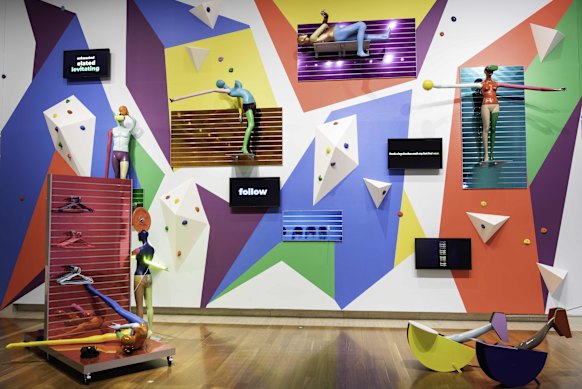
Two silver unicorns that look like blocky Minecraft creatures stand to one side. Three life-size, cobbled together, vaguely human figures occupy a corner. A decommissioned speedboat painted fluoro orange sits on a large trolley. When she is finished with it, it will be standing in the QAG’s Kenneth and Yasuko Myer Gallery on eight misshapen legs.
“I called him Darwin,” Williams says, indicating the boat, “because Darwin is actually the name of a mudskipper [Periophthalmus darwini, an amphibious fish with leg-like fins]. There’s always movement in my work, and this idea of how we move and why we move.”
“What’s in the boat, Justene?” prompts the publicist hovering nearby.
“I’ve got the jellyfish lady,” Williams responds. “It’s a bit like a soft sculpt – oh, I hate the word soft sculpture – anyway, it’s like a costume sculpture, and it’s based on a ballet.”
Williams is wearing a stripy blue pyjama-like outfit, a blue ribbon in her curly blonde hair. Her eyes twinkle as she moves about the space, talking and fossicking.
Her manner reminds me of the lovably mischievous Yoda of The Empire Strikes Back, before we learn the little gnome is actually a Jedi master.
“I love when something’s had a life,” she says. “I believe that energy is stored in stuff, like that boat. They’ve had a life, and you can work with that. Then I get a bit hocus-pocus, because I start to think about what people have done with them before.”
If Williams seems at home among the debris, it may be because she literally grew up in a wrecking yard in Bankstown, Western Sydney.
“Me and my sister, we’d hop in cars, and sometimes there’d still be a battery and the windscreen wipers would start, and you imagine yourself going off into another place … I can still see the sea of metal.”
Williams got her first job at age 14 at Sportsgirl. She later worked in merchandising at Westfields across Sydney, and setting up bridal fairs.
Today she is one of Australia’s leading multidisciplinary artists, as well as a popular lecturer in sculpture at Queensland College of Art and Design, Griffith University.
Last year she was in the spotlight as the subject of the winning portrait in the Archibald Prize. Her Griffith colleague, Julie Fragar, painted her as a kind of goddess figure floating above a stack of her own art materials – mannequins, cages, funnels, bits and bobs.
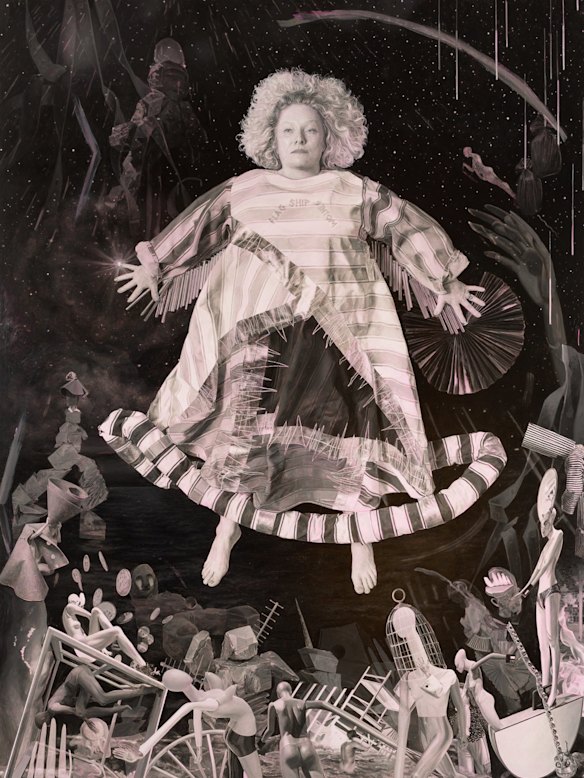
“There is nobody like Justene,” Fragar said in her artist’s statement. “She thinks big and makes bigger, deploying everything from car bodies to opera singers to make work as fearless and feeling as she is.”
Williams has been well known in the art world for a long time, but the Archibald proved a different level of wattage.
“It was odd,” she recalls, “because people contacted me that I hadn’t seen for a long time, out of the blue. ‘Oh Justene, hi, do you remember me?’
“I think it was a really beautiful painting that Julie did. It was good for the university too, that both of us happened to be in this thing.”
Williams was teaching at the Sydney College of the Arts when the Rozelle facility was closed and moved onto the main University of Sydney campus. Many lecturers lost their jobs, and Williams was snapped up by Griffith. She relocated to Queensland in 2021.
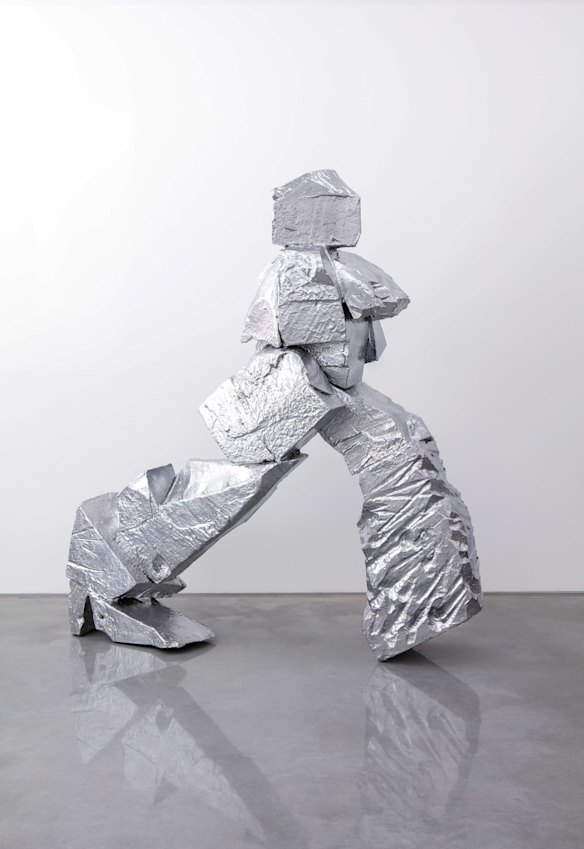
Brisbane’s geographical beauty, and cheaper real estate prices, thrilled her. So did the larger studio spaces. Her QAG show features a hulking four-metre-high sculpture of a woman painted silver titled Sydney Sheila – “I would have never made that in Sydney. No way!”
“There is never too much. This is the chaotic rule of Williams’ art”Philosopher and critic Stephen Zepke
Sydney Sheila is not dissimilar to the five-tonne bronze sculpture she installed as part of Brisbane’s Queen’s Wharf development in 2024, with its huge pendulous breasts, permanently bemusing pedestrians between the Commissariat Store and the casino.
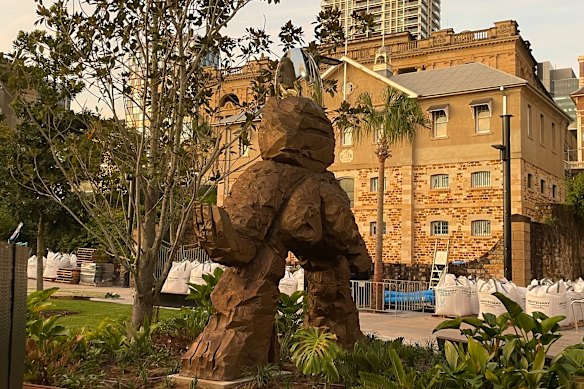
“Justene is one of Australia’s most interesting contemporary artists, and she very much has this belief that art is for everyone,” says Ellie Buttrose, curator of contemporary Australian art at QAGOMA.
“She’s interested in how you can express yourself with intuition, and also with joy, and how to engage in contemporary life, and she does that through using very humble materials that anyone can access.”
Found objects litter Williams’ exhibition. A coin-operated children’s shopping centre ride with two little pigs under a large mushroom will be turned into a rotating sea creature. Several TVs salvaged and a chandelier from the former Treasury Casino help recreate her 2011 work Crutch Dance.
Fringe art movements from the early 20th century captivate Williams. Her work frequently references a famous 1913 sculpture by Italian Futurist Umberto Boccioni depicting a running figure whose limbs seem to be fracturing and falling apart (Unique Forms of Continuity in Space).
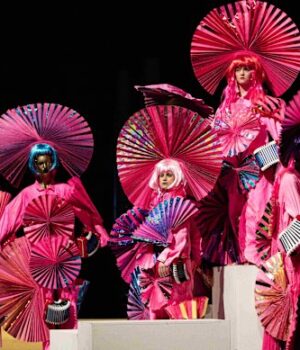
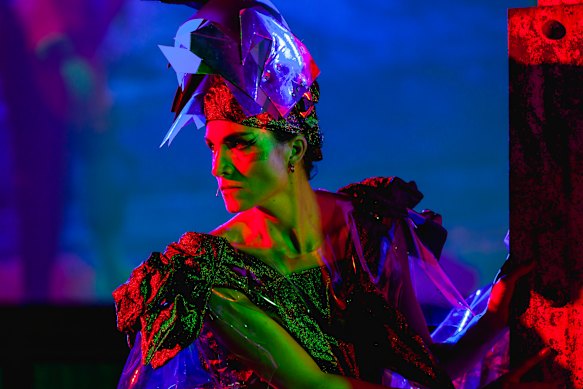
The aforementioned ballet that inspired the jellyfish lady was a 1911 Ballets Russes production called Sadko, and featured costumes by Russian Futurist Natalia Goncharova. Williams is a big fan.
In 2016, she collaborated with the Sydney Chamber Orchestra to restage a 1913 opera about time-travelling revolutionaries called Victory Over the Sun.
Confused? Yes, I am. I confess I struggled with Williams’ work until I read the essay by Stephen Zepke in her exhibition catalogue which – unusually for a catalogue essay – made everything simple. Zepke fondly describes Williams’ oeuvre as “a pile-up”.
“There is never too much,” he writes. “This is the chaotic rule of Williams’ art … until it reaches a point of tension that it can no longer sustain and the blister breaks, the primordial pond disgorges its foetal mass, and something careens into the gallery.”
Whatever that something is, galleries want it. Williams was in Auckland and Tasmania this year with a piece titled Making Do Rhymes with Poo, in which she performed menial tasks with recycled materials: labour presented as “pleasure, play and pain”.
In November, she will be part of the opening festival of the $915 million Powerhouse Parramatta museum, premiering an opera with music by nine neurodiverse musicians.
“A Magical Hotstart began with the Powerhouse Collection itself and with my memory of my mum trying desperately to hotstart her car,” Williams said when the work was announced in September.
In the meantime, Once We Were Mudskippers will bring under the one roof, if not a retrospective of Williams’ work, then a kind of monumental remix.
“You can’t really do a retrospective of her work,” Buttrose tells me, “because she’s like, ‘remember that sculpture? I cut it all up and now it’s this new sculpture’. It’s this sense of no waste, which I think must frustrate her gallerists, who are like, ‘I could have sold that!’”
Williams pauses by one of the humanish figures, the one with one brown leg that is curled up like a party blower. “I named him after my dad, Teddy. He’s not around any more. He’s got some wedges holding him up. The wedge is very important. If you pull it out, everything can come falling down.”
A few years ago, a purported psychic told Williams facts about her father based on some of his jewellery. It got her thinking about the supernatural side of family Christmases, and from that she created an installation called Santa Was a Psychopomp. The unicorns, once their dollar-bill horns are affixed, will be the reindeer, with sleighs made from eskies, yoga mats and bottles of whisky.
“When I made these, originally around that time of COVID and stuff, there was this thing about the world not being so great,” Williams says.
“I still want some happiness. I always hope there’s a bit of magic still in the world. Do you know what I mean?”
Justene Williams: Once We Were Mudskippers runs October 3, 2026, to March 7, 2027 at Queensland Art Gallery. Entry is free.
Get alerts on significant breaking news as happens. Sign up for our Breaking News Alert.