Source : Perth Now news
Phone calls packed with colourful language, meetings at Nobu, Fijian hideouts, all-day drinks at London pubs, promises of millions of dollars.
It was enough to fill out 38 sitting days as the NSW Independent Commission Against Corruption (ICAC) sliced and diced a Liberal Party corruption scandal.
At the heart of the probe, the ICAC examined alleged collusion between fugitive property developer Jean Nassif and party powerbrokers including two brothers of former NSW premier Dominic Perrottet.
Jean-Claude Perrottet, Charles Perrottet and his wife Anita Perrottet endured days of grilling in the witness box.
In an inquiry dubbed Operation Rosny, the watchdog investigated alleged kickbacks involving Nassif and his company, Toplace, between 2020 and 2023.
Political donations from developers have been banned in NSW since 2009, yet the ICAC’s widening net led to mentions of other powerful Liberals, including federal Opposition Leader Angus Taylor.
Former ICAC assistant commissioner and retired Supreme Court judge Anthony Whealy rates Rosny one of the most impactful investigations in the body’s almost 40-year history.
“You can already rank it as a very consequential inquiry,” he tells AAP.
“That is because it’s taking quite a broad swipe into the machinations of party politics, the relationships between developers and politicians and where those intersections can go seriously wrong.”
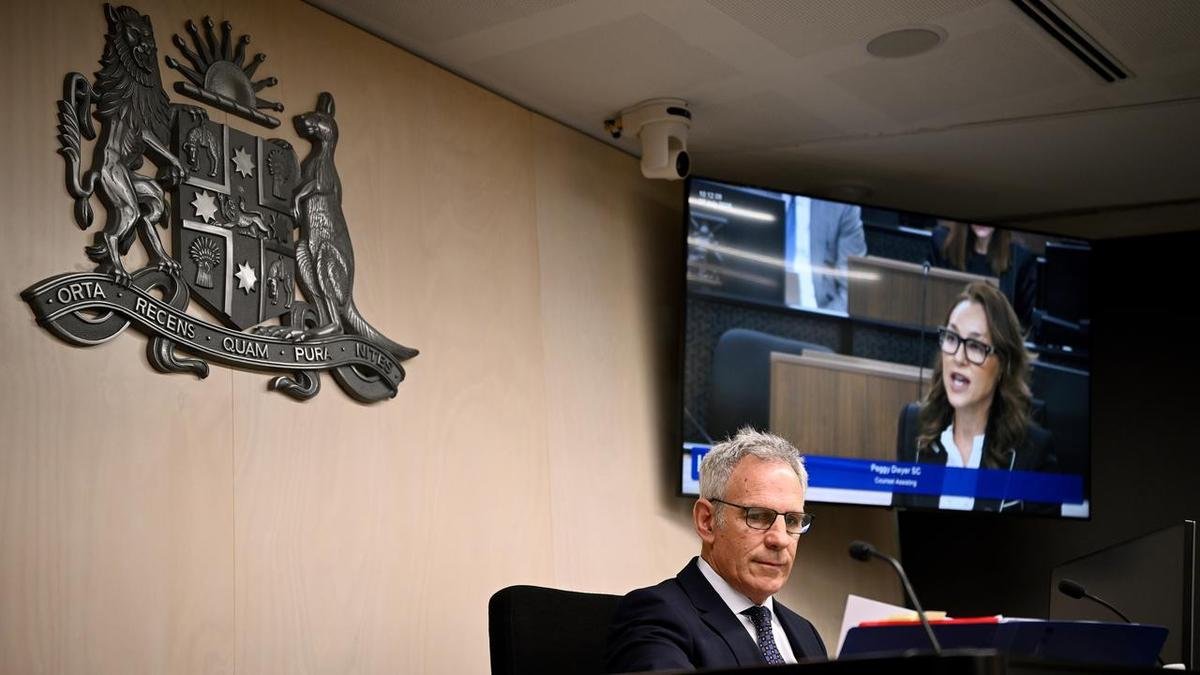
The inquiry began with a bang in July when counsel assisting Peggy Dwyer launched her opening statement with the adage, “Money in politics, as in other spheres of life, has the potential to corrupt.”
It ushered in weeks of forensic accounting and questions over embarrassing text exchanges about surveillance of mayors, sham contracts and fake arrangements spanning Beirut, London and Cessnock.
Twenty witnesses were called including the bombastic Nassif, who dialled in virtually from his bedroom in Beirut, wrapping up on Tuesday.
Their memories – from a demure Jean-Claude Perrottet and emotional senior Liberal MP Damien Tudehope to brash lobbyist Jeremy Greenwood and a befuddled Anita Perrottet – were put to the test on the stand.
In their responses, revelations were unearthed and admissions recorded that have immeasurably damaged the Liberal Party as it heads to a state election in March.
“In terms of the Academy Awards, some would be given out for splendid attempts to shy away from the truth without very much success,” Mr Whealy says.
“Overall, the spectacle we saw was rather amusing but then it wasn’t amusing at all; it was really quite serious.”
He says a number of witnesses have tarnished their reputations by not being open and honest with the commission.
Central to the probe was how the Reformers, a conservative Christian sub-faction within the Liberal Party, allegedly circumvented donation caps by setting up schemes to hide the money trail.
Mr Taylor, who is not under investigation by the corruption watchdog, has denied making pledges to the ultra-conservative faction.
“I want to shake down Angus for 10K,” the now sacked head of Catholic Schools NSW, Dallas McInerney, wrote in a message aired at the inquiry on Tuesday.
The opposition leader said “no payment was made” when questioned about a $15,000 “injection” and monthly $3000 donations to the Reformers.
Former NSW premier Nick Greiner doesn’t want to wade into how Operation Rosny will affect the party whose federal executive he served until March this year.
But he credits the creation of ICAC in 1989, during his tenure as premier, as one of his most important contributions to keeping politics accountable.
“ICAC is now close to 40 years old, so in a broad sense it’s been successful – and the fact that it’s been copied everywhere is a fair indication of that,” he says.
Its public airing of dirty laundry, which played a role in Mr Greiner’s own political demise, later brought down popular Liberal premier Gladys Berejiklian and Labor heavyweight Eddie Obeid.
Yet it has not been immune from criticism.
Mr Greiner says the commission’s sometimes spectacular binge-watching sessions were not all necessary.
“There’s room for more common sense and discretion,” he insists.
But he reserves sterner ire for how long it often takes the ICAC to establish a probe and make corruption findings, and then whether it recommends prosecutions.
The watchdog aims to have a report tabled in parliament within 180 days of receiving final submissions but in practice it takes much longer.
“Clearly the time frames are absolutely absurd,” Mr Greiner says.
“It cannot take years and years when you’ve got all the powers that ICAC has … My general impression is it’s way too slow.”
Rosny was sparked when state Liberal MP Ray Williams used parliamentary privilege in 2022 to claim powerbrokers in his party were engaged in branch-stacking and improper local council dealings.
Mr Whealy says the watchdog’s invaluable oversight role should reassure the public that no matter how corrupt political parties might appear, there is always a comeuppance.
“There are some rotten apples around and (the ICAC) reinforces that notion but it doesn’t destroy trust altogether in the political system,” he says.
“It’s a comfort to the community … that there’s a vigilant oversight body doing its job properly.”