Source : INDIA TODAY NEWS
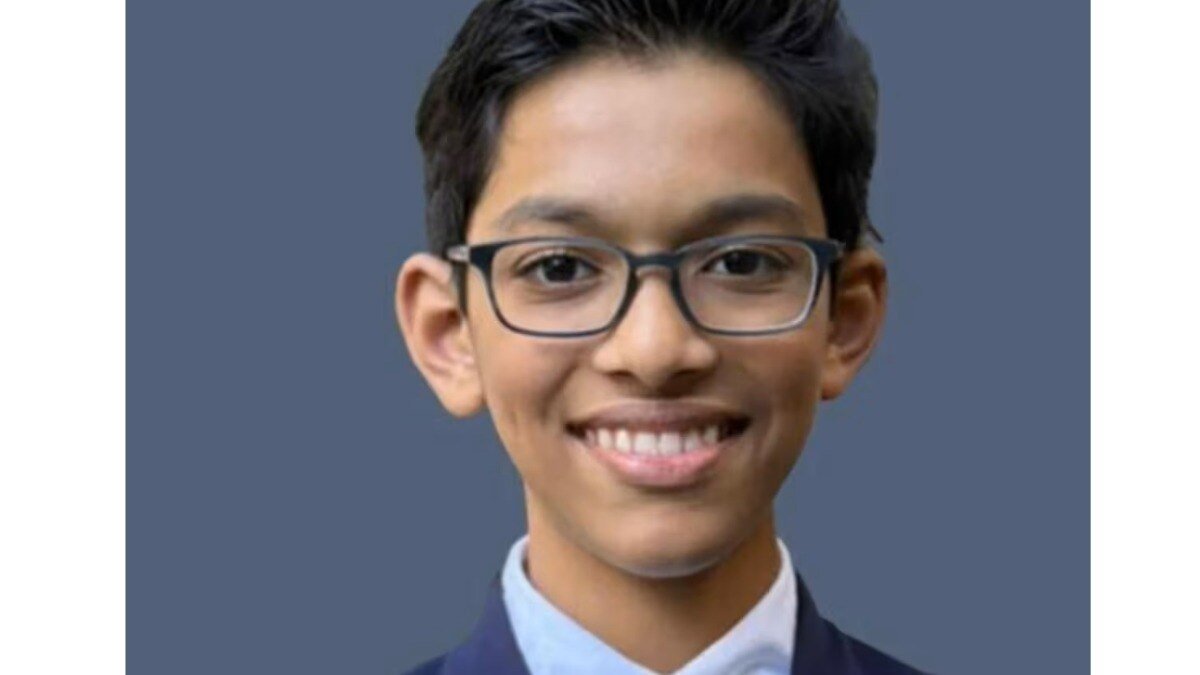
There are inventions which begin in a laboratory, and there are others which begin with a question that refuses to leave the mind. For Ankith Burki, a seventh-grade student in San Jose, California, the question was a plain one: if water is scarce, might some of it be gathered from the air around us?
The question has a large setting. According to the latest WHO and UNICEF estimates, 2.1 billion people still lacked safely managed drinking-water services in 2024. The world has made progress, but the want of dependable water remains a serious problem.
advertisement
Ankith, however, did not begin with the world. He began with a machine.
FROM A SCHOOL PROJECT TO A NATIONAL STAGE
The work, titled Investigating the Effect of Low-Frequency Sound in Enhancing the Efficiency of Water Generation in Thermoelectric Atmospheric Water Generators, has earned Ankith a place among the 30 finalists of the 2026 Thermo Fisher Scientific Junior Innovators Challenge.
The Society for Science lists him as a seventh-grader at BASIS Independent Silicon Valley.
The finalists are due to gather in Washington, DC, from October 23 to 28, where they will present their research and take part in team challenges. Each finalist receives $500, while more than $100,000 in prizes are to be awarded.
FIRST, HE HAD TO MAKE WATER FROM AIR
His project was an atmospheric water generator, a device which draws moisture from humid air and turns it into liquid water. To build his prototype, Ankith used the Peltier effect. In simple terms, an electric current moves heat from one side of a thermoelectric material to another, allowing one surface to become cold.
After repeated trials, his machine was able to lower the temperature around it by 7.5 degrees Celsius. That was enough to bring the air below its dew point—the point at which water vapour begins to form droplets. The droplets could then be gathered and measured.
Yet making water was only the beginning.
Ankith wondered whether the machine could be persuaded to make more of it.
THEN CAME THE SOUND
His next idea was unusual: put a speaker beside the machine.
The thought was that low-frequency sound might produce vibrations capable of bringing small water droplets together. If those droplets joined to form larger ones, more water might be collected.
To test the idea, Ankith carried out four-hour trials. Five were conducted in silence. Ten more were performed with low-frequency sound, using two forms of waves: sine waves and triangle waves.
THE RESULT WAS CLEAREST WITH THE SINE WAVE
The machine collected 117 per cent more water under the low-frequency sine-wave condition than during the silent tests. That figure comes from Ankith’s experiment and does not, by itself, establish that the method would produce the same increase in a larger or different machine.
That distinction matters. A promising school experiment is not yet a solution to a worldwide water problem. But it is a useful beginning.
A SCIENTIST WITH A SINGER’S EAR
There is another detail in Ankith’s story worth noticing. He is also a singer of Indian Carnatic classical music. The Society for Science records his wish to become an environmental engineer and his belief that scientific solutions ought to be accessible to people with fewer resources and opportunities.
It is tempting to call the connection between his music and his experiment poetic. Perhaps it is simpler than that. He studies sound in music, and he has now studied sound as a physical force.
His machine has not solved the water crisis. No honest account should say that it has.
What it has done is rather more modest, and perhaps more valuable at this stage: it has taken a great problem, reduced it to a question that a young student could test, and produced a result worth testing again.
Sometimes invention begins not with an answer, but with the courage to ask a smaller question.
– Ends
SOURCE :- TIMES OF INDIA