source : the age
The longer I’ve thought about it, the more convinced I’ve become that Melbourne’s secret is that it’s integrated. Ours is not a city of discrete neighbourhoods like New York. Not really, anyway. It’s not a city of enclaves and subcultures – “villages”, says Eddie McGuire – like Sydney. It’s not that Melbourne is undifferentiated. It’s highly varied. But it’s that the borders between these variations are subtle and fuzzy. More matters of degree than essence.
Probably nowhere is that truer than in sport and the arts, which we will talk about at The Age’s Melbourne Assembly civic forum later this month. There’s a world, perhaps most of the world, where these things are discrete: different concepts appealing to different cohorts, some dwelling in the overlap, many not. In Melbourne, much more dwells there. The Melbourne Football Club has a fan who plays trumpet in the stands, who sometimes can’t make it to games because he has to play with the MSO. If you run an art gallery, no one will blink if you are a passionate Essendon supporter. Bulldogs, maybe.
That’s a rarer gift than we know. In Sydney, for instance, even sport alone is stratified. You follow union or league, or neither. But none can be a lingua franca. Tell me what you love and I’ll have a fair chance of guessing which school you went to. That’s not without its benefits: each code has its particularities, its own bespoke culture. But in Melbourne, sport and art mingle seamlessly as participants in a common social drama. They are neither mere sport nor mere art. They are culture itself.
Culture is a rich concept. It is not the same thing as a collection of events. It’s not the sum of its economic parts. It’s more the mysterious thing that knits those parts together, that gives them greater meaning. That’s why I have enormous sympathy with Nick Cave’s tour producer Paul Sloan’s way of looking at Cave’s concert in the Alexandra Gardens. Sloan’s battle to stage it was referenced in The Age earlier this week. Naturally, as the Bad Seeds’ promotor, he has commercial interests at play. But his vision of a show that was “quintessentially Melbourne” is ultimately a cultural one. It’s not a concert as a mere event. It’s about the full integration of a Melbourne artist and the city that produced him.
But culture is also fragile. It needs events to sustain it, sure. But events can equally erode it where they exist for their own sake, or are mere facsimiles of elsewhere. I think this is why so many footy fans have such an allergic reaction to the recent phenomenon of blaring out songs after goals; or (more mildly) of announcers introducing the home side player by player to tepid applause; of every break in the game becoming an opportunity for some fan “activation” or other. It’s not that they are new. It’s that they’re not of us.
Everyone who has been to watch a major sport overseas will know their origin – usually the NBA or the NFL. And everyone who has done that will know that in our game, they become impositions from different sports with different rhythms that don’t suit. They are the most anaemic imitations of someone else’s culture. As though the consultants who dreamed them up don’t know Melbourne, and don’t care to because they assume it’s a market like any other market. But Melbourne often spurns things that make sense elsewhere. Ask Kyle and Jackie O, or Starbucks.
The point is not curmudgeonliness, slavishness to tradition or base parochialism. In sport as in the arts, Melbourne has always embraced the new. It has always tasted what other cultures will offer us. The NFL’s recent visit proved that. State of Origin works here. The Australian Open’s evolution got it exactly right. Our Comedy Festival is one of the world’s best because it distils the best of Melbourne: varied, local and international at once, feeding off the energy of a hub. In a word, integrated.
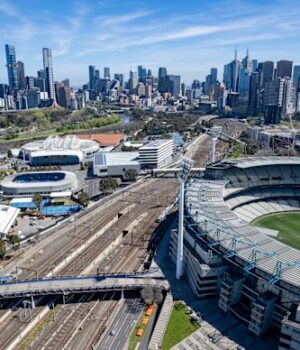
Somewhere in there is guiding principle. Connecting the MCG and Melbourne Park is a great idea, and an integrating one. But only if it somehow makes the events they host feel like Melbourne being itself: the MCG more the people’s ground not less; Melbourne Park a meeting place not an event space; the arts as comfortable in this new cultural square as sport. And of course, though I don’t dwell on it here, the grassroots of both tended so people can come to these places as participants, not consumers.
None of this is easy. We live in a world where culture is one of the hardest things to sustain. Where the water cooler once stood, now stands the algorithm, denying us common experiences – or even worse, weakening our desire to have them. The economics are only getting harder, and if it means the Town Hall is an expensive venue, even something like the Comedy Festival is vulnerable. Government money cannot answer all questions, especially if inflation is with us a while. But so often the most fragile things are the most precious. And we have no hope of preserving them, if we can’t recognise what we hold in the first place.
Waleed Aly is a broadcaster, author, academic and regular columnist. He is moderating the Sport and the Arts session at the Melbourne Assembly.
Melbourne Assembly will be held from October 19 to 21. More information is available on the Melbourne Assembly website.
The Opinion newsletter is a weekly wrap of views that will challenge, champion and inform your own. Sign up here.
 Waleed Aly is a broadcaster, author, academic and regular columnist for The Age and The Sydney Morning Herald.