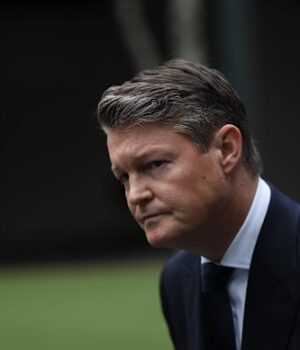
Source : the age
It was a tale of two interviews.
When Premier Ben Carroll was on Monday asked if he would accept the support of Greens MPs in parliament if it meant staying in power after November’s state election, he said he’d throw the keys back.
A day later, his opponent Jess Wilson faced the same question about One Nation. The opposition leader was less emphatic. She told the ABC’s Raf Epstein the only deal she was interested in was the existing coalition agreement between the Liberals and the Nationals.
“I am running to form a majority government,” she said repeatedly, refusing to engage with the prospect of needing votes from Pauline Hanson’s party to maintain supply or confidence in parliament.
Carroll’s braggadocios and Wilson’s evasion, while different in tone, reflect the same disconnect between the fundamental change taking place in Victorian politics and the determination of the established parties to stick to the old rules.
Nearly every opinion poll published over the past six months, including successive Resolve Political Monitor surveys conducted for this masthead, indicate that Victoria’s next government, whether led by Labor or the Liberal and National parties, may need the support of other parties to run the state.
Yet, whenever they are asked about this, and which parties they may be willing to work with, Carroll and Wilson refuse to countenance the possibility of not being able to govern in their own right.
Bob Brown, the Greens elder statesman who in 2010 negotiated with then-prime minister Julia Gillard an agreement that helped Labor govern in minority, says this is the standard approach of major party leaders when campaigning. But he says that in Victoria, it is time for the premier and opposition leader to have a more open conversation with voters.
“I think they do need to be mature enough to say if we don’t have the numbers, we will work with the most like-minded parties or independents to form government,” he tells The Age. “That’s not a difficult thing to do. Whether you’re Liberal, Labor, One Nation, or Green, or independent for that matter, that’s how it works.”
Major parties threaten any concession to minority government as verboten. Research suggests that most of the people who will decide the November 28 election don’t think like this and accept we have moved past a binary choice of government.
Across May and June, a Resolve Political Monitor survey asked 1100 Victorians if the two-party system was over, and 45 per cent agreed. Just 13 per cent disagreed. The rest were undecided.
The biggest cheerleaders for an end to the two-party system were One Nation voters, with two out of three declaring our Ford v Holden political era at an end. Labor voters were far from dismissive, with 40 per cent in agreement. So why is Carroll, the man who leads Labor in Victoria, so opposed?
Multi-party governments are in the norm in Tasmania – which has a different voting system to Victoria – as well as in New Zealand and many European parliaments. It is standard practice in Europe for political leaders to declare before an election, which rival parties they would and would not be prepared to work with.
Carroll’s position, if taken literally, means that if Labor falls short of the 45 seats it needs to form government unaided, it won’t work with other parties or independents to assemble a workable majority.
“It’s a spoilsport approach,” Brown says. “It is saying: I’m not mature enough to negotiate and accept the people’s verdict.
“If the voters in a democracy hand you that card, you have to deal with it, that’s your responsibility. Spitting the dummy and saying ‘I’ll throw back the keys’ or, in the case of the Liberals, ‘I won’t even talk about having to deal with other parties after the election’, is not mature politics in the 2020s.”
Carroll disputes this line of criticism. He said on Tuesday he was being respectful to the electorate by making his intentions clear, likening his response to Prime Minister Anthony Albanese who ruled out minority government ahead of the 2025 federal election.
The most likely shade of minority government after the state election is a Coalition government supported by One Nation, followed by a Labor government supported by the Greens.
However, these are not the only possibilities. The numbers may exist for the Coalition to govern with support from Greens and/or teal MPs. If Labor and the Coalition are both left well short of a majority, it would even raise the possibility, albeit unlikely this time round, of a “grand coalition” between the major parties.
Victorian Labor, which has been in power for 12 years and since the retirement of Daniel Andrews has recorded a collapse in popular support, is ruthlessly exploiting the prospect of a Coalition and One Nation power-sharing arrangement to boost their anaemic primary vote. That scare tactic will continue through to polling day.
So far, Wilson has steadfastly refused to say anything that could box herself in.
By doing so, Wilson is demonstrating a level of discipline rarely seen in a Victorian Liberal leader. She also leaves unanswered Labor’s attacks. When how-to-vote cards are published, any preference deal between the Coalition and One Nation will be used to fuel claims the traditional centre-right and great disruptor are acting in concert.
Speaking on the ABC, Wilson ruled out a formal coalition with One Nation, saying there would be “no deals”. The unspoken details are not whether One Nation MPs could serve as ministers in a Coalition government – they won’t – but the terms by which One Nation would guarantee a Wilson government confidence and supply.
Former state MP Susan Davies says there is no rule book to follow when negotiating such an agreement. She was one of three independent MPs who in the weeks after the shock result of the 1999 state election provided the numbers needed by Labor leader Steve Bracks to govern in minority and end the Kennett government.
The morning after the election, Davies immediately contacted a woman in politics she admired and trusted. “I rang up Joan Kirner and said: ‘Help! I think we’ve got the balance of power’.”
Kirner put Davies in touch with then Queensland MP Peter Wellington who, after the1998 Queensland election was gatecrashed by surging support for One Nation, supported the Beattie government in minority.
Acting on Wellington’s advice, the Victorian independents – before they had any discussions with rival suitors – wrote a charter that set out a series of principles for better government. This included greater accountability, democratic reforms to parliament and specific targets to address the needs of rural Victoria, which had been disproportionately impacted by service cuts under the Kennett government.
“That’s what we used to help us decide who would take government,” Davies says.
The resulting agreement, which was signed in the form of a memorandum of understanding, remained in place until the 2002 election when Labor was re-elected with a parliamentary majority. It did not contain a long list of policy demands from the independents or require them to support any government legislation or vote as a bloc.
Davies agrees that Victoria is moving inexorably towards a multi-party democracy, whether at this election or future ones, but is unsurprised that neither the premier nor opposition leader are willing to admit it.
“The majors can’t afford to speculate on that,” she said. “They will never do it, so it’s a pointless question to ask. They will never willingly say that they will form any sort of arrangement with any minor party. The reality is that when they see which way the vote goes, they will.”
Swinburne University politics lecturer Robert Hoffman said major parties also gave themselves wiggle room by ruling out a “coalition” with the Greens or One Nation.
“A coalition in the Australian context is a very formal signed power-sharing agreement that formalises that parties are working in clear cooperation for the duration of a term of parliament, that they collectively form the government together,” he said.
“It’s very easy to find a way to make a deal that circumvents that … and there’s a few different ways.”
In the case of the Gillard government, the Greens’ support for Labor hinged on policy commitments, while in Tasmania the minor party agreed to support governments in return for ministerial portfolios.
“What’s more common and more likely, particularly in a case of a narrowly hung parliament, is you’ll see the party that eventually forms government securing an agreement for supply,” Hoffman said.
“Independent minor parties will say, look, we retain our freedom to vote whichever way on policy, except that we won’t bring the government down.”
Hoffman said this could even be formalised by the governing major party putting up a confidence motion in themselves to show they have the numbers to govern.
Senior sources in One Nation and the Coalition say there are no back-channel communications between the parties. The Nationals and Liberals are campaigning fiercely against One Nation candidates in regional seats, and there are some suburban electorates that may come down to an orange versus blue contest.
Victorian One Nation leader Warren Pickering, who needs to finish well ahead of his Liberal rival in the seat of Pakenham to join the next parliament, this week told News24 there were “diplomatic ties” between the parties.
A senior Liberal, speaking anonymously to detail confidential party matters, cast doubt on these supposed ties, describing Pickering’s comments as “smoke and mirrors”. “Recruiting some former Liberal Party members to run for your campaign does not constitute a diplomatic relationship,” the Liberal said.
Pickering also ruled out any prospect of his party supporting a minority Labor government.
“We will absolutely do what it takes to get rid of this dangerous Labor government here in Victoria, and we’ll work with whoever we must to ensure that we achieve that objective,” he said.
One Nation have not nominated any conditions for supporting the Coalition in the event of a hung parliament. A senior party source, speaking anonymously to detail internal deliberations, noted that Hanson and her chief strategist James Ashby had learned from the opportunity they missed after the 2016 federal election – when One Nation had four MPs in the Senate – to extract greater political gains from their balance-of-power position.
The commentary is unhelpful for Wilson and the Liberals as they seek to blunt Labor’s attacks and convince conservative voters to come home to their party.
One frontbencher, also speaking on the condition of anonymity, says their internal research shows One Nation supporters drift back to the Coalition if they are told a vote for Hanson’s group risks keeping Labor in power.
For now, Hanson is impatient to start talking to Wilson about what might be possible. “If it means that you actually have to put your tail between your legs and bloody work with One Nation to get rid of Labor in this state, then do it,” she told Channel Seven.
For the Liberal leader, it is a conversation she is not yet willing to have.
Start the day with a summary of the day’s most important and interesting stories, analysis and insights. Sign up for our Morning Edition newsletter.
 Chip Le Grand leads our state politics reporting team. He previously served as the paper’s chief reporter and is a journalist of 30 years’ experience.Connect via email.