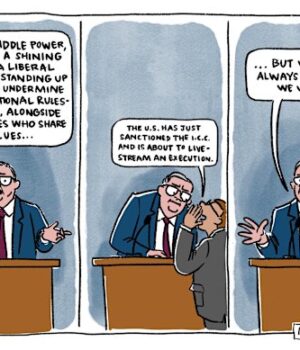
source : the age
To submit a letter to The Age, email letters@theage.com.au. Please include your home address and telephone number below your letter. No attachments. See here for our rules and tips on getting your letter published.
SCHOOLS
That independent and religious schools should not be supported by government funding is an idea worth pursuing here (“Radical plan to end private school fees”, 14/10). Many independent and religious schools have facilities that state-financed schools can only dream about: concert halls, pools, gymnasiums, staffed libraries, etc.
Private (ie independent) schools in England do not receive government funding but rely on parents or guardians to meet the cost of educating their children. It is a choice every family makes.
I liken this way of equity in education to transport choices. You can use public transport at minimum cost or you can pay for a taxi at your own expense. The ability to pay high fees should not be the determining factor to receive a good education.
Gillian Yung, Kew
Funding non-government schools is standard
The only reason a proposal to remove fees in non-government schools is portrayed as radical (“Radical plan to end private school fees”, 14/10) is that we have been fed 60 years of propaganda that Australia is unique in funding such schools when doing so is standard practice throughout the OECD. Finland fully funds them but bans them from charging fees. England fully funds those that do not charge fees. New Zealand almost fully funds those that charge very low fees.
Cutting all funding to fee-charging schools is politically untenable, but a smart party that wanted to win the coming state election would offer a substantial increase in funding to the Catholic sector and low-fee independent schools that agreed to cap their fees, and enrol the same proportion of disadvantaged students as the government sector.
We all accept that the public health system funds non-government doctors via Medicare and non-government chemists via the PBS. We ought to accept that the public education system can include schools that are not owned or run by the government.
Chris Curtis, Hurstbridge
Tech study doesn’t need to be a trade-off
Your correspondent (Letters, 14/10) provides a clear-sighted view of the technical v academic school debate. She rightly argues that “good schools have great teachers who create opportunities for everyone”.
Adequate funding of public schools would enable teachers to provide such opportunities so all students can reach their full potential. It isn’t just a matter of manual training or academic pursuits. All students should have access to the education that suits them. For many, that will include learning from both streams. I want tradies to not only competently fix my home but to understand the wider world in which they live and vote.
Judy Williams, Beaumaris
Don’t repeat the mistakes of the ’90s
The reference by your correspondent (Letters, 14/10) to “in the past, narrow offerings at technical schools cut off many working-class students from hopes of a university education” has a historical import. It recalls the late 1980s and the early 1990s when social and political pressure was placed on students to stay at school to year 12. Many were, in effect, “parked” at school in a context of being stigmatised if they didn’t want to go to university. It appears that a “class” issue still remains in secondary schooling, however, the educational failure of the 1990s shouldn’t be repeated.
Des Files, Brunswick
End the right to discriminate at faith-based schools
Allegra Spender’s Private Member’s Bill to stop faith-based schools being able to fire and expel students and staff based on sexuality, gender identity, pregnancy and marital status cannot be enacted soon enough. As for the Australian Christian Lobby’s claim that this is about freedom, not discrimination, I believe most Australians, including gay Catholics like me, realise this is about their freedom to discriminate.
As a former teacher working in independent and faith-based schools, I know only too well how the constant threat of firing disables a teacher to challenge homophobia and transphobia in the classroom. The data proves that affirmation, friendship and volunteerism are vital enablers for queer young people to thrive. All schools should have a duty of care to proactively make schools safe so that all students can learn and all teachers can teach.
Olivia Brozecki, Howlong, NSW
THE FORUM
Complicated issues
The article, “Barrister’s claims on sexual assault spark outcry” (14/10), raises a number of important issues. Firstly, it is clear that a sexual assault may still have been committed regardless of whether a conviction has occurred. Given the high bar required to convict – proof beyond reasonable doubt – as a matter of logic, there must be victim-survivors where there has been no conviction.
On the other hand, it is also hard to refute the claim that not all persons who allege sexual assault are telling the truth. There are many instances where this has been clearly established, including cases of simple recantation. Nobody knows what percentage of allegations are in fact false (whether intentionally or mistakenly), and the “guestimate” of 5 per cent is itself unreliable; it is an estimate of proven false allegations. Research on this aspect reveals there are a large number of allegations which are in the “don’t know” basket.
The tension between establishing a “victim” before the criminal law and a victim in fact is unresolvable. The reasons for this include the very requirements of the criminal law, and the fact that false allegations do occur.
Con Differding, Torquay
Perverse logic
Re “Barrister’s claims on sexual assault sparks outcry” (14/10): What’s next? Unless murderers confess, the victims will be deemed “alive”?
Les Aisen, Elsternwick
More training required
Reframing Melbourne barrister Geoffrey Steward’s starting-point assertion that “some women lie” — a determinative framing that shapes how the story is told thereafter — the more honest and empirically grounded starting point would be to say that a significant proportion of sexual assaults are committed by men who know they have not obtained a woman’s active consent, and many others who remain silent about the abusive conduct of their peers.
Because the correct framing is supported by every available dataset: high prevalence, low reporting, minuscule conviction rates, and a well-documented pattern of bystander silence that shields perpetrators.
In this context, it goes without saying that annual refresher legal education for lawyers, judges, police officers, and all court-adjacent personnel ought to be mandatory to dismantle the rape myths that continue to be consciously and/or unconsciously rehearsed in courtrooms across Australia to the grave detriment of victim-survivors of a heinous, yet persistently underestimated, crime.
Jelena Rosic, Mornington
Growing pains
Ross Gittins makes some valid points in trying to untangle the twaddle peddled by politicians about immigration (“Immigration is too easy a scapegoat”, 14/10). But he’s still an economist peddling the line we have to have continued population growth for the sake of caring for an ageing population and propping up the economy.
This is the same old macroeconomic theory that doesn’t match the fact that planning approvals for massive new subdivisions on the city fringe, or high-rise redevelopment in the inner suburbs, have not ensured the resulting capital gains from these developments fund new schools, kindergarten and health services to support the people who live in those dog boxes with no room for a tree and veggie garden. So the basic infrastructure is not funded, private profits are pocketed, and another generation is worse off than the one before.
Not to mention what this form of growth is doing to the planet.
Bernadette George, Mildura
Treaty repeal essential
I disagree with your correspondent that repealing the Indigenous Treaty is a retrograde step (Letters, 14/10). In fact, many people see its repeal as essential.
Despite Victorians rejecting the Voice referendum, then-premier Jacinta Allan proceeded with the Treaty without seeking a public plebiscite. A poll was entirely justified as parts of the Treaty radically alter parliamentary government in this state. An Indigenous council was established that could second-guess the decisions of an elected government. Such an arrangement effectively re-engineers our democracy.
Claims the Treaty is necessary for the Indigenous to have their views represented inside the tent could be equally applied to any other group. That is why we have a parliament where all voices can be heard. There are better means of addressing Indigenous disadvantage.
Martin Newington, Aspendale
Liberals’ insult
The Liberals’ policy to repeal the current act and abandon the Treaty is an insult to First Nations people. It refuses to acknowledge the harm done to them since we invaded their country. I, like many, will refuse to vote Liberal while this policy exists.
Andrew O’Brien, South Yarra
Booing shameful
On the anniversary of the Voice to parliament referendum, the shameful booing of the Welcome to Country at the weekend’s Australia Cup final (“FA boss condemns booing at cup final”, 13/10) shows not only how far we have to go to achieve reconciliation with First Nations people, but also how sadly we are moving further away from a unified Australia.
Divisive politics from One Nation and Jess Wilson’s Liberals, who have made a point of promising to tear up Victoria’s Treaty, have a lot to answer for. A unified Australia cannot be built by turning reconciliation into a political wedge.
James Alexander, Fitzroy
Damning indictment
Heidi Everett’s story of homelessness in the streets of the city (“I walk city streets just to stay safe”, 14/10) is a damning indictment on our society’s failed public housing system that has been sold off and dismantled by successive governments over the past 40 years.
Data shows Victoria has 40,000 public housing applicants on the priority waiting list. That is, people like Everett who desperately need and deserve housing within a short period of time, but who are actually waiting up to 20 years.
It is time governments ensured multinational corporations paid their fair share of tax so we can properly fund public housing, health services, aged care and the NDIS.
Jeff Fiedler, Castlemaine
Help the homeless
Included in Heidi Everett’s compelling account of her life on the streets was a plea to help the homeless. Her suggestions included various ways to help the homeless find places to cook their own food, and where to find somewhere to camp or sleep.
Coincidentally, The Age featured a full-page ad authorised by more than 100 social sector organisations pleading with the prime minister to restore Ask Izzy’s funding. Not-for-profit organisation Infoxchange operates Ask Izzy, which supports more than 38,000 community organisations delivering vital services. The Ask Izzy website/app provides information for people seeking help for assistance services.
This is not only useful for homeless people who do have a phone, it is very practical tool for passers-by in the community who have been approached for help (as I have on occasions) by vulnerable people who don’t know where to seek assistance in their area.
I’d like to know why the federal government is ceasing funding to provide such vital information.
Sally Davis, Malvern East
No going back
Your correspondent (Letters, 14/1) says if Josh Frydenberg re-enters politics, a “difficult tasks await him” (leadership?). The party has moved right, but it’s more a deep-dive into the far-right to reclaim voters lost to One Nation.
Scrapping net zero when global warming is expected to reach 1.8C in the not-too-distant future is just mind-blowingly stupid. There is no way Frydenberg could be successful in Kooyong without a commitment to net zero and renewable energy. Nuclear power: don’t even think about it.
Frydenberg would also be aware only 23 per cent of voters under 40 voted for the Coalition in 2025.
There is no way back to the political centre for the Coalition this side of the 2028 election, nor, I believe, for Frydenberg.
Neil Hudson, East Melbourne
Make the switch
Many people have made the switch to reduce their transport costs as electric vehicles now lead car sales. Cheaper renewable options help the household budget and as Shane Wright reports, according to the IMF, “the sharp lift in renewable energy sources” has protected the global economy, too (“Australia is facing the sharpest jobless rate rise in developed world”, 14/10).
What is the Coalition waiting for? Many Australian households have moved to renewables manage their costs. If the Coalition wants to be the better economic managers, they could get moving, too.
Jenny Kashyap, Bentleigh.
Easy decision
Prime Minister Anthony Albanese just keeps digging holes for himself with his inability to make decisive decisions. Despite widespread support, he caved to the gambling industry; with AI glasses, he has vacillated. Now with the abhorrent live-stream of the execution in the United States, Albanese is looking at what can be done to stop it, which is an admirable sentiment but not actual action (“Big tech, media warned over live-streamed US execution”, 13/10).
Prime minister, just ban it. Tell the telcos and other providers that they must not allow it into Australia. Sure, people with VPNs will find ways around it, but surely Albanese can make a stand on this matter with a simple clear-cut decision.
Ross Hudson, Mount Martha
Stay in your lane
The Greens remind me of the car in front that’s weaving all over the road (“Split emerges in Greens over military aid to Ukraine”, 14/10). Could they please stay in their lane and campaign for social justice and the environment? That’s already a lot. Let the Ukrainians make up their own minds about defending themselves or rolling over to Russia.
Di Cousens, Upwey
AND ANOTHER THING …
Eggs
The ACCC investigation into a potential eggs cartel could end up in boiled eggs.
Peter Randles, Pascoe Vale South
I now eggspect to see eggceptional and eggspansive letters about the bad egg industry!
Myra Fisher, Brighton East
America
The prospect of a live-streamed execution means we confront the morality of the deed. Averting our gaze makes us complicit.
Peter Bennett, Clifton Hill
Having watched the prolonged death of democracy live-streamed from the Oval Office, Australians have no appetite to watch another American execution.
Ken Machin, Grovedale
It’s not a good idea to tell narcissists to “look in the mirror”. That’s probably where it all started. Lawrie Bradly, Surrey Hills
Potholes
Rocky road is my favourite chocolate treat, but the rocky roads I am forced to drive on are not nearly as palatable.
Tris Raouf, Hadfield
Some years ago, the Brunswick council repaired all the potholes in a quiet suburban street, and installed speed humps the following week.
Martin Harris, Heidelberg
Furthermore
Pity the poor bloke down on the beach going insane, trying to measure the rise in sea levels.
Gerry Lonergan, Reservoir
I am always amused by the classification of “world-class” when applied to luxury units or cruise ships. In many parts of the world, people live in shanty towns with no running water or sewerage, and huts made of thatch and adobe, or tents. A different world perhaps?
Julie Christensen, Blackburn North
I can understand the complexities and absurdities of world politics, but I have never understood the AFL trade period.
David Cayzer, Clifton Hill
Finally
You know you’re getting old when you’re older than the Pope.
Rob Prowd, Box Hill South
The Opinion newsletter is a weekly wrap of views that will challenge, champion and inform your own. Sign up here.
To submit a letter to The Age, email letters@theage.com.au. Please include your home address and telephone number below your letter. No attachments. See here for our rules and tips on getting your letter published.