Source :- THE AGE NEWS
Blinkers On is a weekly column covering the biggest issues of the spring racing carnival.
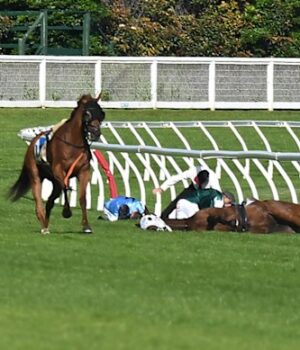
Racing Victoria needs to be transparent this week as it digs into the reasons behind the death of horse Ohope Wins following Saturday’s $6 million Caulfield Cup.
Now more than ever, the public deserves a proper and thorough review of the circumstances surrounding the tragic mid-race tumble that resulted in Chris Waller’s talented mare being put down and two jockey’s lives being put at risk.
At stake is the sport’s social licence, especially in the lead-up to the Melbourne Cup.
While we all agree that the two-horse fall was an accident, and a terribly sad one at that, there is an obligation to provide transparency.
The alternative could be devastating. The Melbourne Cup was brought to its knees by public pressure in 2020, following seven horses deaths in seven years, largely due to soundness issues – which was not the case at Caulfield.
Stewards face an important task. They opened an inquiry on Saturday and it will be ongoing this week. Detailed findings of their review need to be released.
It does not help that the industry continues to erase footage of such catastrophic events from its archives – a long-standing policy to avoid viewer “distress”.
But such censorship not only airbrushes history, it removes the public’s right to form a balanced view on who or what was to blame.
Several key factors will need to be taken into account.
Firstly, the jockeys. While Mark Zahra (Half Yours) and Jye McNeil (Ohope Wins) were the victims of the fall, thankfully escaping largely unscathed as did last year’s winner Half Yours, there was an ugly bumping duel immediately before the crash between Rachel King (Green Spaces) and Jabez Johnstone (Kings Valley).
While this column is not suggesting they caused the carnage that followed, their actions need to be assessed for the good of the sport.
Then there was the Caulfield track. With the rail out three metres and the horses racing on a fast surface, it presented a leader bias that might have contributed to tighter, messier racing.
All of this will, and should be, examined by stewards. It’s important that the public is kept informed as well.
‘Turf’ war: Dispute over Caulfield coverage
To see just how big an impact horse safety has on the industry, you need look no further than the “Turf” war that erupted over Saturday’s broadcast.
The ever-cheery and normally unflappable Seven commentator Jason Richardson found himself defending his network and colleagues on social media on Saturday night over an alleged “lack of information” in the immediate aftermath of the tragic fall.
“Richo” took umbrage at an X post from racing personality John Rothfield, aka Dr Turf, who alleged there had been an “attempt to sanitise what we had just witnessed”.
Dr Turf wrote: “The lack of information, the misinformation and the absence of opinion following the dreadful fall at Caulfield today highlighted how out of their depth both 7 and RDC (Racing.com) broadcasters are when incidents of this nature occur.”
Richardson, who co-hosted the coverage from Caulfield, replied with “absolute garbage, mate”.
“We broadcast all of the information provided to us by the stewards,” he said. “Would you like us to guess? No.”
He also defended Seven’s on-course news reporter Xander McGuire, saying: “Was he ‘out of his depth’? No.”
Racing.com’s mounting yard expert and Mornington trainer Amy Yargi also took aim at Dr Turf, posting on X: “that is absolute drivel”.
But Dr Turf was not finished. He clarified his earlier post with, “I was not referring to information … I was referring to the absence of opinion surrounding the incident that caused the fall itself”, alluding to the “aggressive riding” of several jockeys.
Dr Turf has previously been a panellist on several Racing.com programs, and racing radio station RSN, and currently co-hosts a regular podcast with Richmond great Kevin Bartlett.
He has not been shy in his criticisms of racing in Victoria in the past.
In May last year, he publicly slammed Racing Victoria, which owns Racing.com, for its decision to axe on-air media talent. “I don’t want to talk about the amateurish, appalling administration of racing in this state and the media platforms such as RSN and Racing.com and the ineptitude that oversees them,” he said on his podcast at the time.
Seven backed in its Caulfield Cup coverage when contacted by this masthead. Racing Victoria said Racing.com played an important role in updating the public on the condition of riders and horses once relevant people had been notified and information was available to be shared.
A lost tradition
While on the touchy subject of racing’s need to protect its social licence, it seems the traditional Melbourne Cup parade through the streets of the city has been lost in time.
The event, where horses and the Cup moved down Swanston Street before thousands of cheering families on the first Monday in November, was cancelled in 2023 and is not expected to make a reappearance any time soon.
Racing Victoria CEO Aaron Morrison was asked about the parade’s future at last week’s launch for national thoroughbred week (running from November 20-30).
“I think the political climate’s changed,” Morrison said.
“This year, obviously, it won’t be happening, but we’ll work with Melbourne major events groups and see what we can do with that going forward.”
Morrison has been strong on promoting safety protocols and the aftercare of retired horses and said the spring had seen a resurgence in “younger people – under 35s – and a lot of females”.
“I think that’s a credit to the entertainment that we’re putting on, the great events, and a lot of great work being done by the clubs,” he said.
“I also think we’ve done a lot with the social licensc of the sport.”
Melbourne Cup week is broadcast by Nine, the owner of this masthead
A numbers game
Racing is often seen as a game of inches, but now it might also be a game of percentages, especially when it comes to the potential return of the Cox Plate to Moonee Valley.
This year’s weight-for-age showcase will be staged at Flemington on Saturday for the first time ever while the Valley undergoes a major facelift – the most ambitious, and expensive, overhaul of a metropolitan track this century.
But the Valley’s plans to re-open by next September and take back the jewel in its racing crown hit a serious snag in July when Racing Victoria announced it would withhold the event unless the boutique venue’s $250 million rebuild met industry expectations.
The Valley admitted work on a new grandstand would not start until 2029, making hosting a 20,000-plus crowd problematic.
But that did not stop Valley CEO Michael Browell declaring earlier this month they were “100 per cent” confident of staging the 2027 Cox Plate using temporary infrastructure – a view not 100 per cent shared by the Racing Victoria boss last week.
“We can maybe debate the percentage,” Morrison said. “But I think it’s progressing really well, and we’re working very closely with them to understand what those facilities look like.
“There’s no doubt there’ll be racing back at Moonee Valley. We just need to work through what the customer facilities are going to be looking like over the next couple of years.”
Changes at the top
At least Moonee Valley can be certain of an impending boardroom change, unlike disquiet that is eminating out of Flemington.
MV committee member Su-Ann Khaw is stepping down after nine years in the role, and will be replaced by a sole nominee Michael McGrath at the club’s annual general meeting on November 10. McGrath is an owner of DFS stores, as well as a food export and import business.
The Victoria Racing Club, which hosts Melbourne Cup Week, was hoping for a similarly smooth transition at its December AGM after chairman Neil Wilson announced his retirement this month.
The VRC board raised eyebrows and sparked speculation of a rift after it held a secret ballot to anoint Wilson’s successor as chair, director Vin Cox – meaning Wilson voted on a replacement he will never serve under. Club vice-chair Michael Ramsden was overlooked in the vote.
Wilson denied any rift, as reported by The Age last week, calling the transition process proper governance and “good business”.
But time will tell.
Cox is up for re-election next month, as are directors Glenn Carmody and Michael Saadie, while Wilson’s seat will need to be filled. VRC members can nominate for a position on the committee later this month.
The decision that has raised eyebrows among trainers
A surprising twist emerged last week as part of the ongoing breast cancer drug saga.
The Victorian racing tribunal admitted in its decision against small-time trainer Nathan Dunn that the drug, known as formestane, “can sometimes be labelled” as naturally occurring in horses, as it is in human athletes.
For those not up to speed with the mysterious cases, this is a significant shift.
It means 12 trainers, including Dunn, might have been fined thousands of dollars across the past 19 months for taking their horses to the races with a substance that the animals produced themselves.
It is safe to say, the tribunal’s decision raised eyebrows among the training fraternity
If it is ever proven to be the case – and this masthead acknowledges ongoing research has not been validated – the racing industry might find itself in the grip of an ugly lawsuit.
To date, neither Racing Victoria stewards nor trainers from 13 Victorian stables – Patrick Payne is yet to front the tribunal – have been able to explain how or why their horses returned positive swabs. The trainers have continually protested their innocence.
All of them claimed they had never heard of the drug.
A quick chemistry lesson: formestane is an aromatase inhibitor and anti-estrogenic substance that has performance-enhancing qualities when taken orally or administered intra-muscularly.
That is why WADA provides a threshold for athletes – to distinguish between natural occurrence and cheating.
There is no such threshold in horse racing, and racing’s testing laboratory has not released a reading for any of the cases.
Which makes the Dunn tribunal decision fascinating. Part of it read: “The drug can sometimes be labelled endogenous (coming from inside) or exogenous (coming from outside) and is most likely to be a combination of some external source through the use of a syringe or partially endogenous from endogenous hormones produced from inside the body of the horse.
“If the level is a high one, it is more likely to be from an external source. However, the tribunal cannot speculate about the source in this matter as there is not any evidence about the concentration level of the drug in this case.”
There have been no formestane positives in Victoria since November last year.