SOURCE :- SIASAT NEWS
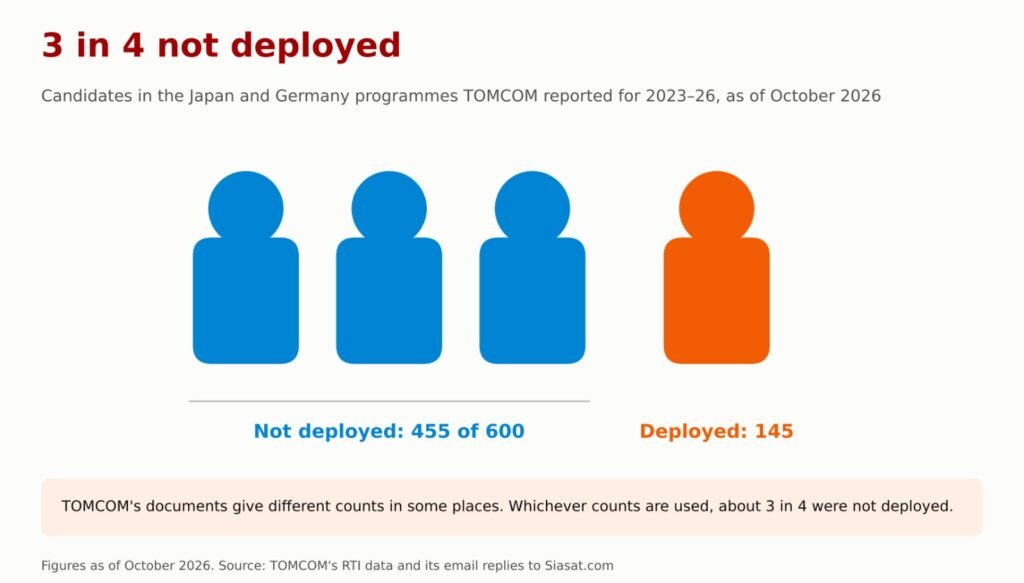
Hyderabad: The Telangana Overseas Manpower Company Ltd (TOMCOM) enrolled 600 candidates in the Japan and Germany programmes it reported for 2023 to 2026. By October 2026, 455 of them, or 75.8 per cent, had not been deployed abroad. Only 145 had.
The figures come from TOMCOM’s replies to two Right to Information (RTI) applications and to questions Siasat.com sent on September 16. They are the first programme-wise figures TOMCOM has made public since it was set up as a state government company in 2015. Its documents do not always agree, but on any of its counts, three in four candidates were not deployed.
“Deployed” is TOMCOM’s term. Its figures exclude candidates awaiting visas or holding pre-visa approvals. Whether any of the 455 left by other routes is not shown. In Part 3 of this investigative series by Siasat.com, candidates from the programmes run with Fairstreet India Pvt Ltd disputed TOMCOM’s figures, saying some reached Germany through private firms.



Siasat.com’s first RTI application sought a complete list of all TOMCOM’s overseas employment and training programmes from 2023 to 2026. The second sought batch-by-batch records of its Germany programmes. What came back was 13 programme groups, all in Japan and Germany, run with nine partners: in Japan, NIHON, Leading Edge, NAVIS Human Resources and NSDC International (NSDCI) – the overseas arm of the National Skill Development Corporation.
In Germany, the partners were TGM Services Pvt Ltd (Magic Billion), 2COMS Consulting, Fairstreet, Indo Euro Synchronization (IES) and Triple Win, a programme of Germany’s Federal Employment Agency and its development agency GIZ.

Nothing was listed for at least 11 other countries where TOMCOM advertised jobs over the same period: the UK, the UAE, Saudi Arabia, Israel, Greece, Qatar, Canada, the US, Australia, Fiji and Singapore.

Partners it announced for Japan in April 2025 (TERN Group and Raj Group) and for Germany in December 2025 (Nexwave GmbH) are missing too, so even the Japan and Germany list may be incomplete.
Two of the Japan programmes are dated 2022–23, a year that runs from April 2022 to March 2023, though Siasat.com asked about 2023 onwards. The one run by NAVIS began training in January 2023. For the other, run by NSDCI, no start date was given. This report counts both, as TOMCOM listed them.
The 600, stage by stage
All 600 are in programmes that have finished training, the only ones for which TOMCOM gave stage-by-stage figures. Of them, 142 did not complete language training, 201 completed it but did not clear the required exam and 112 cleared it but have not been deployed, leaving 145.


Germany accounts for 475 candidates, Japan for 125. Japan’s programmes deployed a higher share, 38 or 30.4 per cent, against Germany’s 107 or 22.5 per cent. Germany’s candidates were more likely to finish training and clear the exam, but less likely to be deployed once they had.

In Germany, enrolment nearly tripled, from 79 in batches TOMCOM labels 2023–24 to 236 in 2025–26, while the share deployed fell from 49.4 to 16.9 per cent. Some 2025–26 batches still await exam results or visas.
The 2024–25 batches, most of which finished training by August 2025, are at a similar 17.5 per cent. In Japan, enrolment and the share deployed both fell.

Programme by programme
TOMCOM counts each candidate deployed under the programme and partner they enrolled with. Its figures do not show who arranged each job, whether it was the one the candidate signed up for or whether those who say they found work through private firms.
Siasat.com asked who placed TOMCOM’s Germany candidates and in what jobs, and, on October 23, whether the 12 Fairstreet Ausbildung candidates it counts as “deployed” included private recruits or people moved into other trades. TOMCOM answered neither, so how many jobs each partner arranged is not known.

In Germany, two programmes deployed more than half their candidates: the first two electrician batches (31 of 52) and the 2023–24 Ausbildung, or vocational apprenticeship, batches in non-health trades (36 of 63). Four deployed fewer than one in 10, while two of them sent none.
In Germany, nursing has the lowest share deployed of any job group after the bus drivers. The two programmes TOMCOM lists as nursing alone, Triple Win’s and Magic Billion’s, have deployed 12 of 145, or 8.3 per cent, and 22 have cleared B1. Triple Win’s, the largest single programme, has deployed nine of 129.
2COMS’s 62 candidates are not included. TOMCOM’s summary lists them as nursing and non-health combined, with 16 deployed, while its batch-by-batch table lists all three batches as nursing. So how many were nurses is not clear.
Ausbildung non-health candidates outside 2COMS have the highest share deployed in Germany, with 48 out of 142, or about one in three. Electricians are at 31 of 107, or 29 per cent.
In Japan, the 2022–23 caregivers deployed were 29 out of 50, while the other three programmes had a fifth or fewer. None were deployed in the 2025 caregiver batch. By job, those deployed under the Japan caregivers programme stand at 34 of 103 and hospitality at four out of 22.


Years after training
TOMCOM calls its programmes “ongoing.” Told on September 16 about the Germany Ausbildung and bus-driver candidates’ accounts that very few had gone abroad, it said the programme was “currently at different stages of the placement and deployment process.” Asked why, if the failure rate was that high, it said, “Ongoing process.” Asked, batch by batch, how many had passed, been interviewed, been placed and travelled and how many were left without jobs, it gave the same reply for every batch, even those that finished training in early 2024: “Programmes not closed. It is ongoing process.”
Only the Germany batches, which the second RTI application asked about one by one, came with training dates. For Japan, TOMCOM gave only programme years 2022–23, 2024 and 2025. Of 17 Germany batches, 12 finished language training more than a year before TOMCOM posted its RTI replies on October 22, 2026. Four of them were more than two-and-a-half years before.
Those 12 enrolled 322 candidates – 163 passed the exam and 97 have been deployed. The months since training, shown batch by batch, include time spent sitting external exams and awaiting results, which depends on exam slots and attempts.


Of the other five, three finished training within the past year and have deployed no one yet – the third and fourth electrician batches and Triple Win’s second nursing batch. For the two run by 2COMS, TOMCOM gave no usable dates.
In Germany, of the batches more than a year past training, the bus drivers have the lowest share deployed: none of 19, about 17 months after training ended in May 2025, though four had job offers. In Japan, Leading Edge’s 2025 caregiver batch has deployed none of 21, although two have contracts.

The language exam
In Germany, of those who completed language training, 81.7 per cent cleared A2, the level required of electricians and bus drivers, and 47.9 per cent cleared B1, required for Ausbildung and nursing, or 57.4 per cent leaving out the nursing batch still awaiting results. In Japan, 50.6 per cent cleared the JLPT or JFT exams.
These rates count everyone who ever passed, at any attempt. The data gives one “cleared exam” figure per programme, without dates or attempts. Asked for first-attempt passes and missed deadlines, TOMCOM pointed back to that data. Asked how many passed within the deadline in candidates’ agreements, it answered “NA,” or not applicable.

Of 85 in Germany who cleared A2, as many as 31 have been deployed. Of the other 54, about 38 are from the two latest electrician batches: 11 have pre-visa approval, 19 were rejected at interview and are training for fresh interviews in January 2027, five missed their interview and three were rejected and withdrew. Of 128 who cleared B1, 76 have been deployed.
Still in the pipeline
TOMCOM’s data lists 26 candidates who have not yet gone abroad but hold a contract, a job offer or pre-visa approval. In Germany, they are 11 electricians, nine nurses waiting for visas and four bus drivers. TOMCOM said on October 27 that two of the bus drivers have pre-visa approval. In Japan, they are two caregivers.
If all 26 travel, the share deployed would rise from 24.2 per cent to 28.5 per cent.
TOMCOM is also running free German classes this year for another 270 candidates, separate from the 600, in Hyderabad, Kodangal, Mancherial and Nizamabad. Half, 135, are nurses, the group with the lowest share deployed after the bus drivers, and 177 are at A1, the first level.
TOMCOM has named no employers for them and given no deployment figures.

TOMCOM’s records show some candidates in its Germany programmes leaving at the final steps: a first-batch electrician marked “visa received and dropped,” a Magic Billion nursing candidate who left after clearing B1, a 2COMS candidate who “cleared B2 but dropped due to personal reasons” and six in another 2COMS batch who left after training, as many as were deployed from that batch.
Nor is it clear whether TOMCOM still counts as deployed those who later quit, like the Ausbildung candidate Siasat.com spoke to, who resigned and came home. Asked on October 23, it did not say.
Figures that don’t agree
TOMCOM’s figures disagree with one another, or with their own arithmetic, in at least 10 places. Five change the overall picture, moving the share deployed between 23.5 and 25 per cent. This analysis uses the summary, identical in both RTI replies.

All programme figures are TOMCOM’s own, from its two RTI replies and its email replies to Siasat.com’s questions of September 16 and October 23. Siasat.com re-added TOMCOM’s printed totals and calculated the percentages from its counts.
(This is the fifth report in Siasat.com’s investigation into TOMCOM)
SOURCE : SIASAT