
Source :- THE AGE NEWS
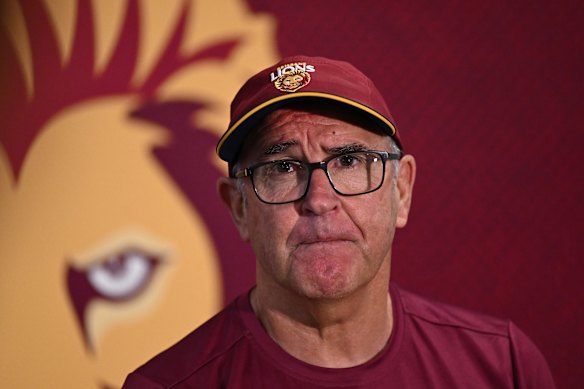
More than two years have passed since Chris Fagan entered a Q-Clash believing he might be coaching the Brisbane Lions for the last time.
The emotional toll from the Hawthorn racism allegations still weighed heavily and that, compounded with a cancer scare, created a doom-laden backdrop for a coach whose side had lost the 2023 grand final by four points and was sitting at 2-5 in early May the following season.
History relates that club bosses Andrew Wellington and Greg Swann went to Fagan’s house the morning after the Lions had defeated the Suns following a tip-off from club doctor Paul McConnell that the coach was seriously struggling.
Fagan had told his wife Ursula and his manager James Henderson that he was thinking of walking away from the Lions. The heavy injury toll suffered during the Gold Coast game, combined with a truthful and cathartic session with Wellington and Swann, changed his mind.
Two days after the Lions’ 2024 premiership, Fagan – in an understatement perhaps punctuated by the ultimate victory – said of that pivotal Q-Clash: “It was a great win, but it wasn’t a great day for the club, and they didn’t need me having a sook”.
Two seasons later, Fagan heads into another Gold Coast game again under a mid-season cloud.
The injury toll this time around is at crisis levels, but what is equally perplexing as the dual premiership coach attempts to steer his team into Brisbane’s eighth straight finals series has been the absence of characteristics that have shaped the club’s DNA during the Fagan ascendancy.
Both Fagan premierships came after the club had looked in serious trouble in June and both required the team to contest three games leading into the grand final with no week’s break.
And yet, this time around, the problems are different and more concerning. Not so much in the long term, given the club’s sound list management boosted by some prodigious father-sons and academy picks. But the outlook for 2026 is more concerning, given the stated aim at the start of the Fagan-Swann-David Noble regime in late 2016 to emulate the Geelong and Sydney models by making finals (almost) every year.
And yet even Chris Scott’s formidable era has never seen the Cats win successive flags. In recent weeks, Fagan has hinted at the fatigue brought on by playing 80 games over three seasons (the most of any team in AFL history), a factor underlined by the Lions’ early season start over the past two years due to Opening Round, and the fact they travel every second week and have travelled to the majority of their finals.
But fatigue and injuries only make up part of the picture. Denis Pagan’s era at North Melbourne never saw successive premierships, but his Kangaroos missed finals just once in 10 seasons and finished top four seven years running. Towards the end of his time at the helm, Pagan identified a malaise setting in entitled, “The success disease”.
More recently Fagan has referred to “the disease of me”. The curiously woeful third quarter against the Giants two weeks ago led to a Thursday morning soul-searching session that addressed the disease: the lack of defensive effort, the attempts by the younger stars in particular to win the game through individual labour, and the on-field finger pointing.
Last Saturday, the Lions were well-beaten again by premiership favourites Fremantle, but afterwards Fagan was his typically stubborn self – refusing to lose faith in those senior leaders who have gone above and beyond for him so many times. In the past, Fagan has resorted to humour, Ted Lasso episodes, his so-called “Dancing on thin ice” motto and celebrating points.
But there were no tricks at training or in the team meetings this week. He took heart from their final quarter and simplified the build-up to the Suns game with a back-to-basics approach.
The ledger has looked significantly worse than 6-6 from 12 games at the season’s midpoint, but the un-Brisbane-like behavioural signs began post-season. First up was the departure of Swann, who was poached by the AFL in the middle of last year and who was Fagan’s closest ally and confidant at the club.
Not only were the Wednesday night dinners with the Fagans, the Swanns and Leigh and Deb Matthews a weekly punctuation mark, but Swann and Fagan were also neighbours and regular walking partners. Swann tended to stay away from the football department, whereas his replacement, Sam Graham, has been more prone to micromanagement.
The operational styles of Swann and Graham differ, and Graham has not joined the Wednesday dinner crew, which continues with just the Matthews and the Fagans. Fagan undoubtedly misses Swann’s pragmatic approach to football and player politics, his former sounding board.
Gold Coast’s almost-successful attempt to poach Lions football boss Danny Daly frustrated the premiership coach; coming as it did so late in 2025. Fagan approached Ken Hinkley to become his new head of football in the event Daly departed and was disappointed when chairman Wellington and CEO Graham told him the search for a new football boss would require a thorough executive search.
In any event, Daly chose to remain with the Lions – in turn frustrating Damien Hardwick. But Fagan felt he had done enough to choose his successor should Daly have departed.
Then came Lachie Neale’s very public marriage break-up, an event which saw Neale relinquish the captaincy and now points to his departure from the club. The likelihood that Neale could leave at the end of this season to be closer to his young family back in Perth was one thing, but the speculation that several Victorian clubs remain a good chance of luring Neale is quite another.
Worryingly, Neale, still the Lions’ leading player in the coaches’ votes, has suggested to club bosses in recent weeks – perhaps softening up his employer – that his departure could benefit them by opening up midfield space for Levi Ashcroft and injured academy star Daniel Annable.
Also uncharacteristic was the Lions’ on-field leaders pointedly communicating early in the season to club bosses that it would be unacceptable for the out-of-contract Zac Bailey to command significantly more money than his star teammates who had settled for less. The restricted free agent is reportedly canvassing a seven-year, $10 million contract from Adelaide. The Lions’ six-year offer is between $6 million and $6.5 million.
The Lions’ injury list stands at 15, including structurally crucial leaders like Dayne Zorko, Ryan Lester, Jarrod Berry and Jack Payne. Furthermore, pre-season surgeries to Josh Dunkley, Bailey, Jaspa Fletcher and Berry meant none of those players were adequately prepared for the ’26 season.
Now the out-of-form co-captain Hugh McCluggage will miss at least five weeks after injuring his calf at training on Thursday.
Added to that are the retirement of spiritual on-field leader Oscar McInerney, and the culturally damaging exit of Brandon Starcevich and also Callum Ah Chee, who accepted better financial offers elsewhere.
In recent years the Lions’ older brigade often covered for young stars like the Ashcroft brothers, Fletcher, Logan Morris and Kai Lohmann. Now those leaders are largely out of form or injured.
Fagan was Tasmania’s No.1 choice to take over the new club’s football operation but rejected it last year, telling Devils bosses he planned to live in Melbourne once he stopped coaching Brisbane. Contracted until the end of 2027, the prevailing view was that he could step away should the Lions achieve a three-peat in 2026.
The career opportunities that await Fagan post-coaching remain widespread. His passion for football and love for the compatriots who helped him achieve success will shine through again on Wednesday when he delivers his eulogy for close friend Neale Daniher at the latter’s state funeral.
But in 2026 his famous loyalty to his players, unwillingness to drop proven performers, and justified pride in what he has achieved since taking over the cellar-dwelling Lions have bordered upon a zealous defensiveness at times this season.
The impression is that the coach has identified a malaise more serious than simply an unacceptable injury toll, fatigue, or even the inaccuracy in front of goal that dogged the club in 2024.
Notably, after a visitor to the club photographed the team’s whiteboard highlighting the strengths and weaknesses of Essendon players in the lead-up to the round-eight clash, the normally humble Fagan was publicly and uncharacteristically unapologetic.
Although the revelation was unintentional and involved subterfuge, the club should never have left such information, however trivial, open to exposure. It left the club open to accusations of uncharacteristic hubris.
The coach has not resorted to public excuses, despite the injuries and potential fatigue. Still, the 80-games-in-three-years equation keeps coming up lately and cannot have escaped those players who looked like shell-shocked robots during that horrendous 14-goal Giants third quarter at Engie Stadium, and too often lacked energy at crucial points of this season.
Helping the reigning champions recover from individual injuries falls to the high-performance team at Springfield Central. Curing “the disease of me” falls to every player, coach and football staffer. The key to finding that cure lies in locating the unity and cohesion and lack of selfishness which has marked the Fagan era.
Keep up to date with the best AFL coverage in the country. Sign up for the Real Footy newsletter.
 Caroline Wilson is a Walkley award-winning columnist and former chief football writer for The Age.Connect via email.