Source : INDIA TODAY NEWS
The first Indian home on the Moon may not look anything like a house on Earth.
There may be no big windows opening to a lunar sunrise, no brick walls, no balconies and certainly no gardens in the conventional sense. Instead, it may arrive folded and packed inside the payload bay of a spacecraft, travel hundreds of thousands of kilometres through space and then be assembled, panel by panel, on a world where there is no air to breathe, temperatures swing wildly and radiation constantly bombards the surface.
advertisement
That vision is now taking shape in an ambitious Indian concept called Bheem — the Bhartiya Extraterrestrial Expandable Modular Habitat.
Developed by a team of researchers at the Indian Institute of Science (IISc), Bengaluru, including Indian astronaut Group Captain Shubhanshu Shukla, the concept attempts to answer one of the most important questions facing the future of human spaceflight.
Once humans reach the Moon, where will they live?
The answer cannot simply be to carry an entire house from Earth.
That is where Bheem comes in.
WHAT IS BHEEM?
The proposed habitat is built around a modular, panel-based architecture that can be transported compactly and assembled after reaching an extraterrestrial destination.
The concept is designed for expansion, allowing a habitat to potentially grow as the human presence around it grows. The researchers say the approach could significantly increase the usable volume available compared with the volume occupied during launch.
But between an architectural concept and an actual Indian house standing on the Moon lies perhaps the greatest engineering challenge India has ever attempted.
The problem is not designing a house. It is surviving outside it.
IT BEGAN WITH A QUESTION
For then-astronaut-candidate Shubhanshu Shukla, who had just completed the Russian leg of his astronaut training in 2021, it all began with a simple question – If India wants to land its astronauts on the Moon, where will they live?
Shukla has been involved in research into the future of human habitation beyond Earth ever since, and for him the question extends far beyond sending astronauts to another world.
“Getting there is only the first step. Keeping humans alive there is the real mission,” he told IndiaToday.in, in a telephonic conversation.
A lunar habitat would have to protect astronauts from extreme temperatures, dangerous radiation, micrometeoroids and lunar dust while providing breathable air, water, food, power and a reliable life-support system.
Astronaut Shukla argues that if humans are expected to live beyond Earth decades from now, the work on the technologies needed to support them cannot wait until they arrive. “It has to begin now.”
Bheem is therefore not a blueprint for a ready-to-build lunar villa. “It is a starting point, an attempt to imagine the architecture and engineering systems that India will need if its human spaceflight ambitions eventually extend from low-Earth orbit to the Moon and beyond,” Shux added.
The design tackles one of the biggest problems in extraterrestrial construction: launch volume.
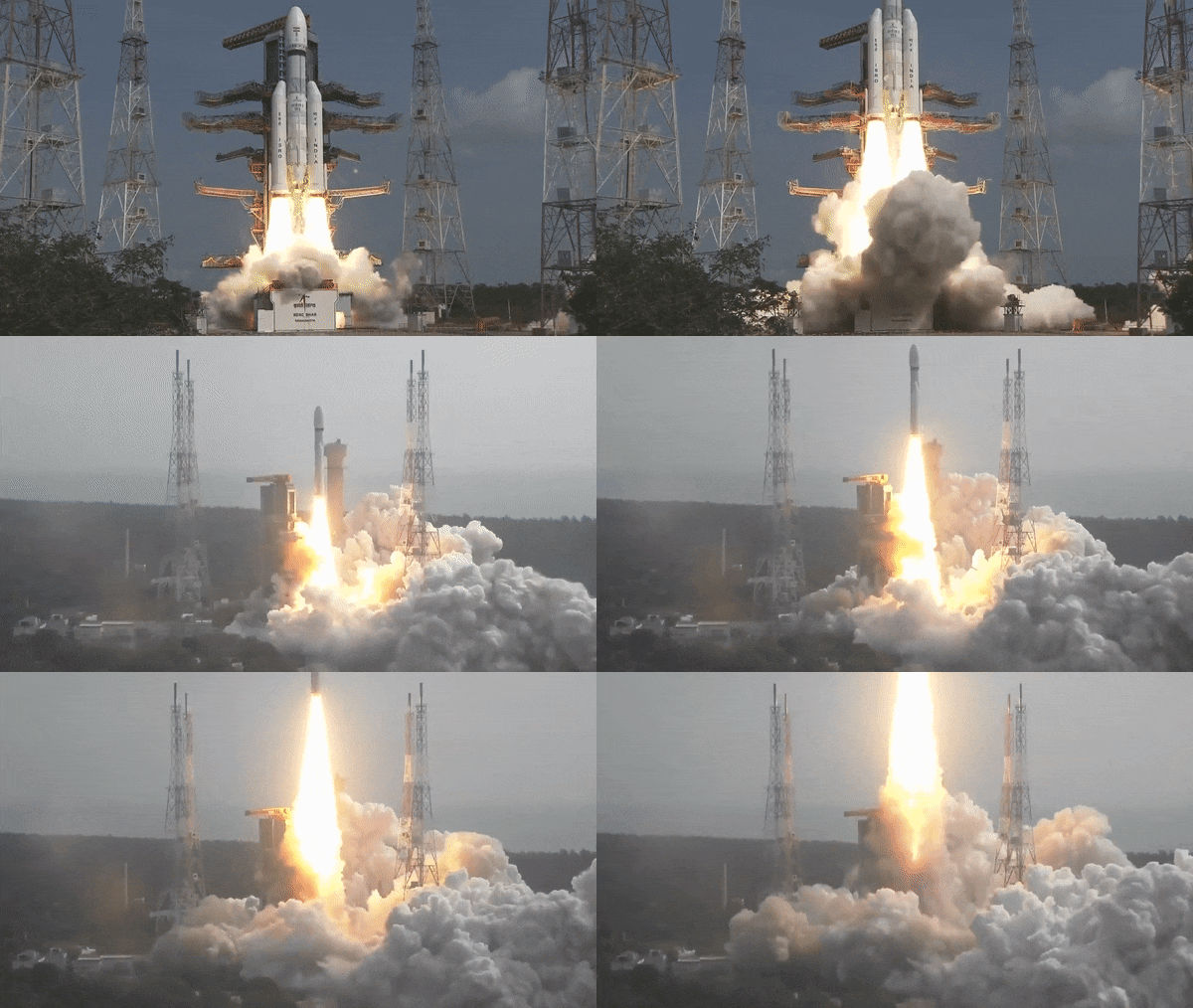
LAUNCHING A HOUSE INTO SPACE
Sending large, rigid structures into space is enormously difficult and expensive. Rockets have strict limits on both mass and volume. A habitat designed to fit compactly inside a launch vehicle but expand after landing could therefore offer a major advantage.
The Bheem concept uses modular panels that could potentially be assembled into different configurations depending on mission requirements. If a settlement grows, more modules could theoretically be added. If part of a structure is damaged, individual components may be easier to replace than an entire habitat.
The architecture, however, is only the skeleton.
The Moon house of the future will need an entire industrial and technological ecosystem behind it.
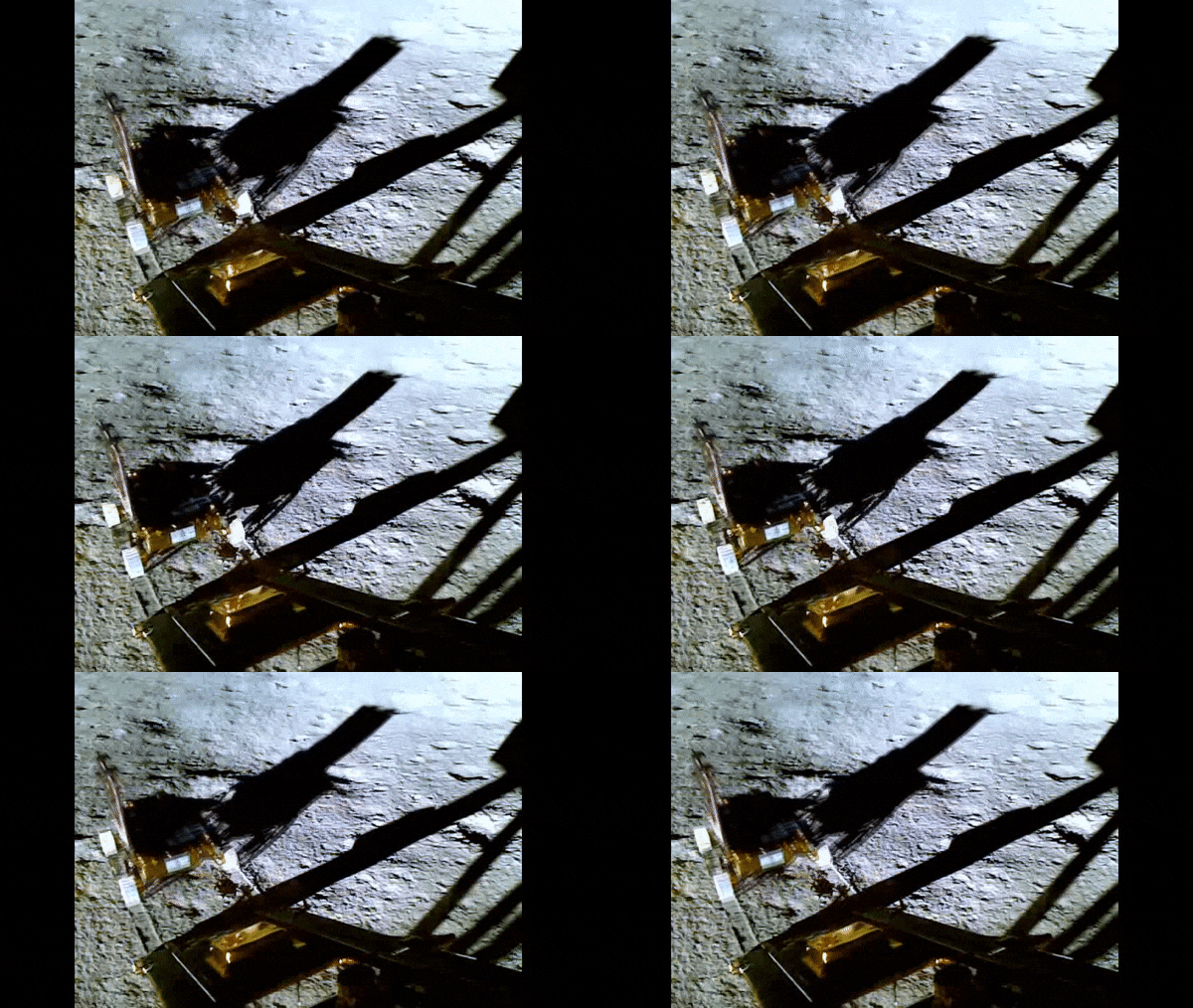
DOES THE MOON HAVE WHAT INDIA NEEDS TO BUILD A HOUSE?
The short answer is: partly, but not yet in a form that can simply be picked up and turned into a house.
One of the most important ideas behind future lunar settlements is called in-situ resource utilisation, or ISRU. Instead of carrying everything from Earth, astronauts and robots would use materials already available on the Moon.
The most obvious resource is lunar soil, known as regolith.
India already has experience exploring how extraterrestrial soil could become a construction material.
Researchers at IISc and Isro have previously developed experimental “space bricks” using lunar soil simulants, bacteria and other materials. The idea is to reduce dependence on construction materials launched from Earth by using locally available resources.
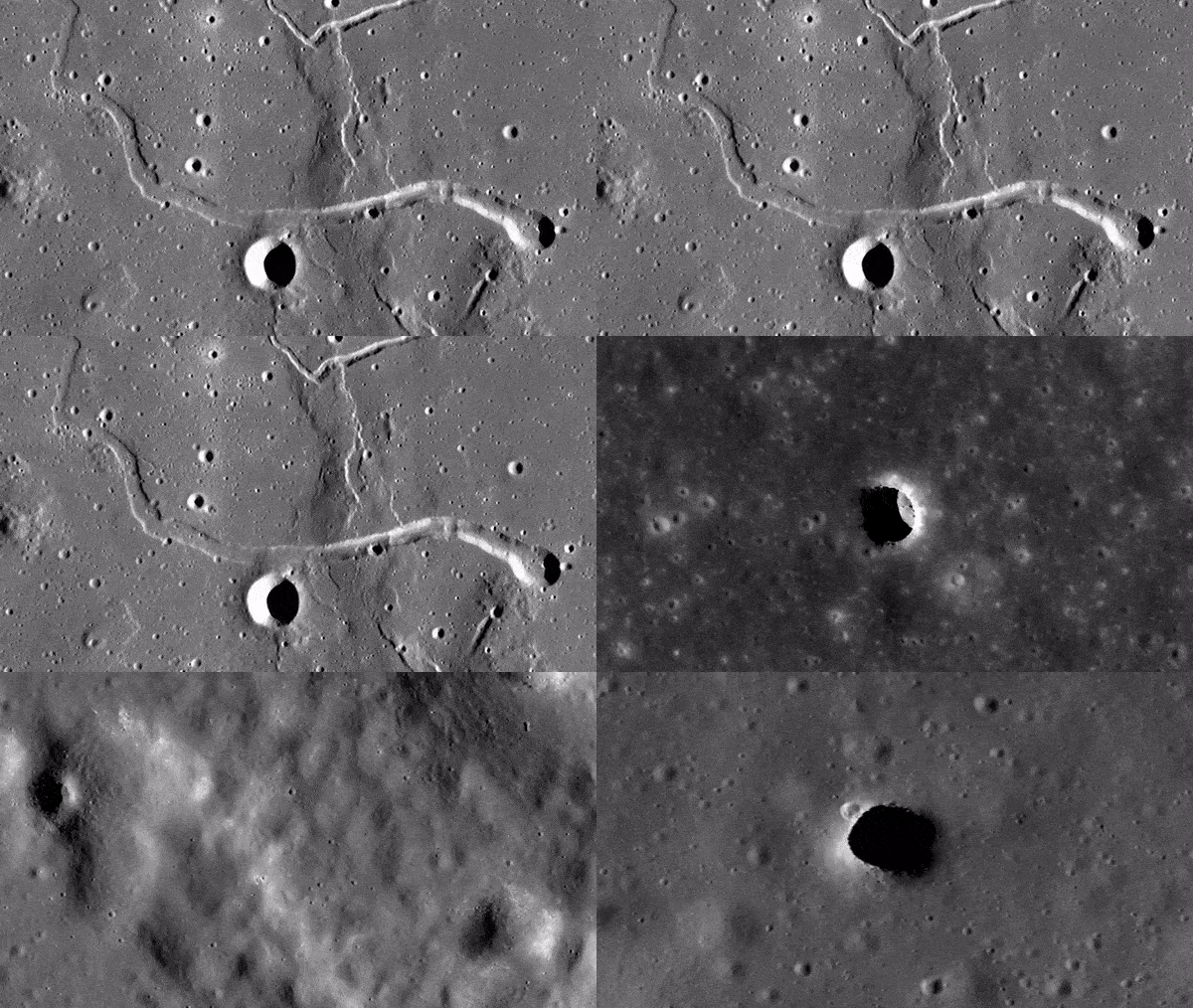
Professor Aloke Kumar, whose laboratory at IISc has worked extensively on extraterrestrial construction and habitation technologies, has been part of efforts to explore how biological and engineering systems could one day help transform local planetary material into usable structures.
The work is significant because transporting building materials from Earth would be prohibitively expensive for any large-scale lunar settlement.
“But there is a major difference between making experimental bricks on Earth and building an operational habitat on the Moon,” Prof. Aloke told IndiaToday.in.
WHAT WILL IT TAKE TO BUILD A HOUSE ON THE MOON?
A real lunar construction programme would need robots capable of collecting and processing regolith, autonomous or remotely operated manufacturing systems, reliable energy supplies, and technologies that can function in vacuum and extreme temperatures.
Scientists would also need to determine which local materials can provide structural strength and which can offer protection from radiation.
This is where lunar soil could become particularly valuable.
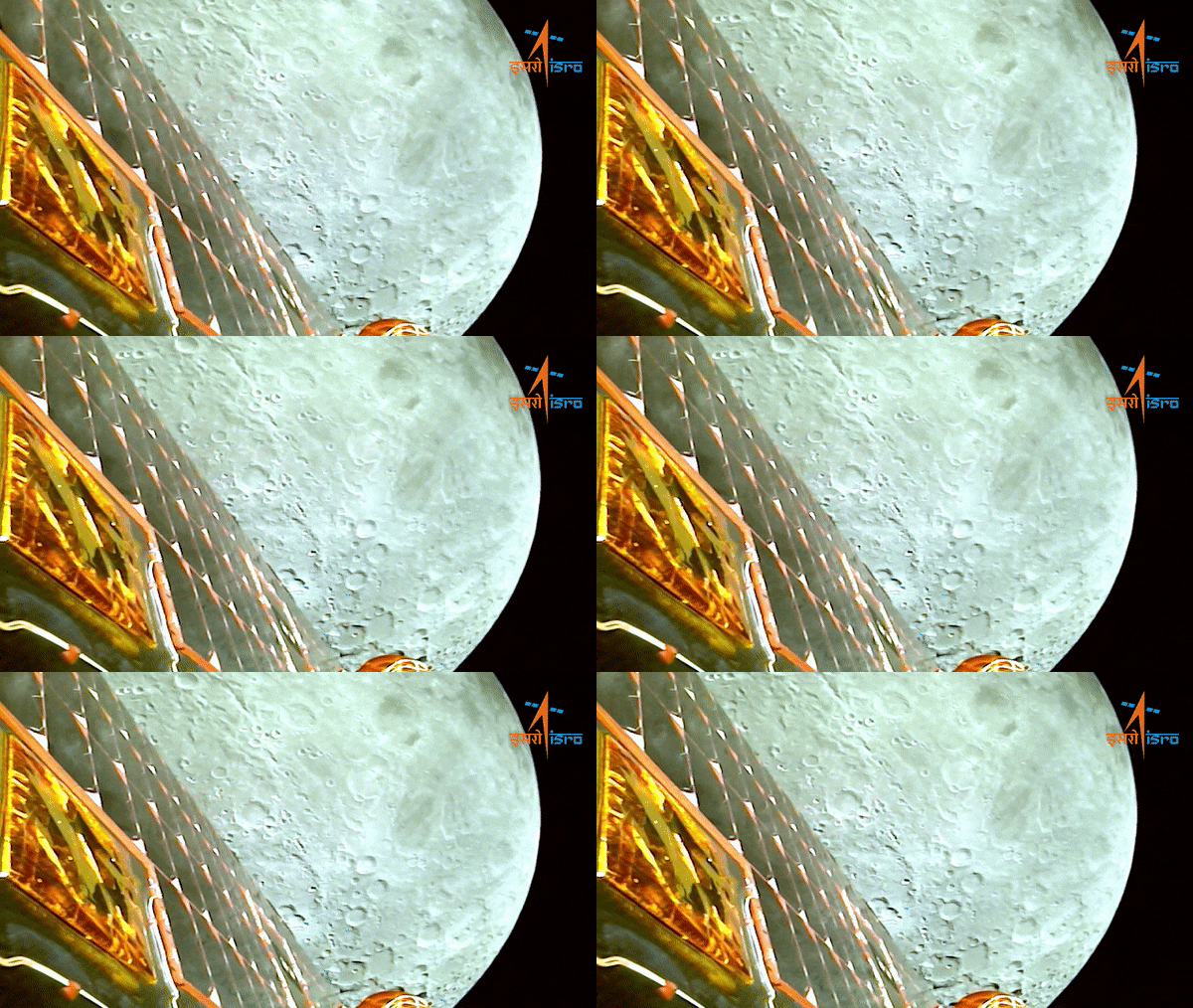
Instead of using regolith to construct the entire pressurised living space, future missions may use it as a protective layer around habitats brought from Earth.
A Bheem-like structure could potentially provide the human living volume, while locally sourced material could help shield it from the hostile lunar environment.
That could dramatically reduce the amount of shielding material that needs to be launched from Earth.
WATER COULD BE THE MOST IMPORTANT BUILDING BLOCK
A house on the Moon will require far more than walls. It will require water.
Water can support human life, but it can also potentially be split into oxygen for breathing and hydrogen and oxygen for rocket propellant.
India’s Chandrayaan-3 mission has added important information about the lunar environment, particularly at southern higher latitudes where future resource exploration could be critical.
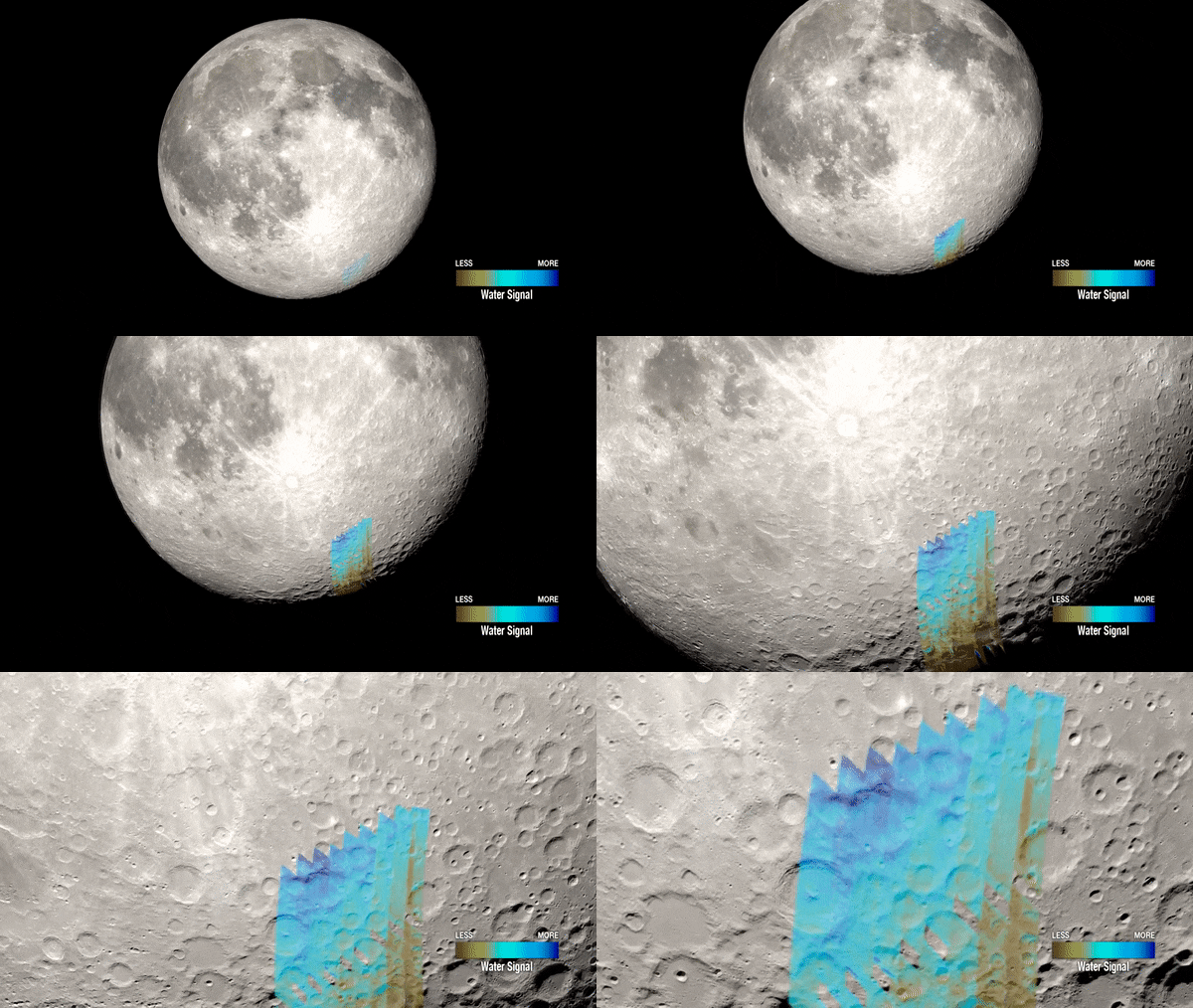
Isro has said understanding near-surface temperatures and the stability of water ice is important for resource utilisation and establishing sustainable long-term lunar habitats.
However, identifying resources and building the industrial capability to extract and use them are very different things.
India will eventually need technologies that can locate water, extract it, purify it and integrate it into a closed-loop life-support system.
This is one of the areas where India needs to move beyond exploration and towards what could be called space infrastructure technology.
The Moon cannot support a settlement if every litre of water, every kilogram of oxygen and every replacement component has to be launched from Earth.
A HOUSE MUST FIRST BECOME A LIFE-SUPPORT MACHINE
Aastha Jhala, founder of Aaka Space, has worked on terrestrial analog habitats and space architecture designed to test technologies and human behaviour in extreme, isolated environments.
Her work highlights another critical reality: a future space habitat is not just an architectural structure.
It is a machine for keeping humans alive.
“Closed-loop life-support systems will need to recycle water and manage oxygen and carbon dioxide. The habitat will require power, thermal management, environmental monitoring, food production systems and emergency redundancy,” Aastha told IndiaToday.in.
Aaka Space has been working on analog habitats and human spaceflight-related infrastructure in India, including systems designed to study isolation, confined environments and the challenges of long-duration habitation.
The company has also explored extraterrestrial construction concepts and radiation shielding using locally sourced material analogues.
For Bheem or any similar Indian lunar habitat to move beyond a concept, these systems will have to be tested together.
A functioning Moon house cannot depend on a single technology.
Its walls, power system, air supply, water recycling, communications, radiation shielding and emergency systems must operate as one integrated ecosystem.
That integration will be one of India’s biggest challenges.
BEFORE MOON, INDIA MUST BUILD ON EARTH
The path to a lunar habitat will likely begin in some of the harshest places on Earth.
Deserts, high-altitude regions and isolated research stations can serve as analogues where engineers and astronauts test technologies under extreme conditions.
Companies like Aaka Space, Protoplanet have been involved in developing analog habitat programmes in India, including projects designed to simulate the operational and psychological conditions astronauts may face during long-duration missions.
These experiments could prove essential.
A habitat may look perfect in a laboratory simulation but fail after months of continuous operation when astronauts face equipment failures, isolation, fatigue, limited resources and environmental stress.
India will need long-duration testing of Bheem-like systems before sending anything to the Moon.
That means building prototypes, testing them in vacuum chambers, exposing materials to radiation, and studying how they behave under extreme temperature cycles.
THERE IS A MISSING PIECE TO THE PUZZLE: A ROCKET
Bheem also depends on something India does not yet have: a complete transportation system capable of routinely carrying large amounts of cargo and humans to the Moon.
India’s human spaceflight programme is currently focused on the Gaganyaan mission and the development of capabilities for crewed missions in Earth orbit. A lunar habitat would require the next level of capability.

India would need heavy-lift launch systems, deep-space transportation, lunar landers capable of carrying large cargo, autonomous construction equipment and eventually human-rated lunar transport.
The Bheem concept has been discussed in the context of future launch architectures and the ability to efficiently transport large habitat structures within available payload limits.
But the transportation system is only one part of the challenge.
Once the habitat reaches the lunar surface, India would need robots capable of unloading, positioning and assembling it, potentially before astronauts even arrive.
The first Indian house on the Moon may therefore be built not by astronauts, but by machines.
FROM IMAGINATION TO INFRASTRUCTURE
Bheem remains a concept.
There is no Indian lunar construction mission carrying its first panels to the Moon. There is no robot currently waiting to assemble its walls on the lunar surface. And the teams working on the concept need more funding to push their research into development.
But that does not make the idea insignificant.
Nearly every major human space programme begins with a question that sounds impossibly distant. Before there was the International Space Station, there were concepts.
Before humans walked on the Moon, there were designs, simulations and ideas that existed only on paper.
Bheem represents India’s attempt to begin thinking about what comes after launch.
And somewhere between the first sketch of Bheem and a real structure standing beneath the black lunar sky lies India’s next great space challenge: learning not just how to reach another world, but how to live on it.
– Ends
SOURCE :- TIMES OF INDIA