

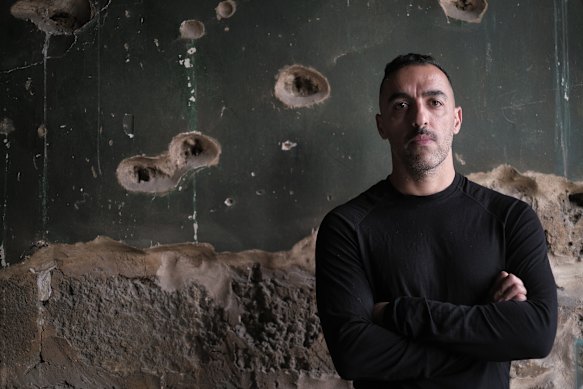
Source : the age
For the Lebanese in the diaspora like myself, the consequences of the country’s civil war are inescapable and palpable. They reverberate socially, politically, economically and emotionally, both within the state and beyond it, and are an ongoing source of curiosity, mystique and suffering.
In trying to move on in their new lives, our parents shut away their grief, anger and desolation, pouring their energies into raising children who would one day seek to understand the unspoken horrors that they had lived, to make sense of what continues to haunt the small but spirited nation to this very day. It is from this place of curiosity that Antoun Issa’s debut novel, Rebirth, materialises: capturing the harrowing and heartbreaking realities of war, as experienced by a poor Beirut family in Lebanon in the 1970s.
Based on his mother’s life, Rebirth follows Laila Khalil, the eldest of five children in a Lebanese Catholic family, who has just left school so that she might work to help provide for her family. She is of marriageable age and the local hairdresser, Nicolas, has caught her eye. But before he can ask for her hand in marriage, the civil war breaks out: ignited by a fatal shooting outside a church one April morning and a revenge massacre of Palestinian bus passengers in Ain Al-Rammaneh later that day.
The effect on daily life is immediate, but the Khalils are worse off than most: caught in the crossfire between the Phalangist militia and the Palestinian Liberation Organisation (PLO), due to their proximity to a Palestinian refugee camp called Tal al-Zataar. Despite her father’s pleas that the family – both sons and daughters – not engage in any war-related activities or side-taking, the war brings tragedy to their doorstep, scattering the family and determining a future that Laila could not have envisioned for herself.
In an epilogue to the work, Issa writes that he was compelled to pen the story after a frank conversation with his mother, after years spent trying to understand the intergenerational trauma that permeated their daily life in Melbourne.
“The destruction of war is never confined to the period in which it is fought,” he writes, lamenting the “enduring loss of an indigenous way of life” for those like her and their descendants, as they mourned a Lebanon of old that they “could never reclaim”.
Issa’s narrative has a laudable immediacy: its events are brutal and keenly felt, and I felt a kinship that extended beyond mere ethnicity with the characters and their aspirations to live in peace. Laila is characterised by a maturity that was typical of young women of her time and place, and the resourcefulness of her mother, Nour, in the face of ongoing poverty is a testament to the matriarchs of Lebanese families, and their resilience and strength. The spirit of the broader community as the world crumbles around them is commendable, too.
Issa’s story does not attempt to give readers an overview of the tenuous political machinations underpinning the war, nor does he weigh in on sectarian conflicts or the current political climate, though the subtext is there.
Instead, he presents the war’s physical and emotional toll on people and places. His mother’s district, named for the bridge built by an Ottoman pasha and once a hub of activity for providores of all kinds, is decimated by the conflict; and the limbs of neighbours and loved ones, blown up by errant shells, are collected by those who remain.
And while some central characters get offered a lifeline, it’s not a happy ending narrative, and readers who have inherited a sense of displacement, dispossession and a lack of belonging will recognise the paradox from which the work has emerged: of gratitude for one place and the innate yearning for another.
Rebirth is an affecting chronicle of a family’s day-to-day in a country falling in on itself. Pulsating with tragedy and resilience, it highlights our inability to escape fate, while reminding us that there’s always strength in community, identity and understanding the past, and serves as a reminder to never repeat that past.
Rebirth by Antoun Issa is published by Hachette ($35).
The Booklist is a weekly newsletter for book lovers from Jason Steger. Get it delivered every Friday.