source : the age
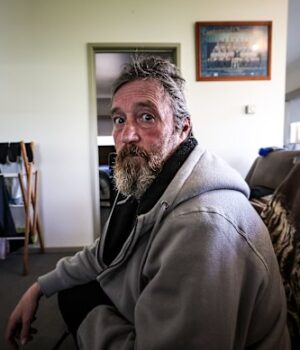
Peter Barry was about to start an exciting new chapter in his life. He was preparing to sell his house in Colac, in Victoria’s south-west, and take a job driving heavy machinery and trucks in the West Australian mining industry.
His son’s family had already moved there and lined up work for Barry. But things didn’t go to plan.
Just before he was due to leave in May 2019, Barry found himself lying on the floor after falling while taking a coffee cup to the kitchen sink.
He dragged himself into his bedroom and stood up using the bed for support, but when he walked into the laundry, he fell again, this time cutting his head and arm on the way down.
“I’m laying on my back talking to myself. ‘Get up, get up, you silly bastard’,” he said. “And I couldn’t.”
Barry didn’t realise that he was having a stroke. A friend found him, and he was rushed to hospital, where he learnt that at 58, he was paralysed down on his left side.
Though he has since regained limited movement and can now hold jars with his left hand to open them, the stroke had a profound impact on Barry’s life. He can no longer work, lost his truck licence and now drives a modified car.
Despite the life-changing effect of the stroke, Barry said support from the National Disability Insurance Scheme (NDIS) enabled him to regain some independence – particularly through the provision of a motorised scooter he uses to make trips to the shops.
“I’d be lost without this thing,” he said.
When it opened in 2013, Colac was among the first locations in Victoria to get its own NDIS office where participants and support workers could speak to staff in-person. But a recent unexplained closure for about a month has raised questions and hampered the scheme’s ability to support the community.
CoConnect, a Colac-based not-for-profit group which supports more than 250 people across the south-west navigate the NDIS, said the temporary closure came without warning and was an unwelcome surprise to many.
“We just showed up and no one was there,” CoConnect support co-ordinator Prue Muvengi said.
A spokesperson for the NDIS said its Colac office was closed due to maintenance required on heating. However, other government tenants of the same building, including Centrelink, continued operating in the same space throughout the same period.
Victorian Liberal MP Richard Riordon said the unexplained office closure in his electorate of Polwarth was not good enough.
“The unplanned closure caused great distress to many clients and client advocates who require in-person meetings and advisory,” Riordan said. He noted the closure came at the same time as transport services in the Colac area were cut for 70 residents of group homes.
Though the NDIS office has since resumed operating with staff present, Muvengi said the closure had created stress and confusion for clients.
She said there were previous instances where the NDIS had advised her over the phone that it could not find or accept forms she had submitted online, and she had to attend the local office.
The temporary closure also came on the back of Muvengi’s concerns about reductions to funding packages for Colac people living with a disability, which is complicating efforts to provide them with the support they need.
Barry estimates his funding package has been slashed roughly in half since his stroke in 2019.
While he said the first package was generous and he did not use all his funding allocation, his in-home support hours had since been reduced from two hours daily to six hours a week over three days. His funding package no longer allows for supports including a pool membership, where he could have aquatic rehabilitation.
“Being on a disability pension, your money just doesn’t go far enough to have little pleasures like that,” Barry said.
An NDIS spokesperson said participant plans might go up or down after reassessment, with funding based on individual circumstances and the disability-related support needs of the client. The spokesperson said while the NDIS might provide funding to assist a participant access a pool or gym safely, it did not fund memberships, which were considered an everyday living cost.
Recently, the NDIS has moved to crack down on fraud, but the agency insisted participants’ funding was based on assessed reasonable and necessary supports and was unrelated to fraud or non-compliance measures.
Start the day with a summary of the day’s most important and interesting stories, analysis and insights. Sign up for our Morning Edition newsletter.
 Benjamin Preiss is The Age’s regional editor. He was previously state rounds reporter and has also covered education for The Age.Connect via X or email.