Source : THE AGE NEWS
There are two very distinct narratives emerging about artificial intelligence right now, and they’re both getting more extreme.
You don’t need to be tuned into the debate to notice these two letters are appearing everywhere. AI is mentioned daily in the news, it’s brought up in work meetings, it appears in government policies and there’s barely a work conference where the topic if not discussed on and off stage.
What you think about the topic depends on which of the two extreme narratives you’re more likely to believe.
At one end of the scale is the positive vision where the broad adoption of AI and robotics is on its way to creating a revolutionary new world. In this telling, goods and services will be dramatically cheaper, everyone will have access to high-quality healthcare and there will be little need to slave over much of the boring and time-consuming tasks that make up many people’s experience of work.
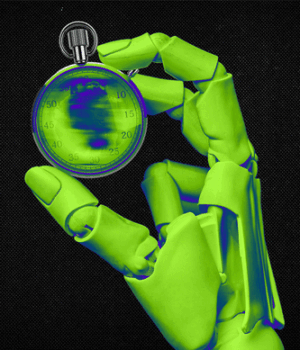
We do have one thing on our side right now, but not for much longer – and that is time.
Elon Musk calls this “the age of abundance”, and Jeff Bezos predicted last week that a likely outcome of wide AI adoption would be the average person working just three days a week. Nvidia’s Jensen Huang told The New York Times last month that he thought it was a fallacy that AI would destroy jobs, and it will instead create even more jobs.
These grand visions of the future are driven primarily by the same tech oligarchs who are creating and selling this tech utopia. They want us to believe that everything will be better in their fantasies, with only pesky rights like privacy, truth and copyright needing to be sacrificed on the way there.
At the other extreme end are AI alarmists, who conduct media tours warning us that the technology is on a path to destruction. It is self-improving at a pace that will soon be too powerful to control, they say, which could plausibly lead to cyberattacks, disinformation at scale, autonomous weapons or bioengineered pathogens that will threaten our very existence.
Many of these warnings on AI safety come from whistleblowing employees who have spent years working on the technology inside frontier labs, before deciding that they’ve now gone too far. One former Anthropic scientist, Evan Hubinger, resigned last month after giving a personal estimate that the risk of AI leading to the destruction of all humanity over the next decade is around 10 per cent.
These two extreme AI narratives – abundance or extinction – are both difficult to fully comprehend. Depending on which of them you lean towards will determine if you get excited every time an AI lab debuts a more powerful version of the technology, or if you wish they just downed their tools and stopped. But without any meaningful signs of regulation at their sources of these codes, primarily in the US and China, we’re all uncomfortably at their mercy.
We do have one thing on our side right now, but not for much longer – and that is time. Despite all the recent advances, we are still at the stage of the technology when we can impact its outcome.
It is still not too late for inbuilt safety checks across the leading frontier labs, government regulation, or even an agreed pause on the development to allow everyone to catch up. We need time to think about all the possible outcomes, formulate and debate legislation, agree on compromises and decide what kind of future we want.
That window of time is closing fast, but it’s still open for now.
Is AI going to save us or destroy us? The answer depends on which of the two extreme ends of the narrative you’re more likely to believe, but the vast and growing valley between them is too wide to ignore.
Tim Duggan’s new book, Clear in Tension: How to get better at conflict, is out now from www.clearintension.com.au.
Get workplace news, advice and perspectives to help make your job work for you. Sign up for our weekly Thank God it’s Monday newsletter.
 Tim Duggan is an author, founder and optimist. He co-founded Junkee Media, is the Chair of the Digital Publishers Alliance and writes the monthly newsletter, OUTLET (One Useful Thing Literally Every Time).