Source :- PERTH NOW NEWS
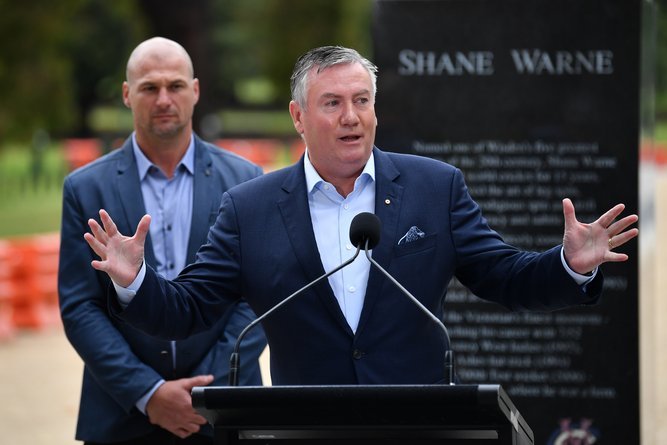
AFL luminary Eddie McGuire did not hold back in April when the AFL announced a new-look illicit drugs policy aimed at closing loopholes and providing harsher sanctions.
The former Collingwood president and omnipresent media voice welcomed twice-yearly hair testing for all players as opposed to urine samples under the old regime.
“No more urine samples is quite good because the players have been taking the piss themselves for far too long,” McGuire said.
Nearly six months on and the AFL has been engulfed in another drug scandal and the question remains: Is its health and welfare-first model helping or hurting players?
Channel 7 reporter Tom Morris reported it was alleged there were illicit drugs present in a room at Melbourne’s Pullman Hotel on Monday morning, with the five Sydney Swans players present, Riley Bice, Nick Blakey, Isaac Heeney, James Jordon and Chad Warner, banned for the remainder of the season for breaching club standards amid an ongoing investigation by Victoria Police’s Sexual Crimes Squad.
When asked whether drugs were involved or whether his players had been tested, Sydney Swans CEO Matthew Pavlich said: “That matter is for the police.”
This masthead is not suggesting the Sydney Swans players are guilty of any wrongdoing, just that they are assisting police with their inquiries.
However, the allegations speak to the AFL’s overarching drugs policy and whether there is a strong enough deterrent to prevent players running the gauntlet.
The Swans are second on the AFL ladder and staring into a premiership window. Their chair Andrew Pridham said the club had taken the matter so seriously it had effectively “torpedoed” its season.
The 7NEWS allegations that cocaine was found in the hotel room may have also torpedoed the AFL’s new drug policy.
“We’ve seen players run the gauntlet far too much. It’s now about helping players. We are losing players. It is a scourge in our community. I know it’s become a lot more accepted. It doesn’t make it any better,” a hopeful McGuire said back in April.
Under the AFL’s old drug regime, players faced a three-strike policy but were exempt if they self-reported and were only subjected to a urine test.
Under the new system, which includes the AFLW for the first time, players are hair tested twice a year. Unlike urine testing, which can only detect drug use in the previous 72 hours, hair testing can recognise drug use from up to three months beforehand.
Players who return a positive reading are now made known to club doctors and the chief executive and asked to attend a behavioural program on their first offence. A second consecutive offence triggers a management plan and a fine of $5000. Once a player hits a third offence, it is treated as regular use and they are referred to an independent panel who will determine whether they are fit to play.
Like the old system, players are not automatically named and shamed after a positive test, with confidentiality remaining a core pillar of the health and welfare model.
Does it go far enough? Not according to Channel 7 commentator Kane Cornes.
“I get it’s an issue across society, but these aren’t regular people. I think it is more than fair to be anonymous after one strike, but fined and more people at the club know about it, and then on a second offence you are actually named,” he said.
The AFL and the players union, the AFL Players’ Association, spent two years negotiating the new drugs policy.
It followed explosive allegations in March 2024 from independent Federal MP Andrew Wilkie under parliamentary privilege that the AFL ran an off-the-books illicit drug testing regime designed to hide positive results by having players fake injuries.
He cited former Melbourne doctor Zeeshan Arain, alleging there had been “wilful inaction” by the AFL to address a “prevalence of drug abuse in the sport”.
Last March, the AFL and AFLPA were at loggerheads again after revelations the league provided a target testing list featuring 51 player names to Sport Integrity Australia.
While the AFL was bracing for a increase in positive tests under the new system, its CEO Andrew Dillon said the aim was to “decrease use”.
“We need a policy that’s fit for purpose for 2026 and beyond,” he said.
“I think the collaboration, we’ve got club representatives, player representatives, the Players’ Association and the AFL here, it’s a genuine industry collaboration.

“It’s the most comprehensive in Australian sport and again I thank the players, Players’ Association and clubs for leaning into this.”
Channel 7 commentator and former Saint Nick Riewoldt, said on Triple M at the time of the announcement of the new model “it is time for a refresh”.
“I think this is where the AFLPA need to be stronger; a stricter, tighter drug code for the players has to be a good thing, doesn’t it?” he said.
“Fines for testing positive, naming of players (testing positive) … just greater ramifications around a positive test. The removal of the loopholes that have allowed players to self-report and essentially get a get out of jail free card anytime they take drugs.
“We’re not just talking about illegal behaviour; we’re talking about dangerous behaviour.
“A stricter drug code could only be a good thing for the players and the players’ health and long-term prospects from a health and wellbeing point of view.
“The trouble now is that you read ‘ankle injury’ or ‘finger injury’ (on the injury list), and there’s every chance that’s not the case. Now, everyone is tarred with the same brush, and we’ve all heard the rumours. In this situation, only those who have tested positive will be named for that.”
In August 2010, late Hawthorn and Richmond player Travis Tuck became the first player to be suspended under the illicit drug rule after confessing he had used the dangerous and illegal substance GHB.

Under the system at the time, the club was not told until after the third strike. The Hawks believed their extensive welfare network could have prevented a third strike if they had been informed.
Melbourne’s Joel Smith was banned for four years in late 2024 after testing positive for cocaine on match day. He had five rule violations to his name, including four counts of trafficking or possession between 2020 and 2022.
Adelaide duo Tyson Stengle and Brad Crouch were suspended by the AFL in October 2020 for “conduct unbecoming” after being caught by police in possession of an illicit substance.
Stengle received a four-match suspension for the start of the 2021 season due to a prior disciplinary infraction, while Crouch received a two-match ban.
In June 2022, Western Bulldogs midfielder Bailey Smith was banned for two games after he admitted to using an illicit substance.
Collingwood forward Jack Ginnivan was also handed a two-match suspension and a $5000 suspended fine in February 2023 after admitting to illicit drug use. Both admissions came after the emergence of a social media video.
In his speech to Parliament, Wilkie read a signed statement from retired player Shaun Smith, the father of the suspended Joel Smith.
“Shaun maintains that his son had not been a cocaine user prior to joining the AFL,” Wilkie said.
“To quote Shaun: If I had known that there was a massive drug problem at the AFL when my son was 14, I would have said ‘You’re playing baseball. You’re playing something else.’“