

Source : THE AGE NEWS
For more than a century, copper has quietly underpinned the modern economy. It carries electricity through homes, factories, renewable energy projects, telecommunications networks, and data centres. Despite decades of technological change, few materials have proven as versatile or as difficult to replace.
That versatility is reflected in where the metal is actually consumed. The International Copper Association notes almost 70 per cent of global copper use is tied to electrical applications, underlining its central role in power networks, buildings, industrial equipment, transport systems, and the broader global electrification of modern economies.
Yet the rise of artificial intelligence has raised fresh questions about copper’s place in the digital world. Not because the metal is running out of applications, but because the latest generation of AI systems is exposing an unexpected bottleneck: the processors powering modern AI can increasingly handle information faster than conventional communication systems can move it.
In the race to develop more powerful AI, moving data is becoming almost as important as processing it. This distinction is driving renewed interest in technologies which use light rather than electricity to carry information.
For decades, copper has performed two jobs simultaneously. It acted as a carrier of both electrical power and information. Traditional computer systems, internet infrastructure, and telecommunications networks relied heavily on copper wiring to perform both functions.
But artificial intelligence is forcing engineers to reconsider the old arrangement. Unlike conventional computing tasks, which are often handled by individual processors, modern AI models are trained across vast networks containing thousands of chips working together as a single system. These chips constantly exchange enormous volumes of information.
As a result, communication between processors is becoming a critical factor in overall system performance. The challenge is that moving data through copper comes with physical limitations. Electrical signals generate heat, consume energy, and become increasingly difficult to manage as data volumes rise. For years, those limitations were manageable. However, today’s AI workloads are beginning to test those limits. This is why optical communication technologies are attracting growing attention.
The idea itself is hardly revolutionary. Much of the world’s internet traffic already travels through fibre-optic cables as pulses of light moving through glass. Fibre has long been recognised as a superior medium for transmitting large amounts of information over long distances.
The question now being explored is whether those same principles can be extended deeper into computing systems. Researchers and technology companies are investing heavily in photonic chips, advanced fibre technologies, and optical networking systems capable of transferring more information while consuming less energy.
The goal is not simply to build faster computers but to build more efficient systems. Artificial intelligence has altered the industry’s priorities. Computing power remains important, but communication speed, energy consumption, cooling requirements, and system integration are becoming equally significant factors.
The winners in the AI race may not be those with the fastest individual processors; they may be those who build the most efficient overall platforms. For investors and commodity markets however, the more interesting question is what this means for copper.
At first glance, the copper outlook might appear threatening. If information increasingly travels via light rather than electricity, copper’s traditional role in communications could continue to shrink, much as it did when fibre-optic networks replaced large sections of legacy telecommunications infrastructure.
But that conclusion tells only part of the story. The technologies driving the growth of artificial intelligence are also driving an extraordinary increase in electricity demand. Every data centre, server rack, and cooling system requires power.
The same electrification trends supporting the growth of electric vehicles, renewable energy generation and battery storage continue to place growing demands on power transmission and distribution networks.
The demand is already showing up in market estimates. Macquarie Bank recently updated its commodity models to factor in the wave of multi-gigawatt infrastructure rollouts announced by Big Tech. These include Meta’s massive “Meta Compute” initiative, Microsoft’s coordinated “Community-First AI Infrastructure” push, and the colossal $500 billion Stargate Project to build OpenAI infrastructure in the US.
Together, these projects represent a historic global power leap. Propelled heavily by the Microsoft and Meta projections, global data centre power capacity is forecast to skyrocket from 77 gigawatts to 334 gigawatts by 2030.
Because these multi-gigawatt facilities require massive on-site power distribution networks, this expansion translates directly into an incremental copper demand surge. Analysts estimate it will require an additional 330,000 to 420,000 tonnes of copper solely for data centre and power grid infrastructure by 2030.
The difference in copper demand between a conventional data centre and a hyperscale AI facility is one of orders of magnitude. A standard data centre might require between 5,000 and 15,000 tonnes of copper across its power distribution systems, cooling infrastructure, and connectivity layers. In contrast, a hyperscale AI training facility can consume up to 50,000 tonnes of copper per facility.
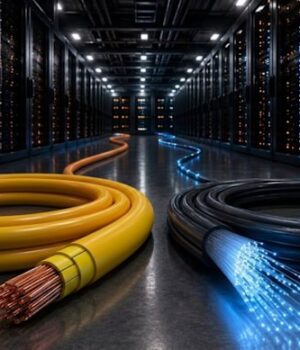
This quantum leap suggests a copper demand up to ten times greater than legacy infrastructure and all these networks remain heavily dependent on the metal. In many respects, fibre optics and copper are becoming less like rivals and more like partners: one excels at moving information, while the other excels at moving energy.
Artificial intelligence may at first appear to accelerate the separation of those roles, but it does not eliminate the need for either. Indeed, the irony is that some of the technologies most often portrayed as threats to copper could become powerful drivers of future copper demand.
Bloomberg Intelligence has also estimated AI-related data-centre expansion could lift global copper consumption by as much as 2 million tonnes by 2030, a reminder that even the most digital parts of the economy remain tied to physical electrical infrastructure.
AI systems may eventually communicate through increasingly sophisticated optical networks, yet the energy required to run those systems still has to be generated, transmitted, and delivered. History suggests technological revolutions rarely eliminate foundational materials; more often they redefine their purpose. Artificial intelligence appears to be doing exactly that.
The future may see more information carried by photons and less by electrons. Fibre-optic technologies, photonic computing, and advanced communications networks are likely to become increasingly important components of the digital economy. But as the world becomes more electrified, copper’s role as one of the most effective and widely used conductors of electricity appears no less secure.
The International Energy Agency’s longer-term outlook points in the same direction, projecting global copper demand to rise to about 34 million tonnes by 2040 from about 26.7 million tonnes in 2024 as electrification, grid expansion, and clean-energy infrastructure continue to build.
If anything, the AI revolution highlights a reality which has always existed. Data and energy are entirely different problems and while fibre may increasingly carry the data, copper will still be carrying the power.
Is your ASX-listed company doing something interesting? Contact: mattbirney@bullsnbears.com.au


