Source : PERTHNOW NEWS
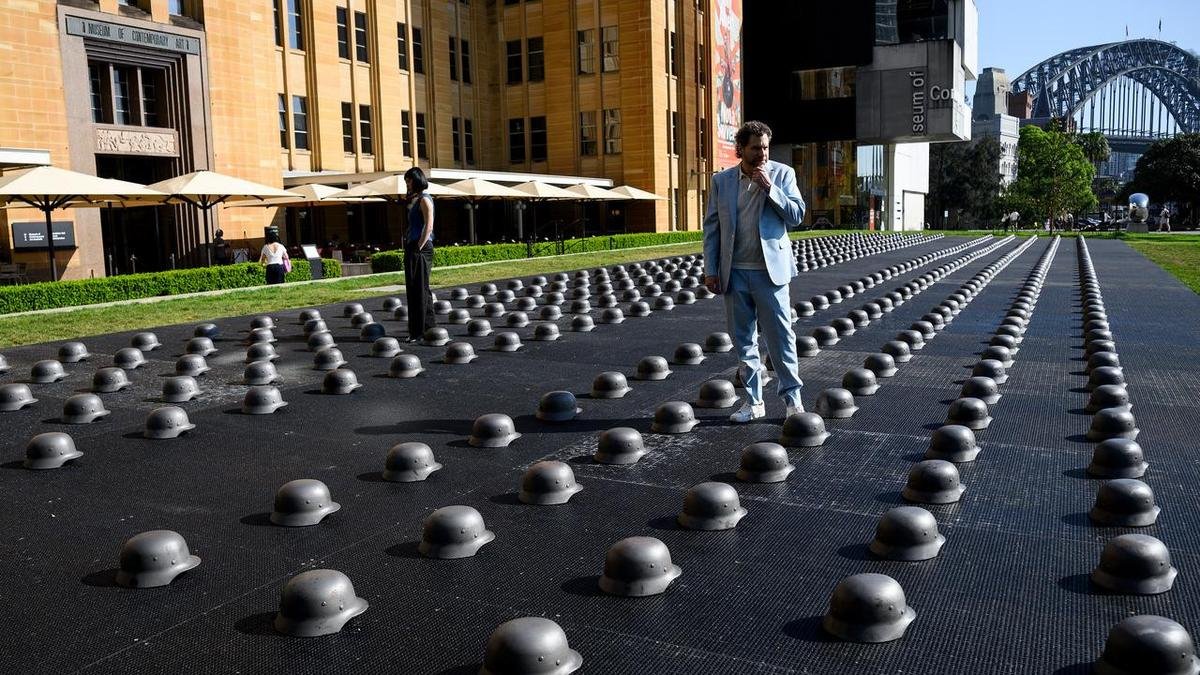
Spanning 40-metres in length, exiled Chinese artist Ai Weiwei has sculpted 500 cast iron combat helmets that shimmer in the sun overlooking Sydney Harbour.
The expansive public installation, Mushrooms, at the Museum of Contemporary Art is a meditation on war and how millions of victims are killed and displaced in intractable conflicts.
Arranged in ten uniform rows on a raised mesh platform, the work was inspired by the widely lampooned gesture of Germany donating of 5000 helmets to Ukraine in 2022 when Russia invaded.
Despite the internationally renowned artist not attending the opening, he reflected on how wars have shaped the modern era.
“In the era we live in, the 21st century, wars have not ceased,” he said.
“We continue to exist in a time where war and peace interchangeably assume each other’s roles, shaping the identity of our age.”
The museum’s director Suzanne Cotter hoped the public would reflect on the epic artwork sprawled across the lawn by walking through it and examining its striking qualities and scale.
“The helmet directly allude to the human skulls so it’s about physical fragility but it’s also about the fragility of peace and the fragility of stability,” she told AAP.
“It’s intended to move people to stop and think because here in Australia we’re a fortunate country because of our distance to war but they also impact all of us even if they happen elsewhere in the world.”
The outdoor art work will be on display for the next seven months.
Capitalising on the public facing installation of the work, the museum has also created an engagement program inviting people to record video messages called Say Your Peace.
Funded by the Balnaves Foundation, the installation is the second in a three-year series commissioning artists to create large-scale artworks on the waterfront lawn.
“Bringing art out into the public realm, out of the gallery where it intersects with people’s daily lives … makes it so special,” the foundation’s head Hamish Balnaves said.
“It’s a timely work and timeless work unfortunately, because war has always been with us so this transcends our current times.”