

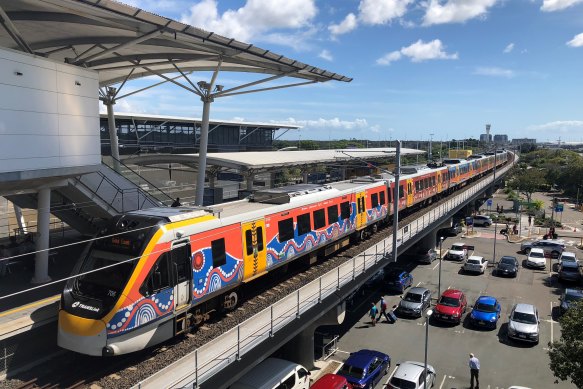
source : the age
The Queensland government could acquire Brisbane’s privately operated Airtrain for $45 million, the state’s lone Greens MP says, based on analysis drawing on the asset’s reported financial value.
The proposal centres on financial statements from USS Axle, a subsidiary of UK-based pension fund Universities Superannuation Scheme that acquired the Airtrain in 2013.
The statements, lodged with the Australian Securities and Investments Commission, suggest the value of the Airtrain concession has been steadily declining by about $5 million annually and may have already fallen to about $45 million.
Maiwar MP Michael Berkman said that created an opportunity for the state to negotiate a relatively low-cost buyback. But, should negotiations prove fruitless, Berkman said the government should force the issue with drastic intervention.
“If that means legislating to extinguish the contract, the government can and should do it,” he said.
“If we paid the owners a fair price of $45 million, which is what their own financial reports say it’s worth, it would be the cheapest and quickest public transport project in Queensland’s history.”
A spokesman for Queensland Transport Minister Brent Mickelberg said the government was committed to the current arrangement.
Under that arrangement, Airtrain has exclusive rights under a 35-year contract with the state government that started in 2001. At the end of the contract in 2036, the asset would be returned to the state.
The agreement prohibits any other form of airport public transport. It also allows higher fares – a one-way trip from Central to the airport on Airtrain currently costs $22.30 – instead of the 50¢ fares charged elsewhere on the rail network.
Critics have long argued the deal limited fare integration and discouraged airport passengers from using public transport.
According to the figures submitted to ASIC, Airtrain’s value declined from a little more than $100 million in 2013-14 to about $50 million in 2024-25, reflecting annual amortisation over the life of the contract.
Based on that pattern, the valuation could drop to about $45 million in 2026.
Berkman said that was a reasonable benchmark for any buyback negotiations, but this masthead understands Airtrain has previously demanded several times that amount to exit the contract early, with the end of the concession period still almost a decade away.
But Airtrain chief executive Chris Basche said the declining asset value did not tell the whole story.
“The statutory balance sheet is backward-looking, based on historical cost amortised under applicable accounting standards,” he said.
“It does not reflect the economic value of the Airtrain concession.”
Basche said Airtrain would not comment any further on its statutory accounts or discussions with the state government.
In the most recent financial statement filed with ASIC, USS Axle director Timothy Heaton’s language suggested the company was in no mood to sell.
“The directors … believe that the state government’s substantial capital investment program to expand and improve the SEQ rail network over the next decade towards the 2032 Olympics and the terminal expansion plans at Brisbane Airport are beneficial to the group’s mid- and longer-term prospects due to the strategic importance of the [Brisbane Airport Rail Link] as part of the public transport network,” he wrote.
The decade’s worth of financial statements shows variation in Airtrain’s value, including a temporary increase in 2021-22 attributed to a reversal of a previous impairment.
Still, Berkman said the overall trend was clear enough to guide policy decisions.
“By ending the private contract we could also get to work building a new station at DFO, and boost frequency from 30 minutes to every 15 minutes,” he said.
However, the financial filings revealed a hidden multi-million dollar roadblock to the Greens’ proposal.
USS Axle had nearly $50 million in internal debt and unpaid dividends owed to its parent company. Any government move to force a buyout or cancel the contract could first require legally untangling and clearing this separate corporate debt.
“The Airtrain’s corporate owners might try to argue that taxpayers should cover their debts too, but we think the government should stand its ground and pay what the asset’s worth on the books,” Berkman said.
“It seems pretty likely that Airtrain has set up these complex financial arrangements to dodge tax, and they shouldn’t be allowed to rip taxpayers off even more.”
Asked if he was concerned about the potential reputational risk to Queensland of breaking the contract, Berkman said it was a bad deal that should never have been made.
“Exceptionally bad deals call for exceptional measures,” he said.
“Ditching the Airtrain contract sends exactly the right message: that we won’t let corporations hold Queenslanders to ransom any more.
“Companies looking to invest in Queensland should have absolute certainty that we won’t tolerate such a raw deal.”
Start the day with a summary of the day’s most important and interesting stories, analysis and insights. Sign up for our Morning Edition newsletter.


