Source : the age
Anthony Albanese has left the door open to an opt-out copyright regime for artificial intelligence companies, despite warnings from Australian writers, artists and other creators that such a system would undermine fundamental copyright protections.
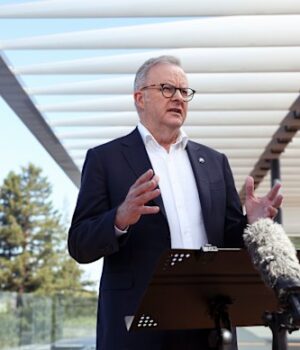
The prime minister raised the need for international rules governing AI during a visit to California, where he met Apple executive chair Tim Cook and the company’s executive team.
Australia will join fellow middle powers at the United Nations this week amid an attempt to shape the global response to AI amid growing debate over whether the technology is developing faster than efforts to control its risks. The race is being played out largely between the United States and China, as Washington and Beijing compete for technological and strategic advantage.
Asked whether there was a danger in handing too much power to tech companies, given warnings about the risks posed by increasingly powerful AI systems, Albanese said he accepted there were risks.
“I certainly accept that there are risks, and that’s why we need to mitigate. That’s why we need to act, and that is something that’s recognised by the companies themselves.”
He said the international debate was already under way among leaders preparing to attend the UN General Assembly in New York.
“What is being discussed this week, and has already been the subject of interaction between leaders who’ll be attending the UN this week, is what’s the international framework as well to take advantage of the benefits but also to mitigate the risks,” Albanese said.
Spruiking Australia’s pioneering social media ban for under 16s, Albanese met with Apple executives behind closed doors for an hour at Apple Park in Cupertino, California. Media were briefly allowed on site for a product demonstration, including the new foldable Duo phone, but were not allowed to film or take any photos of the meeting, buildings or any Apple employees.
US President Donald Trump said on Saturday (US time) he was forming an “AI force,” as many, including those from within the industry, have recently sounded the alarm about the dangers of Artificial Intelligence continuing to grow unchecked.
“We are leading China, and the rest of the World, and I intend to keep it that way!” Trump wrote.
On copyright, Albanese did not rule out the Australian government considering an opt-out system for copyright material used to train AI models.
Instead, he stressed the need for Australia to regulate AI and said legislation establishing Australian AI standards would be introduced before the end of the year.
“Part of that will be protecting intellectual property,” Albanese said. “[The debate] shows the need to regulate and the need as well to acknowledge that sitting on the sideline is not an option because this is a global phenomenon that we are having.”
The federal government is considering how to attract major AI companies, including OpenAI and Anthropic, to establish or expand operations in Australia.
The ABC last week reported that AI companies would be allowed to train their models on online content without paying creators as long as they struck deals with enough rights holders, under one plan put forward.
Under Australia’s existing copyright regime, the owner of copyright in a piece of writing, photograph or other creative work generally has the right to control how it is reproduced and commercially exploited.
Creators and rights holders have warned that an opt-out model would reverse that principle by allowing AI companies to use copyright material unless individual creators took steps to prevent it. They argue the burden should instead fall on AI companies to seek permission before using protected works to train their models.
Booker Prize-winning Australian author Richard Flanagan argued last week in this masthead that copyright was the foundation of Australia’s creative industries rather than an impediment to AI development.
“No artist I know is happy to see destroyed a system that has developed over centuries to enable them to work,” Flanagan wrote. “Copyright law is not a block or a problem – it is the foundation of all the creative industries.”
Albanese said there were three components to dealing with AI: safeguards imposed by technology companies, national regulation and an international framework.
“One is companies themselves making sure that they have proper safety protocols in place,” he said.
“Secondly, is nation states and their capacity to have AI standards, and we’ve said we’ll have legislation before the end of the year on Australian AI standards. Part of that will be protecting intellectual property.”
Cut through the noise of federal politics with news, views and expert analysis. Subscribers can sign up to our weekly Inside Politics newsletter.
 Rob Harris is the national correspondent for The Sydney Morning Herald and The Age based in Canberra. He is a former Europe correspondent.Connect via email.