

SOURCE :- THE AGE NEWS
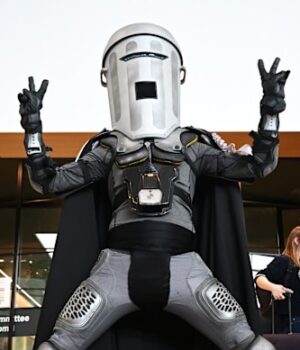
Clacton-on-Sea: The laughs came easily one month ago when British politician Nigel Farage dared his opponents to take him on at a byelection, only to discover that his main challenger would be a man who wears a garbage can on his head.
The prospect of the Reform UK leader being humiliated by Count Binface, a candidate with an eye for black capes and silver headgear, generated global headlines for the way it brought classic farce to British politics.
But the joke is wearing thin in Clacton, the electorate where voters will cast their ballots this Thursday (London time). On the streets of Clacton-on-Sea, the beachside town at the heart of the constituency, it is hard to find any enthusiasm for the alien candidate who claims to be a warrior from the planet Sigma IX.
“I don’t think anything about people like that,” says Jean Strain, 87, a retired office worker.
“I think politics and our vote is important, and we should be careful and serious. It’s not some joke.”
Binface has a queue of admirers in London media circles because he has enlivened an otherwise bland byelection during a northern summer lull, with Prime Minister Andy Burnham on holiday and nothing much happening.
The count’s interviews with the BBC, Sky News, The Times, The Guardian and other media outlets have turned him into a momentary darling for progressive voters who want someone to stand up to Farage.
On Station Road near the Clacton Pier, however, some local voters are barely aware that Binface – his family name on the ballot paper – is running.
“I haven’t seen that,” says Jack Wright, 85, a former civil engineer. “No, I haven’t noticed.”
There are placards for Reform UK in the front yards of nearby homes. “I’m with Nigel,” says a poster in several windows. Volunteers for Reform UK walk the streets, knocking on doors and talking to voters. When a bus covered in the Reform UK logo drives past a pub, some of the drinkers cheer.
Wright, one of many retirees in this community, has met Farage and found him to be “quite reasonable”. He expects to vote for him.
“I find there’s no problem with him,” he says.
Critics regard Farage as a dangerous populist because he wants to mobilise the Royal Navy against asylum seeker boats in the English Channel, borrowing the hard-line Australian policy that began when Tony Abbott became prime minister in 2013.
Even so, a policy to cut migration is not an extremist view in Britain today. Polls show it has 70 per cent support.
“I agree that we should stop all these people coming over,” Wright says.
“I know they come over and most of them go and work. But we do support them. We find accommodation for them and things like that, which obviously costs us money.
“And I think there are just too many coming across here.”
This is a corner of Britain where tradition still rules. About 94 per cent of the population is white British, compared to 76 per cent across England and Wales, according to the National Centre for Social Research.
The median age is 58, which is 10 years older than the national median. Only 19 per cent have a university degree, compared to 35 per cent across the country.
Poverty is serious, however, just south of the Clacton Pier and its ageing amusement arcades, Ferris wheel and roller coaster. In this electorate, 65 per cent of households are deprived, compared to 52 per cent across England and Wales.
In other times, this might set up a traditional fight between left and right over economic and social policy, but Labour and the Conservative Party are not running candidates. Farage has called them “cowards” for staying out of the race.
So, the core choice for voters on Thursday is either Farage or the count. It is Man versus Bin. While there are 34 candidates on the ballot paper, all eyes are on the two main contenders.
Simone Wells, 37, a local cafe worker, does not hesitate when asked who she would choose.
“Binface,” she says. “Because I don’t like Farage. It’s just him as a person, and his views.” Does she mean his views about migration? “Yeah.”
There is no secret about the man behind the tin can. Binface is the creation of Jonathan Harvey, 46, a man from south London who has written scripts for satires and comedies including The Thick of It and Have I Got News for You.
While his character delivers British comedy when British politics is so grim, developing the routine appears to have been a challenge during the Clacton campaign. There have been no memorable gags in interviews over the past month. The laughs are all in the costume.
Voters did not warm to Binface when he ran against Burnham in the Makerfield byelection in May, giving him just 95 votes. He is likely to do better in Clacton because voters who dislike Farage cannot back a candidate from the Conservatives, Labour, Greens or Liberal Democrats.
Nationally, voters rally to Binface. An Ipsos survey of 1000 UK adults found 33 per cent said they would vote for the count, compared to 21 per cent who preferred the Reform UK leader.
Locally, voters favour Farage. A Survation poll of 502 Clacton voters last month found 73 per cent would choose Farage and only 20 per cent would back Binface.
When the votes are counted at 10pm this Thursday (polling stations close late in Britain), the alien space warrior is unlikely to trouble the right-wing populist warrior.
The problems for Farage lie elsewhere.
He faces two parliamentary inquiries into financial support he has received from wealthy donors: first, investor Christopher Harborne, who gave him £5 million ($9.7 million); second, crypto millionaire George Cottrell, an aristocrat known as “Posh George” and a long-time supporter of Reform.
Farage seemed to think that forcing this byelection, by quitting parliament last month and recontesting his own seat, would stop those inquiries. In fact, the probes will resume when, as is likely, he returns to parliament.
And that is why many voters in Clacton do not want to bother with this contest.
“I don’t think we should be having this election,” says Strain, the retired office worker. “So I’m not going to vote.”
Her views on Farage are nuanced.
“I don’t dislike him,” she says. “I just wonder how much he is in it for him rather than the rest of us.”
When the next general election comes, Strain will cast her vote on who is best to lead a government, and she is unlikely to choose Farage. At the moment, she favours Conservative leader Kemi Badenoch.
Only 58.7 per cent of Clacton voters turned out to cast their ballots at the general election two years ago. The other 41.3 per cent chose “none of the above” by staying home.
In a sense, Farage and Binface have a shared challenge: making thousands of Clacton residents care enough to turn up to the polling stations.
“I feel quite strongly about it normally because of what women did to get us women the vote,” says Strain. “But this one, I just think, is a bit of a joke. It’s play-acting.”
Get a note directly from our foreign correspondents on what’s making headlines around the world. Sign up for our weekly What in the World newsletter.
 David Crowe is Europe correspondent for The Sydney Morning Herald and The Age.Connect via X or email.

