
Source : the age
Victoria’s peak integrity agency could be given greater powers and a broader jurisdiction to investigate corruption on Big Build construction sites and throughout the public sector, after an about-face from the Allan government on IBAC reform.
But this parliament will not consider any of the proposed changes, which Premier Jacinta Allan said would be introduced well after the November state election.
The announcement on Monday received a mixed response: integrity experts welcomed the prospect of long-awaited improvements to the state’s anti-corruption framework, the Greens expressed scepticism about the government’s commitment to reform, and the opposition described the delayed timeframe as a sham.
The about-face came as the premier disputed the claim that corruption on major project sites exposed by this masthead had cost taxpayers $15 billion but refused to put a price on criminal infiltration of the government’s Big Build program.
The $15 billion estimate was provided by Geoffrey Watson, SC, the author of a damning report into the CFMEU commissioned by the union’s administrator. The estimate was backed separately by the Fair Work Commission’s Murray Furlong.
Under a reform blueprint endorsed by cabinet, the Independent Broad-based Anti-corruption Commission would be given follow-the-dollar powers similar to those currently available to the Auditor-General, a broader definition of corrupt conduct to make it easier to launch investigations, and greater scope to hold public hearings.
The finer details will be developed by a panel of integrity experts including representatives from IBAC, the Ombudsman, Integrity Oversight Victoria and Victoria Police. They have been given a reporting date of May 2027, with the resultant changes to be legislated by the end of next year.
Allan’s recognition of the need for IBAC to have follow-the-dollar powers to trace the misuse of public funds on major infrastructure sites follows almost two years of damaging revelations in this masthead’s Building Bad investigative series.
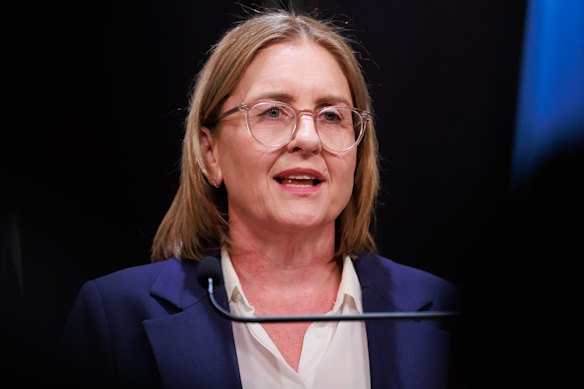
The premier, who has previously been reluctant to give the state’s anti-corruption watchdog sharper investigative teeth, described the proposed changes as “the most far-reaching overhaul” of the agency’s powers since it was established in 2012.
“Victoria’s anti-corruption framework must be transparent, and it must be fit for purpose,” she said. “I am no longer satisfied that IBAC has the powers it needs to do its job in full.”
Key proposed changes to IBAC powers and operations
- Follow the money powers: This will allow IBAC to pursue the spending of public money through private and third-party contractors.
- Broader scope: Widen the definition of corrupt conduct, including potentially, “serious disciplinary offences, conduct worthy of termination, or behaviour that constitutes a serious breach of public trust”.
- Increased transparency: Empowering IBAC to make and publish formal findings of corrupt conduct and allowing it to table recommendations in parliament not just as part of a formal report.
- Digital searches: Changes to ensure IBAC’s investigations are not impeded by virtue of information or data being held on an off-site computer or in the cloud.
- Document destruction offence: A new offence would be created making it a criminal act to destroy or conceal documents or materials that are, or are likely to be, required in connection with an IBAC preliminary inquiry or investigation
The proposed changes were announced as part of the government’s response to a December 2025 report by parliament’s integrity and oversight committee on IBAC’s powers. The government supported 21 of the committee’s 31 recommendations.
The Greens earlier this year introduced proposed legislation that would give IBAC access to follow-the-dollar powers, greater use of public hearings and a more workable definition of corrupt conduct. The government has refused to bring on that bill for debate.
The more significant change to IBAC’s powers within the government’s proposed reforms is to the working definition of corrupt conduct. Since its inception under the Baillieu government, IBAC has been able to investigate matters only where it suspects on reasonable grounds that a crime has been committed.
Integrity experts, including IBAC’s inaugural commissioner, Stephen O’Bryan, his successor Robert Redlich and current Commissioner Victoria Elliott, have argued this is a foundational flaw which requires IBAC to have evidence of criminal-level corruption before it can lawfully start looking for it.
Centre for Public Integrity board member Margaret White welcomed the move on Monday to expand IBAC’s jurisdiction.
“The previous narrow definition considerably weakened IBAC’s ability to [investigate],” she said. “Expanding the definition now allows it to investigate serious, systemic and non-criminal misconduct that other integrity bodies can examine.”
Transparency International Australia chief executive Clancy Moore said the proposed broader definition of corrupt conduct would give IBAC more scope to uncover favouritism, undue influence and other non-criminal conduct that undermines trust in public institutions.
He warned that a royal commission into the allegations uncovered by this masthead was still required to clean up the construction industry.
“For too long, corrupt union officials, organised crime gangs and shonky contractors have infiltrated Victoria’s construction sector, including the $100 billion Big Build program,” he said.
“Premier Allan’s response to the IOC report is welcome, but a royal commission or similar commission of inquiry into corruption in Victoria’s construction sector is still needed.”
Greens MP Tim Read, who chaired the integrity and oversight committee that reported on the IBAC Act, warned that the government’s public statements about changing the definition of corrupt conduct contained “weasel words” which raised questions about its commitment to meaningful reform.
In its formal response to the committee, the government said it supported the intent of the recommendation and would “consider legislative options to broader the definition”.
“They have made no commitment to do anything except consider it,” Read said. “They like the vibe of it and will think about it.”
Read said that unless IBAC’s definition of corrupt conduct was brought into line with that used by the Independent Commission Against Corruption in NSW, more wrongdoing would be tolerated in Victoria.
“You are able to get away with stuff in Victoria that you can’t get away with in NSW or under the federal jurisdiction,” he said.
The Coalition, which has committed to giving IBAC follow-the-dollar powers and establishing a royal commission into Big Build corruption, dismissed Allan’s announcement as damage control.
“The premier has confirmed the desperately needed reforms to Victoria’s anti-corruption watchdog will not be legislated for at least 18 months, meaning Victorians will go to the election without stronger anti-corruption laws and without proper accountability for the scandal that continues to unfold under the premier’s watch,” Opposition Leader Jess Wilson said on Monday.
“If these powers are needed, they should start now.”
In making the case for IBAC’s legislative framework to be overhauled and strengthened, parliament’s integrity and oversight committee relied on the testimony of current and former IBAC commissioners and integrity experts.
Included in its recommendations were proposals to give IBAC more scope to conduct public hearings beyond an “exceptional circumstances” provision contained in the IBAC Act. This includes permitting IBAC to hold public hearings for “educative and preventative” purposes.
IBAC has rarely held public hearings, even in matters of high public interest. An example of this was its decision to question then-premier Daniel Andrews behind closed doors in relation to four separate anti-corruption investigations in December 2021.
This is in stark contrast to ICAC, the peak anti-corruption agency in NSW. Former NSW premier Barry O’Farrell famously resigned after inadvertently misleading ICAC during a public hearing about a donated bottle of wine, and Gladys Berejiklian resigned as premier before she was publicly examined.
The federal National Anti-Corruption Commission has the same “exceptional circumstances” provision as Victoria’s IBAC. All of its examinations have been conducted in private since the agency was established in July 2023.
Allan said IBAC’s decision not to question Andrews in public was a matter for the agency.
In its formal response to the committee, the government said “careful consideration” would be given to expanding the use of public hearings while safeguarding the welfare of witnesses.
Start the day with a summary of the day’s most important and interesting stories, analysis and insights. Sign up for our Morning Edition newsletter.
 Chip Le Grand leads our state politics reporting team. He previously served as the paper’s chief reporter and is a journalist of 30 years’ experience.Connect via email.