source : the age
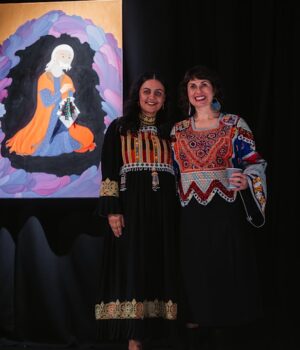
Kat Rae, 45, served in Afghanistan, as did her husband, who died by suicide in 2017. Mursal Azizi, 33, came to Australia as an Afghan refugee. The pair, both artists, have found a deep comfort in their friendship.
Kat: In February, 2025, a friend introduced me to Mursal. We met at a cafe in North Fitzroy and connected straight away – as artists and as people with a connection to her homeland. She’d fled Kabul after the Taliban came to power in 2021. I was in the Australian Army for 20 years and had done two tours there. I wondered if Afghans would be mad at me, feel that we’d let them down, but Mursal was just grateful. The Afghans I’ve met understand loss and know we feel it, too.
Mursal told me she felt lonely. It was painful for me to hear that. As a widow, I knew that feeling. She wanted to find a way to help the women over there. I love people with a mission and art that makes a statement, and hate the collateral damage of war, so we started working together. Sparks in the Dark [showing now at Melbourne’s Shrine of Remembrance] features 260 handkerchiefs embroidered by women living in Afghanistan, one for each week since the Taliban took Kabul.
At its opening, I recited the words, “They shall not grow old as we that are left grow old” [from For The Fallen, by Laurence Binyon], which we’ve been reading every Anzac Day for generations but, this time, the people weren’t silent: Afghans were crying, their grief raw. Mursal gave me a hug and asked where I’d found those words; she said they were perfect.
There’s an Afghan word, hamdard, which means shared grief, a shoulder-to-shoulder connectedness. Australians aren’t very good at expressing grief. They’re more like, “How can we get you back on your feet?” But there’s something beautiful about expressing grief together and trying to do some good with it.
Seeing how the war affected my husband, losing him, cracking open with grief … you can’t help but be empathetic to people going through something, too. As a sole parent in Melbourne, I find I connect more with offbeat families – migrant families, widowed families or those impacted by domestic violence. And I always connected with the depth and warmth of the Afghan people. I missed their openness when I came back to Australia.
Mursal is kind and generous. She invited me round for lunch one day and it was a huge banquet; she’d been slaving away in her little kitchen – I should have blocked out the whole afternoon. There’s this spiced milk pudding called firni that I first tried in Kabul. She knew I loved it and surprised me by cooking it for me. I cried: I was moved that she’d made it for the first time. There’s vulnerability there, no one guiding her by saying, “Oh, next time, do it like this and, by the way, our family always adds a bit of salt.” Making it for me is part of her fight to hang on to something that should be her birthright.
I’m glad and proud I can be one of Mursal’s first Melbourne friends. I love seeing her flourish as an artist and a mother. I’m also grateful that my daughter and partner get to know her and her family. I can say to them, “How cool are these people? How amazing is their food? How important are their art and their stories?”
Mursal: I was lonely when I was introduced to Kat. She had been twice in Afghanistan and is an artist, too, which made it comfortable for me to talk to her. As a newcomer to Australia, I feel the differences between myself and people here. They savour and enjoy life, think about entertainment; we think about survival, our challenges, how we can mitigate risks.
With Kat, I felt understood: I knew she would understand what I say and who I am. She told me her husband had been in Afghanistan, too, and that he suicided on August 16 [nine years ago]. Kabul fell on August 15, four years later. The closeness of the dates was overwhelming for her. She created art about it. I understood that feeling as an artist – the need to get a message out, to get feelings out.
I was working with female embroiderers in Afghanistan and had some samples of their work. I wanted to exhibit them in Australia. I showed Kat, I told her I wanted to do something to help them and she said, “I can help you, if you want. We can do this project together.” I agreed. The next day, she called me and we went to meet her mentor, talk about our project, apply for grants. If I’d been doing it by myself, maybe it would have happened, but it became very real, very quickly with Kat.
The kind of deep friendship we have, people usually develop over years. But it happened fast, with an intense and big connection as we worked on the exhibition. I’m a person of ideas: Kat made it real. The Australian system is new to me; she understands how to take it forward. She even invited the Governor-General to the opening. We complete each other, in a way.
I was pregnant with my first child, my daughter, Sarah, as we worked on the exhibition. Kat drove me places, found me a midwife to talk to, made me fresh food – broccoli with cheese, which was something new for me. One day, she was driving me home and I told her I was afraid about my baby coming, that I would be a full-time mum and wouldn’t be able to do my art. Kat told me she thinks her daughter, Imogen, is proud that she became an artist rather than losing herself in motherhood. That is always in my ears and on my mind. Sarah is nine months old now; I feel she needs a mother who follows her dreams.
One day, when I was pregnant, we went to an Afghan restaurant in Lygon Street. Five of us: my husband, Asad, Kat’s partner, Mark, and Imogen. Being together as families, I felt closer to Kat; it was real. Kat likes the kebabs we do, with the meat and the fat together on a skewer. It was one of her favourite foods in Afghanistan and she tried the same thing here. It made me happy. When your food is appreciated, it feels like your country is appreciated, too. More than the food, what mattered was that we were there as families.
We talked about Afghanistan, the situation of the women and how they live. The country has a rich culture. It’s historical, with so much beauty that people don’t hear about because of the politics and the war. Kat knows the beauty of Afghanistan, too, and that means she can know me.
Lifeline: 13 11 14
Read more from Good Weekend magazine:
Get the best of Good Weekend delivered to your inbox every Saturday morning. Sign up for our newsletter.