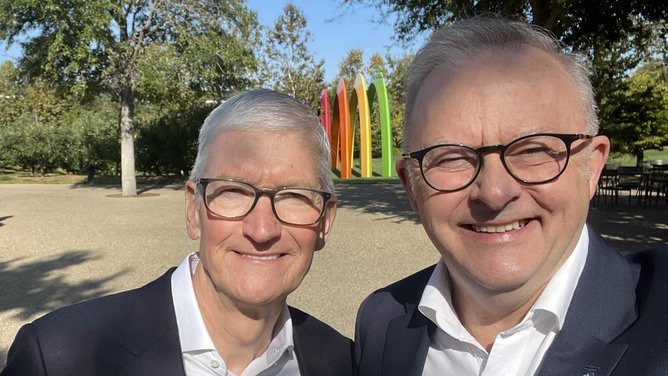
Source : Perth Now news
Anthony Albanese will discuss “international protocols” around artificial intelligence as tech leaders call for a global slowdown, conceding there is a risk humans could lose control of the technology.
Mr Albanese was at Apple HQ in California on Sunday for a meeting with chairman Tim Cook.
He will travel on to New York next week for a meeting at the United Nations General Assembly where he will spruik the government’s action to reduce online harm, including the under-16s social media ban and the forthcoming Digital Duty of Care.
Speaking to the ABC on AI, Mr Albanese said there were three issues: whether companies were putting their own safeguards in place, nation states needing to act and engage with AI, and what are the “international protocols” around the use of AI.
“There are differences of opinion about that,” he said.
“But I’m looking forward to engaging with leaders this week about what form that might take and what role Australia will play in that.”
However, when pressed on whether he believed AI posed an existential threat following a warning from a former Anthropic researcher who said there was a 1/10 “extinction risk” from AI within the next decade, he played down the rising fears.
“Well, it’s a very big deal. I certainly see that,” he said.
Pressed on whether AI was a threat, Mr Albanese continued: “Well, it is indeed, but potentially because the risk is that AI develops in a way in which humans are no longer in control of what AI is producing.”
The Albanese government is currently consulting on its first-ever national standard for AI.
US ‘ahead’ on AI
US President Donald Trump has fiercely resisted calls for a slowdown in the development of AI, citing competition with China.
Grilled on Australia’s US ally, Mr Albanese said he hoped Mr Trump’s forthcoming meeting with Chinese President Xi Jinping would result in “progress”.
“Because the truth is they’re the big two giants,” he said.
“So, we want to see co-operation.
“We’ve seen that in the past with new technologies, even on nuclear weapons, for example.
“We also, I think, (as) middle powers such as Australia, have a role to play here as well.”
Mr Albanese said he thought Mr Trump “knows that, at the moment, the US is essential ahead of China when it comes to the race that is on”.
“He does applaud the development of this new technology, but it is in the world’s interest that there be engagement,” he said.
Mr Albanese denied there was a contradiction in Mr Trump putting his country first when it comes to the advancement of AI, rather than “humanity”.
“President Trump, of course, will act in the interests of the United States,” he said.
“But there’s also a need for all of us to act in the interests of humanity.

“ … It is certainly in the United States’ interest for there to be that recognition of human interests, and President Trump, I’m sure, understands that,” he said.
Mr Albanese said Australia should be “engaged” with US companies on frontier models, but would not commit to the government developing its own.
Copyright issue
Mr Albanese reaffirmed the government’s commitment to giving artists control over how their data could be scraped to train AI amid reports giants OpenAI and Anthropic were seeking to strongarm the government into softening its stance.
“We think that the protection of the creative sector is very important, and we’re engaged constructively,” he said.
Asked whether maintaining control meant any watering down of copyright law, Mr Albanese said: “What it means is control and monetisation of it.
“This is a global phenomenon. So we have a national interest in leaning in here and being proactive. And that’s precisely what we’re doing.”
Asked whether artists might have to opt-out of having their material scrapped, Mr Albanese said: ”Well, that’s a very clear position that they will have control over their intellectual property”
Leading Australia artists, musicians, and publishers have raised alarm bells about copyright abuses by AI.