Source : the age
It goes without saying that most Australians spent more time in the past week mourning country icon Dolly Parton, and debating the motives behind the return of the marital pair known as “the Sussexes” to the United Kingdom, than they spent worrying about the speeches given at the Business Council of Australia’s annual gala dinner. Fair play.
I know which is more interesting. Business and political types should probably also spend less time contemplating their own glorious leadership and more time doom-scrolling. It’s in our modern fairytales that the values which animate us are revealed.
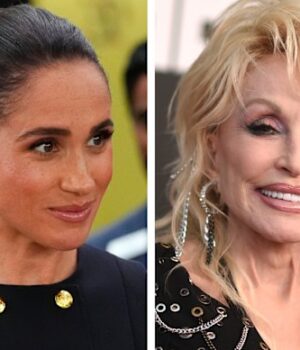
Dolly Parton’s folksy tunes and gigawatts of rhinestone cladding weren’t everyone’s thing; but with or without them, Parton had a certain something that drew people to her and caused them to love her. Meghan, the Duchess of Sussex, on the other hand, who married the now former Prince Harry (also now formerly popular), has a knack for attracting widespread ire. Antipathy towards Meghan is so strong that an acting role she was to take up in the UK has reportedly been withdrawn following intense public backlash.
Meghan has advanced many reasons as to why she is so disliked. Naturally, none that would implicate her. She’s a victim of racism or there’s a social prejudice against ambitious women. It’s the British tabloids, who see in her a new Princess Diana and must draw blood. So many theories, all self-serving.
Parton offered very few ideas as to why she was so loved. But there’s one thing she said of herself that seems to sum it up – “I may look like a show pony, but I’m a workhorse”. Her work ethic was famous. She didn’t believe the world was obliged to adore her, or owed her a living. She put her shoulder to the rhinestone and produced a great gift to the world.
Modern fairytales aren’t so different to the old ones. I am reminded of the stories I consumed avidly as a child – the Grimm ones, in which stepsisters slice off their toes to fit into a shoe (and are outed by birds), stepmothers cook their stepchildren into a stew (and are accused by birds – there’s a theme here), and Death loses patience with his godson cheating him.
They are cautionary tales, which inform people how their actions will be received by others. They express an enduring truth about what we value in other people – what we consider good and admirable, and what contemptible and deficient – that is deeply ingrained in our psyche.
For all the ways Meghan has tried to tell her own tale, her fairytale archetype emerged despite it. As did Parton’s. The public response repeated the lessons of Aschenputtel – the unsweetened version of Cinderella – and Mother Holle. We admire hard work and scorn laziness. We value contribution and dislike entitlement. We admire the horse in George Orwell’s Animal Farm, not the pigs who lead the revolution only to put themselves in the master’s place.
Meghan wants to be a star, but she mistook the golden cage of monarchy for a stage. While superficially spoilt, the royals are really a combination of zoo animal and corporate drudge. I suppose it is some consolation to live in a palace, though you couldn’t offer me enough peacocks and ponies to make it worth the price. It is the dreariest of jobs which requires long hours at events you don’t get to choose, among people to whom you are obligated, within a fixed-role description you don’t get to negotiate, in the service of political and social stability.
The best, like the late Queen, fill royal duty with grace and make it seem light. The worst, like the former Prince Andrew, chafe and sulk that the entitlement is no longer a carte blanche to party like King Henry VIII. Meghan got the gig, but didn’t fancy the slog. She is said to have been shocked that she didn’t get paid for her royal appearances – a stipend that would have come on top of the royal perks and privileges.
Dolly Parton picked the usable parts of her life out of the ashes. She had a literal log-cabin childhood. But that’s not what made her a fairytale princess to Meghan’s stepsister. It was that she never forgot that her talent didn’t make her uniquely special. She never took her fans for granted. She created value in the world in small ways and in big ones, through personal kindnesses and philanthropy that focused on doing real good rather than boosting her own ego through moral preening.
There are many lessons in that for big businesses, which have had a touch of the Meghans over recent years. Some forgot they are there to add value to customers’ lives, not obsess over values more broadly, or – worse still – to preach them. And there are lessons for the government, as it fosters a culture of entitlement under the guise of fairness. Punishing contribution and rewarding entitlement inverts our sense of natural justice. We still live – consciously or otherwise – according to the principle of reciprocity. People (and businesses) the state renders dependent are impoverished in ways that economic transfers can’t make up for.
At the BCA dinner on Tuesday night, the business people and politicians tried to get through to one another on what a good economy and society looks like. If only they’d paid a little more attention to what was happening outside the room, they’d know that we the people have instinctively already decided.
The government might think we’ve escaped from the diligent and parsimonious values of our obviously less enlightened ancestors, but they’re sneaking back in through the trapdoor of our consciousness, disguised as popular culture.
If business groups think they’re losing the political stoush to a government that’s traded growing the economy for buying votes by handing out goodies, they could do worse than tap into popular culture to lead the discussion.
As the Grimms knew, there’s never a “happily ever after” because travails pass down through the generations. A fairytale ending is one you keep fighting for. But the best arguments are the ones we already believe in. It’s up to every one of us whether we want to be Meghan or Dolly.
Parnell Palme McGuinness is an insights and advocacy strategist. She has done work for the Liberal Party and the German Greens and is a senior fellow at the Centre for Independent Studies. She is also an advisory board member of Australians For Prosperity, which is part-funded by the coal industry.
 Parnell Palme McGuinness is an insights and advocacy strategist. She has done work for the Liberal Party and the German Greens and is a senior fellow at the Centre for Independent Studies. She is also an advisory board member of Australians For Prosperity, which is part-funded by the coal industry.