

Source : THE AGE NEWS
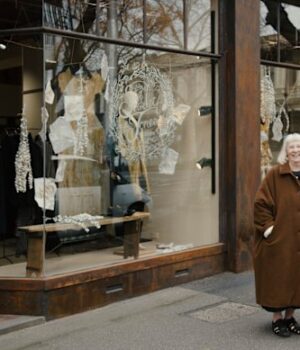
The clothes racks in Scarlet Jones’ new Melbourne fashion boutique are filled with beautiful artisanal items from around the world set against a novel interior design.
The double-fronted Victorian shopfront in Gertrude Street, Fitzroy, represents a new chapter for owner Lynn Clay – a store that comes with a strong Japanese aesthetic.
Her boutiques have pushed against the grain since she first established the business just over 20 years ago. Now at a time when, as Clay says, “there’s a race to the bottom”, she showcases French label Casey Casey, Kaval and Klasica (both hailing from Japan), along with Mina Perhonen, also located in Tokyo but heavily inspired by Finland and a connection to nature.
Clay’s daughter, Emma, has also developed the store’s in-house label, Metta, using all-natural fibres. “I first started buying Mina’s fabrics years ago,” says Clay, referring to the 1960s lounge she bought on Marketplace, which sits on the store’s off-white screed concrete floor.
Not surprisingly, given the number of Japanese designers presented in the store, the fit-out comes with many Japanese features – including screen doors that enclose the change rooms.
Clay was an upcycler of furniture and building materials long before it became fashionable. An important feature of Scarlet Jones is the timber-panelled ceilings and doors that were originally in a house in Toorak.
The owner was doing a complete makeover of the Prairie style, circa 1914 home (think of American architect Frank Lloyd Wright). She even bought the home’s original garage doors, which are stored at the back of her premises, waiting for the right idea.
‘The store was in a sorry state. I didn’t fully realise how much work it was going to take when I first inspected the place.’
Lynn Clay, Scarlet Jones owner
Clay worked closely with builder Trevor Newton, director of Nutone Property, for this bespoke fit-out, one that required considerable work even before the finer materials were laid.
“The store was in a sorry state. I didn’t fully realise how much work it was going to take when I first inspected the place,” says Clay, who had to completely rewire, replaster and literally touch every surface, even before a design took shape.
Clay never sets out with a precise vision before she starts any new project.
Her former Albert Park store, located in a heritage building and earmarked for demolition to make way for five-storey apartments, had a strong rustic feel.
“I sandblasted the walls to create that aged effect. But here, I was after something different. It was just difficult to verbalise,” says Clay, who tested several shades of Porter’s Paints before settling on a faded sandstone hue.
“I was after something quite classic, something that was far from faddish or transitory.”
As well as reusing the timber from the Toorak mansion on the ceiling, Clay used some of the furniture from her Albert Park store – slightly shredded armchairs as though a much-loved pooch had chewed the edges – and antique vitrines, with one signed simply “Gertrude Street”, depicting its origins and obviously coming from another shop along the strip at one point in its history.
Other additions include tapestry-covered armchairs in the window, framed by spiralling fake flowers and wrapped in plastic. Created by window dresser Gary Armstrong, it has a slightly Belgian aesthetic. Vintage mirrors resting against walls are as thoughtfully placed as is a scarf by London-based designers IA – depicting a weathered dress that has been displayed like a mural on a wall when not being worn.
For Clay, discussion on price doesn’t drive her selection of labels. She’s far more interested in sourcing the finest artisanal labels from around the world, creating her own niche in a market she describes as “saturated with corporate fashion, produced in the thousands and purchased because of its name”.
“I’m always looking for integrity in what I do,” she says. “I am certainly not racing to the bottom. At that end, there’s more than enough competition. I would rather people purchased fewer clothes and mend them if needed, certainly not just fill their wardrobes with generic clothing.”
The Business Briefing newsletter delivers major stories, exclusive coverage and expert opinion. Sign up to get it every weekday morning.
 Stephen Crafti is a specialist in contemporary design, including architecture, furniture, fashion and decorative arts.


