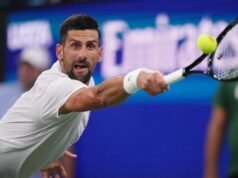
Source :- THE AGE NEWS
It’s a mixed bag for Craig Tiley’s first US Open at the helm: Jannik Sinner, the world No. 1, withdrew from the tournament with a persistent knee injury. He’s one of 20 male and female players who have pulled out of the year’s final grand slam.
On the other hand, defending champion Carlos Alcaraz – always a crowd favourite – is making his return after being sidelined with a wrist injury since before the French Open. He even played the US Open’s mixed doubles last week with legend Serena Williams.
Injuries, and the gruelling pace and intensity of the tour, have been the talk of the year in tennis – particularly here on its North American leg, where players have missed several marquee tournaments amid injury carnage.
According to the Professional Tennis Players Association, upper body injuries are up 42 per cent, arm injuries up more than 100 per cent, and match-ending injuries have jumped 53 per cent.
“The evidence is clear: the season is too long, recovery time is shrinking, and injuries are occurring earlier and becoming more severe,” the association said this month.
The statement was prompted by another spate of withdrawals at the National Bank Open in Canada, a Masters 1000-level event – second in importance and prestige only behind the grand slams.
Both Sinner and Alcaraz skipped the men’s tournament in Montreal for the second year in a row – as did Novak Djokovic and a slew of other players. Hometown hero Felix Auger-Aliassime was forced out at the last minute with a back injury. At the women’s in Toronto, defending champ Victoria Mboko also withdrew.
Masters tournaments are mandatory on the tennis tour; top players are automatically enrolled, and can only withdraw for valid reasons such as injury. Men must also compete in at least four 500-level events a year, and women must enter six.
Every tournament naturally wants to attract the top players, who draw in more fans. But there is growing acceptance in the tennis world that not only are the size and pace of the tours unsustainable, but they are having a counter-productive affect.
One player who has been raising the issue publicly for some time is Australia’s Alex de Minaur.
“I’ve said it for a while: I would like the schedule to be shorter. That’s no secret,” he said in an interview at the Mubadala DC Open in Washington last month. De Minaur is softly spoken and understated, yet clear: “You want your tournaments to consist of the best players, and so that’s something that probably needs to be looked at.”
De Minaur was top seed at Mubadala, a 500-level event; his main competitors were Americans playing on home turf. He had just taken 13 days off to marry fellow tennis star Katie Boulter, which included a whirlwind honeymoon in Portofino. It was the longest he can remember going without a racquet in hand, he said.
“The way the sport is set up, it is a long season, it is a long schedule, and whether you like it or not, I think we’re seeing more and more maybe people not being 100 per cent [fit],” de Minaur said.
“That’s something to monitor. You want to find that balance. It’s got a little bit of a compounding effect … I’m sure the young guns who’ve just come up on tour, they’ve got plenty of energy to go – but [if] you do that three, four, five seasons, and then it starts to catch up.”
Change is on the way. There had been rumours and murmurs about a potential Saudi Arabia-funded breakaway tour, similar to LIV golf, which is now losing Saudi funding. But that has given way to a new proposal, a Masters 1000-level event to be held in the Kingdom from 2028.
That will be the catalyst for a new tennis calendar, internally dubbed “Product 28″, in which the smaller, 250-level events – and perhaps some 500s – are set to be squeezed out. A fund has been established to buy back the licences for tournaments such as the Hong Kong and Chengdu opens. Doubles events are also set to be culled, tennis journalist Ben Rothenberg reported in July on his website Bounces.
This approach is favoured by Karl Hale, the veteran tournament director of the National Bank Open in Canada. Essentially, it means: grow the big events, cut the smaller ones. He has a meeting scheduled next week with top brass at the ATP (Association of Tennis Professionals) to discuss the mass withdrawals from the Montreal tournament this year.
“We have an obligation to [the fans]. They are our oxygen,” he says. “Without them, we don’t have an event, we can’t breathe.”
Some consider Hale’s tournament part of the problem – it is one of many Masters events that has expanded to a 12-day format. He says it is intended to give players longer breaks between matches within the tournament. But when so many tournaments are doing it, it means an extended calendar for everyone. Three of four grand slams have taken an extra day, too, starting on a Sunday.
“What I’m trying to get across to everybody is that if we want tennis to be in the place we want it to be 20 years from now, we have to think big,” Hale says. “The calendar is a real estate play. All the major sports are grabbing more and more real estate.”
He runs through it: the National Hockey League is adding two games this season. The National Basketball Association has launched the NBA Cup. The Champions League has expanded. In short: people want more.
Hale also points out that player prize money is increasing. Craig Tiley recently announced the US Open would pay players a record $US108 million ($150 million) this year – a 20 per cent bump from last year, which was itself a record. In total, US Open players have received a 44 per cent pay rise over two years.
“This is a significant first step in a multi-year investment,” Tiley said. “The US Open continues to be the best economic opportunity for players and the most valuable platform in tennis for players, fans and partners.”
The USTA would not grant this masthead an interview with Tiley. Hale noted: “There’s a lot more money to compensate the players. And that will continue as long as we grow and grow and grow.”
Hale does not think any of the events in the lead-up to the Australian Open will be on the chopping block: he says they are some of the strongest 250-level events on the tour. It is now believed that the Saudi tournament will take place around February, soon after Melbourne Park goes dark.
‘Short-term commercial interests cannot come at the expense of player health.’
The Professional Tennis Players Association
Some older hands are more sanguine about the state of affairs. Swiss legend Roger Federer, who retired from professional tennis in 2022, is in New York for the US Open, where he played an exhibition match this week.
He was asked about the injury woes afflicting tennis and the contentious tour schedule at a press conference.
“Every injury is different. Some are unfortunate. Some are because maybe you just pushed a little too far, and then you got hit with something,” Federer said.
“I always tried to keep a good schedule in terms of enough breaks. That’s easier said than done. I took a lot of chances as well, where I piled on maybe a couple more tournaments than I should have.
“It’s important to prioritise what’s important to you. Everybody has different times of the year when you want to peak – because you can’t peak, clearly, 20 times a year. I think fans shouldn’t forget that as well.”
Federer acknowledged the new 12-day length of most Masters events was “an interesting new dynamic” that players and their coaches would have to adjust to.
“I kind of showed up everywhere,” he said.
“But also we were always very careful of what’s next. I never really wanted to make it all about the slams.”
The Professional Tennis Players Association, however, has a pretty clear view of what’s going on: tournaments are trying to extract more money from fans. And it doesn’t like the phenomenon.
“Short-term commercial interests cannot come at the expense of player health,” the group says. “Protecting players isn’t just about today’s competitors, it is about protecting the future of tennis.”
News, results and expert analysis from the weekend of sport sent every Monday. Sign up for our Sport newsletter.
 Michael Koziol is the North America correspondent for The Age and Sydney Morning Herald. He is a former Sydney editor, Sun-Herald deputy editor and a federal political reporter in Canberra.Connect via X or email.