Source : the age
Hello and welcome back to our live coverage of national and world news this Monday, October 19. Here’s what is making headlines this morning.
Minister for Industry and Innovation Tim Ayres defended Tasmanian independent Jacqui Lambie this morning after One Nation’s latest political cartoon mocked her struggles with vaginal prolapse.
“There’s tens of thousands of Australian women who battle with health conditions like this one. I don’t care about what you say here. To be smashed up by some cheap, nasty bit of political propaganda run out by Pauline Hanson,” he told Nine’s Today show.
“Jacqui’s also been turning up to do her job every day through excruciating pain.”
In August, Lambie made an emotional address to the parliament and revealed her ongoing health battles, including with vaginal prolapse, that she attributed to her time serving in the ADF.
The political cartoon depicts Lambie saying “I can’t laugh because of my prolapsed vagina”.
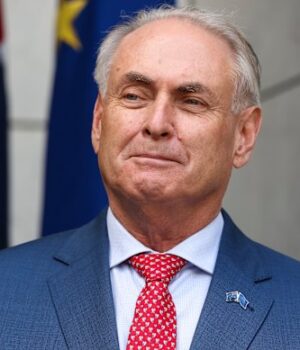
Trade Minister Don Farrell has urged the Coalition to back the Australia-EU free trade agreement, saying that failing to do so would be “an act of economic self-harm”, as Nationals leader Matt Canavan rejects the proposal before shadow cabinet came to a position on it.
“I am deeply concerned that the Nationals – and let’s face it, there’s only four of them in the Senate – [are] trying to pull … the Liberal Party, into a position of opposing our new EU free trade agreement, and so I ask the Liberals [need] to really deeply consider whether they want to be in a position to oppose a free trade agreement,” Farrell told ABC Radio National this morning.
“[Opposition Leader] Angus Taylor, in his maiden speech, said he supported free trade. Most of the Liberals that I speak to, either in the Senate or in the lower house tell me that the party supports free trade, and so what we’re saying to Mr Taylor is stand up to Mr Canavan on this occasion because to defeat a new free trade agreement with the Europeans would be an act of economic self-harm for Australia”.
Canavan and his Nationals colleagues have said the free-trade agreement the government has struck with the European Union is worse than no trade agreement, and should be scrapped entirely. Liberal colleagues speaking to various media outlets on condition of anonymity have said the deal is better than the current trade settings.
Last week Canavan penned an opinion piece in The Australian newspaper that said the deal “exposes Australian jobs to unfair trade, it would weaken Australia’s sovereignty on climate change policy and it does not even provide meaningful access for Australian goods to European markets”.
Farrell said this morning that the Europeans had made “very significant concessions” in striking the deal, and if the government was forced to renegotiate the agreement a worse outcome might occur for Australia.
One Nation leader Pauline Hanson promised she would reverse Labor’s changes to capital gains tax and negative gearing if elected.
MP Barnaby Joyce had previously flagged that the party would reverse the changes made by Treasurer Jim Chalmers in the May budget, but Hanson’s announcement marked One Nation’s first official commitment to do so.
The party leader confirmed her plan to restore the 50 per cent capital gains tax discount and overhaul Labor’s proposed 30 per cent minimum tax on discretionary trusts.
In a statement provided to News24 (formerly Sky News), Hanson said: “Dr Jim Chalmers is experimenting on the Australian economy, and everyday Australians are his guinea pigs”.
“He’s playing with your home, your rent, your business and your savings. When his experiments fail, Australians will pay dearly.”
Industry Minister Tim Ayres defended Prime Minister Anthony Albanese and Treasurer Jim Chalmers after a concession over the weekend that some ministers knew about the ATO’s controversial credit card ban months before it was announced.
Assistant Treasurer Dan Mulino said the government knew in July that the ATO was considering a credit card ban following the RBA’s changes to surcharges.
Ayres insisted he only learnt of the ban “about the same time as it was made public”.
“Now, the transition time was too short. They’ve acknowledged that. They’ve dealt with it. We’re not thin-skinned about criticism here,” he told Nine’s Today show this morning.
“The business community came directly, publicly and privately. Government listened. Anthony Albanese and Jim Chalmers worked together over a few days to make sure that we got it right and we fixed it.”
There are growing concerns within the Reserve Bank that the fallout from the war against Iran means inflation will remain elevated and force it to push up interest rates higher, even if it means more people may end up unemployed as the Australian economy slows.
Ahead of two critical meetings in the run-up to Christmas, the bank is wrestling with the trade-off between bringing down inflation – which has remained above its 2-3 per cent target for three of the past four years – and the broader economic damage that would be caused by tighter monetary policy.
Senior sources within the bank, not authorised to comment publicly, have expressed growing concern that oil prices – which finished last week at $US106 ($152) a barrel – are showing no sign of falling as the war in the Middle East broadens to Saudi Arabia and the Gulf of Aden.
While there is ongoing concern that spending by state and federal governments is also fuelling inflation, the RBA’s own economic forecasts – due to be updated next month – were based on oil prices being as much as $US20 a barrel lower.
Australian inflation, which rose by 0.4 per cent in August, would have fallen but for the increase in petrol prices that month.
One Nation leader Pauline Hanson has claimed protests in France are a consequence of “mass migration” which is “tearing apart Europe” as she claimed similar riots would soon be commonplace on Australian streets if the government did not stop “importing people who reject our democracy”.
In a social media post last night, she said migrants threatened the Australian “way of life”.
There is no evidence to suggest the protests in France have been driven by migrants.
The movement began last month when French teachers and students spoke out against underfunded public education, poor infrastructure, staff shortages and unsanitary classroom conditions.
Paris: Protesters clashed with police for a second day of chaos in major French cities after massive rallies descended into violence and looting over the weekend, sparking anger at the rioters and an argument among national leaders.
French President Emmanuel Macron condemned the violence in an emergency address to the nation on Sunday night (Monday AEDT) amid a political row over whether the national government did enough to prevent the destruction.
The violence began on Saturday after 550,000 people attended rallies to protest about the cost of living and school standards, with masked rioters setting fire to cars and buildings, including the historic town hall in the city of Limoges, which was largely destroyed.
Hello and welcome back to our live coverage of national and world news this Monday, October 19. Here’s what is making headlines this morning.