

source : the age
Hello and welcome to our national news live blog for Monday, June 1. My name is Emily Kaine, and I’ll be helming our coverage for the first part of the day. Here’s what is making news today.
- Price growth across the national property market has ground to a halt, new research shows, with steep falls in Melbourne and Sydney as higher interest rates, stretched affordability and the federal government’s overhaul of tax incentives combine to suppress values.
- Significant amounts of Russian timber are entering Australia after being laundered through China and other countries, evading tariffs imposed after Russia’s invasion of Ukraine and sparking demands for government action. The phenomenon – similar to the flow of Russian “blood oil” into Australia after being processed overseas – means that thousands of Australian home builders could be inadvertently aiding Putin’s war effort.
- The Australian sharemarket is set to slip today, with futures on Saturday pointing to a loss of 13 points, or 0.2 per cent, at the open. The Australian dollar was trading at US71.71¢ at 5.18am AEST.
- The number of confirmed Ebola cases in the Democratic Republic of the Congo has climbed to 260 as officials updated their estimates of the outbreak’s size and international health organisations warned of the risk of further spread. Aid groups have said that without urgent intervention, this could be the world’s deadliest Ebola outbreak ever.
- And US President Donald Trump has toughened the conditions of a proposed peace deal to end the war with Iran, and sent his updated conditions to the country for consideration, three officials told The New York Times.
Staying with Abbott’s appearance on the Today show, the former prime minister has refused to criticise One Nation’s Pauline Hanson as he reiterated his support for Angus Taylor.
Asked whether he thought Hanson could be prime minister, he said: “Look, I’m not into disparaging someone who has been around and has shown a lot of resilience and consistency over the years, but I do believe that the strong Liberal-National Coalition has proven again and again that we are capable of giving Australia the good government our country so desperately needs.”
Abbott also dismissed the suggestion that he should have made a political comeback by running in the next election.
“Look, Angus Taylor is a very good friend of mine. I’ve never met a better man than Angus Taylor. He’s a man of intelligence, conviction, decency. I want him to be our 32nd prime minister,” he said.
Abbott has invoked the Bondi massacre as an indicator of Australia’s “national decline” as he argued society had fragmented under Labor.
“Our society is fragmenting, Our strategic situation is deteriorating. This government is making everything worse … In the end, this is a government that doesn’t really believe in Australia,” he told Today.
“Particularly after the Bondi massacre, which I thought was a dreadful milestone in our national decline, I felt it was really important to get all hands on deck to try to bring our country back to what it should be.”
During his address at the Liberals’ two-day federal council meeting last week, he accused the government of showing ambivalence to the country, which he said was exemplified by Prime Minister Anthony Albanese’s “refusal to stand in front of just one national flag”.
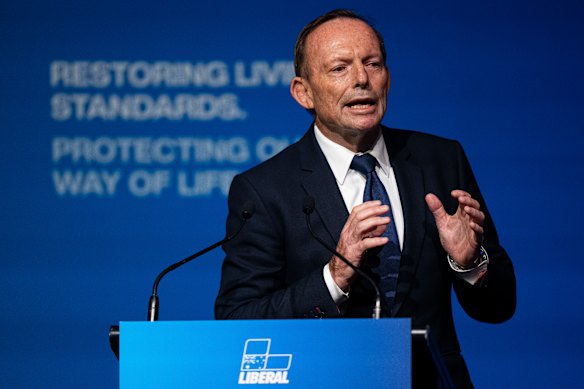
Newly appointed Liberal Party president Tony Abbott is “confident” that he can turn things around for the party as he spruiks his new role and defends the Coalition’s record against new polling that shows popular support for the party is floundering.
The former prime minister told the Today show on Nine this morning that he could help restore public confidence in the Liberals and the Coalition, and claimed that the last government to deliver on outcomes for everyday Australians was his.
Abbott served as PM from September 2013 to September 2015.
“If you look back to the record of Liberal governments, we did scrap taxes, we did cut migration, particularly illegal migration, and we didn’t have an emissions obsession, and it’s so important that we persuade people that the best way to make things better is to have a government which is actually capable of that,” he said.
Senior ministers have responded this morning to new polling showing One Nation overtaking Labor in popularity.
The latest The Australian Financial Review/RedBridge Group/Accent Research poll reveals primary support for Pauline Hanson’s party has jumped four percentage points to 31 per cent since the pre-budget poll a month ago, while Labor’s primary vote has fallen three points to 28 per cent.
Social Services Minister Tanya Plibersek told Seven’s Sunrise program that the government was not “driven” by polls.
“Of course, we’re interested in polls, but they don’t drive us. What we’re concerned to do is understand that people are feeling the pressure, and we are all about reducing that pressure,” she said.
“I think if Pauline Hanson wants to be prime minister, as she said in that interview yesterday, it’s time for One Nation to start talking about how they could deliver … because every opportunity they’ve had, they’ve actually voted against things that would make it easier, make life easier for Australians.”
Minister for Employment and Workplace Relations Amanda Rishworth refused to say whether the government was worried about the poll, dodging repeated questions on Nine’s Today show.
One Nation leader Pauline Hanson said last night she believed she could lead the country.
Speaking to Sky News Sunday Agenda, she said she had the “ability” to be prime minister.
“I won’t knock the job … I’m not going to underestimate myself or say ‘No, I can’t do it’, because you know, have a look at what we’ve got now … And that’s why we’re in a mess,” Hanson said.
“But I’m not making a decision now, and I’m not going to tell anyone what I’m doing at this moment, because I haven’t clearly made up my mind.”
Price growth across the national property market has ground to a halt, with steep falls in Melbourne and Sydney as higher interest rates, stretched affordability and the federal government’s overhaul of tax incentives combine to suppress values.
Figures from property data firm Cotality published today show that through May, during which the Reserve Bank pushed official interest rates to 4.35 per cent and Treasurer Jim Chalmers outlined changes to negative gearing and capital gains tax, capital city property values were static.
But in Sydney, overall values fell by 0.9 per cent to be down by 2.1 per cent over the past three months. The drop was driven by houses, with values falling 1.1 per cent to be down 2.5 per cent since the start of the year. The median value of a Sydney house went through the $1.6 million mark in February. It has now subsided to $1.58 million.
In Melbourne, total dwelling values slipped another 0.8 per cent to be down by 2.3 per cent for the quarter. Again, the value of houses dipped further, down 1 per cent to a median of $958,000 compared with a 0.4 per cent drop in the value of units.
Hello and welcome to our national news live blog for Monday, June 1. My name is Emily Kaine, and I’ll be helming our coverage for the first part of the day. Here’s what is making news today.
- Price growth across the national property market has ground to a halt, new research shows, with steep falls in Melbourne and Sydney as higher interest rates, stretched affordability and the federal government’s overhaul of tax incentives combine to suppress values.
- Significant amounts of Russian timber are entering Australia after being laundered through China and other countries, evading tariffs imposed after Russia’s invasion of Ukraine and sparking demands for government action. The phenomenon – similar to the flow of Russian “blood oil” into Australia after being processed overseas – means that thousands of Australian home builders could be inadvertently aiding Putin’s war effort.
- The Australian sharemarket is set to slip today, with futures on Saturday pointing to a loss of 13 points, or 0.2 per cent, at the open. The Australian dollar was trading at US71.71¢ at 5.18am AEST.
- The number of confirmed Ebola cases in the Democratic Republic of the Congo has climbed to 260 as officials updated their estimates of the outbreak’s size and international health organisations warned of the risk of further spread. Aid groups have said that without urgent intervention, this could be the world’s deadliest Ebola outbreak ever.
- And US President Donald Trump has toughened the conditions of a proposed peace deal to end the war with Iran, and sent his updated conditions to the country for consideration, three officials told The New York Times.


