Source : Perth Now news
Australian retirees are performing unpaid work equivalent to about 321,000 full-time jobs each year, with new research putting the value of their contribution at a total of $16.5bn annually.
Retirees contribute an average 386.3 hours per year through unpaid care, volunteering, community leadership and mentoring, according to UniSuper’s Retire with Purpose research.
But 84 per cent of Australians surveyed believe retirees’ skills and experience are not being used to their full potential, as another 2.5 million people are expected to enter retirement over the next decade.
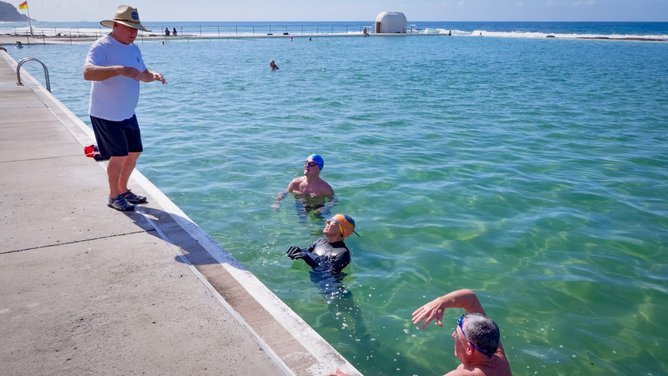
In Newcastle, retiree Phil Williams, 76, is part of that largely unpaid workforce, spending up to eight hours per week during summer teaching adults to swim at ocean baths.
Mr Williams, from Merewether, said he began helping after noticing people struggling in the water and offering them advice.
“I became involved in teaching adults how to swim well because I saw so many people struggling in the water,” he said.
“My goal is to help people incorporate swimming into their routines.”
Mr Williams teaches adults from a range of backgrounds and ages, including migrants who can be highly anxious about entering the water.
One of his most memorable students was a young Bangladeshi man who initially struggled to swim.
“He eventually came to love the water and swam 50m non-stop,” Mr Williams said.
“His smile and reaction were priceless. We are now like father and son. A beautiful thing.”
Mr Williams said the benefits extended beyond helping people become stronger swimmers.
“Swimming offers adults so much in terms of physical and mental health,” he said.
“Also connecting with like-minded people afterwards with coffee and a chat.
“My reward is to witness achievements and the happy expressions on faces. I have many close friends because of teaching swimming.”
The UniSuper research estimated the economic value of similar unpaid contributions being made by retirees across Australia.
Unpaid care for children and adults accounts for the largest component, estimated at $10.6bn per year.
About 38 per cent of retirees provide unpaid care, including for grandchildren, ageing relatives and people living with disability.
Volunteering and community work were valued at another $3.8bn annually, community leadership at $1.4bn and mentoring, coaching and skills sharing at $700m.

The modelling used a replacement-cost approach, assigning an estimated hourly value to each activity before extrapolating the results across an estimated 2.4 million Australian retirees.
Unpaid care and volunteering were valued at $50 per hour, mentoring and skills sharing at $75 per hour and community leadership at $100 per hour.
Paid employment undertaken by retirees was excluded.
The modelling found retirees contributed an average 224.9 hours of unpaid care, 95.5 hours of volunteering or community work, 37.9 hours of community leadership and 28.1 hours of mentoring or skills sharing each year.
University of Queensland professor of clinical geropsychology Nancy Pachana said having meaning and purpose in retirement was strongly associated with better wellbeing.
“If one has meaning and purpose in retirement, not only is wellbeing improved, but also physical health, mental health and cognitive function are positively affected,” she said.
Professor Pachana said older Australians’ skills, experience and social capital remained underused.
“Many people over 50 find it difficult to find employment, robbing the economy of the extra value they could contribute,” she said.
“We can trace this to ageism, the judgment of value based on chronological age rather than skills and productivity potential.”
The research found 82 per cent of Australians surveyed believed retirees’ economic contribution was under-recognised, while 26 per cent of retirees said a lack of suitable opportunities was preventing them from contributing more.

Among retirees who faced barriers to contributing, 37 per cent said financial incentives could enable them to do more, while 35 per cent nominated health and wellbeing support and 35 per cent wanted better access to local opportunities.
A quarter said greater recognition of their contribution, experience and capabilities could encourage them to contribute more.
Professor Pachana said the traditional idea of retirement no longer reflected how many older Australians lived.
“The idea that one retires and sits back in a rocking chair is very outdated,” she said.
She said retirees continued contributing through unpaid work as well as paid employment and entrepreneurial activity.
The research also found retirees who had received professional financial advice contributed an average 8.3 hours a week, compared with 6.3 hours among those who had never received advice.
The finding shows an association between receiving financial advice and contributing more time, rather than establishing that financial advice causes greater participation.
Professor Pachana said planning ahead could allow people to consider a broader range of options for retirement.
“The takeaway is not to put off planning – take small consistent steps and you will reap rewards,” she said.