Source : ABC NEWS
It would be very easy to look at the bare numbers of Australia’s two-day, innings victory over Bangladesh in Mackay and see them as a sign that normal service has resumed.
The number-one-ranked Test side has flexed its muscles on home soil and pounded the tourists into the dust.
Same old Australia, always winning. Nothing to see here.
- As it happened: Australia wraps up two-day victory in Mackay
- Quick hits: A Shoriful stunner amid more left-arm carnage in the 29th two-day Test
But to think this victory has covered over the fault lines exposed by a disastrous defeat in Darwin a week ago would be to bury one’s head in the sand.
The catastrophic issues that resulted in a stunning defeat a week ago have not disappeared.
It is just that in Mackay, Australia’s four galloping horsemen of the Apocalypse rode to the rescue, aided by a friendly pitch, albeit one far less treacherous than the batting card would have us believe.
“I don’t think it should necessarily have been a two-day game,” Josh Hazlewood said after the match to Fox Sports.
“I think there was obviously a little bit of seam movement day one in the morning … You’d expect that in most Test matches.
“But once the shine went off the ball it didn’t do a great deal from a bowling point of view.”
Yet just 369 runs were scored for the loss of 30 wickets in two days of play, an average of 11.2 runs per batter.

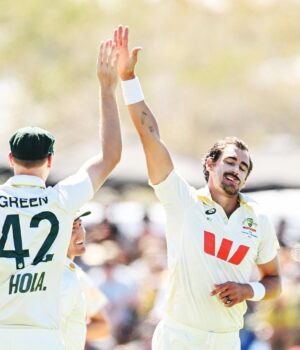
Mitchell Starc claimed 10 wickets across the match for the fourth time in his Test career. (Getty Images: Robert Cianflone)
Mitch Starc will get the headlines and so he should; his 10-51 is evidence that at 36 he is still more than capable of beguiling a team with his mastery of left-arm seam bowling.
The devastation he wrought on the hapless Bangladeshi batters was total, a cyclonic burst of relentless energy a Mackay weather watcher would have found familiar.
His first-inning spell of 5-5 on that opening morning, his five wickets coming in a thrilling 22-ball burst that started from the very first delivery of the match, was of a force-of-nature quality that simply cannot be withstood.
Bangladesh’s batters, so disciplined and patient in Darwin, walked into an ambush armed only with matchsticks for all the use their bats were against such terrifying pace and accuracy.
Starc claimed four ducks, two of them golden, during that sparkling spell, then followed up by taking three wickets in two overs to start the second innings.
Of the 10 batters Starc accounted for in the match, six fell without scoring.
And when he tired, it was up to Pat Cummins, who took three wickets in each innings, with Nathan Lyon chipping in with three of his own on the second day of another rapid-fire Test that only required two days to complete.
Pat Cummins took six wickets in the match, three in each innings. (Getty Images: Robert Cianflone)
This was the third Test only lasting two days of the past seven played on Australian soil.
In fact, four of the past 20 Tests in Australia have been financially ruinous — done and dusted before doors could open on a third day.
And so much of that comes down to the firepower inherent in that battery of bowlers, a line-up containing four of the top 12-ranked bowlers in Test cricket. Australia has enough quality to leave the player ranked sixth by the ICC, Scott Boland, kicking his heels on the bench.
They went to town on a Gabba-like pitch that offered seam and bounce more to their liking than the low and slow Darwin deck.
But what of the batters?
Opener Matt Renshaw made just eight runs. (Getty Images: Robert Cianflone)
After Starc, Hazlewood and Cummins had blown Bangladesh away for 64 before tea on day one, the stage was set for the under-pressure batters to cash in and go big, proving their worth ahead of a trip to a South Africa that is likely to be far from hospitable.
Only four managed double figures — and one of those was Nathan Lyon.
Matt Renshaw made eight, the increasingly under-pressure Marnus Labuschagne four and Alex Carey a paltry five as once more the house of cards came tumbling down at the slightest breath of wind.
Take nothing away from Shoriful Islam, whose 7-48 were career-best figures in Test cricket.
Shoriful Islam went on a tear for Bangladesh. (Getty Images: Albert Perez/Cricket Australia)
But aside from a miraculous inswinging yorker to dismiss Cameron Green on the morning of day two, the other batters were too easily removed.
“I think our bowling has got us out of trouble a lot in Test cricket over the last four or five years,” former Australia skipper Alyssa Healy said on Fox Sports’s commentary.
“We had a really good run with Marnus in form, Steve in form, Travis in form at different points in time, but the bowling has been really consistent.
“While they’re consistent … then you can make the changes in the batting line-up and get them settled.
“We’re not going to be blessed with this bowling attack for very long.“
Australia’s collapse from 4-145 to 8-148 means a rejigging of the middle order has to be considered.
Head has scored more runs than anyone for Australia as a makeshift opener, but his method of dismissal, playing on with an angled bat all three times he has been bowled, coupled with the shaky middle order, suggests he needs to return there.
Labuschagne appears so wrought over his lack of form that an extended absence from the Test team may well do him good, although the success of Cameron Green this tour suggests that if Australia stick with him, he may yet return to scoring runs.
Green’s 67 was classy and assured amid the chaos, the all-rounder a changed man since that drought-breaking ton in Darwin.
Cameron Green scored another half-ton, the only batter to stand up as others crumbled around him. (Getty Images: Robert Cianflone)
Does his poise mean Beau Webster should be dropped for another specialist batter?
As has been discussed, the lack of real quality hammering on the door through the Shield means the list of aspirants is frustratingly short, with so few of the specialist openers in domestic cricket fancied by the selectors.
With no red-ball cricket before the team jets off to South Africa, the selectors are in an unenviable position.
Australia has been limping through Test success off the back of its aging quicks. The moment they are no longer there to provide a rescue, the pressure will really be on.