

source : the age
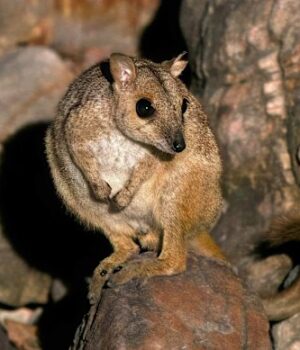
Few people may have heard about Australia’s tiniest wallabies, the Monjon and the Nabarlek, since they live in the remote rocky plateaus of the Kimberley.
Smaller than a domestic cat, they weigh little more than a bag of sugar.
Like most of Australia’s small marsupials, they are endangered species and rarely sighted in remote northern Australia. And they’re fiendishly hard to tell apart.
But the Australian Wildlife Conservancy has recently confirmed the presence of the Nabarlek, Australia’s second-smallest wallaby, at two new locations in the Kimberley – in one location for the first time in 50 years.
It hints at their survival against the odds – feral cats and fire – in pockets across the north.
What makes the discovery compelling is the work required to confirm the Nabarlek’s identity. At just 1.7 kilograms and 36 centimetres long, the nocturnal wallaby is not only hard to spot in the wild, but can be easily confused with the near-identical Monjon and the larger short-eared rock-wallaby.
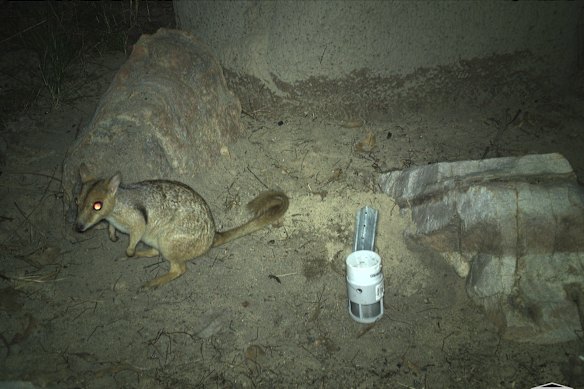
The AWC team, working closely with local Dambimangari rangers, first sets out camera traps in rocky terrain to capture images of these hopping marvels.
“You’ve got to be out at night if you want to spot them in person,” says Larissa Potter, AWC’s senior field ecologist.
“Mainly we use five camera traps each night that are triggered by passing animals.”
But pictures aren’t enough – to conclusively distinguish a tiny Narbalek from a tinier Monjon requires climbing up rock platforms and gathering fresh animal droppings containing DNA that genetically confirms one species from another.
The team has spent years linking camera images and genetic analysis of faeces in order to correctly identify the species.
The new Nabarlek locations are welcome news in the leadup to next week’s Threatened Species Day on September 7, which commemorates the death of the last thylacine in Hobart Zoo in 1936.
“This is very exciting and great news for the species,” says Potter.
“Confirming the Nabarlek’s presence at two new sites is a major step forward for our understanding of where the species occurs.
“It’s also reassuring as it indicates that this threatened wallaby is persisting on the Kimberley mainland in places we didn’t previously know about.”
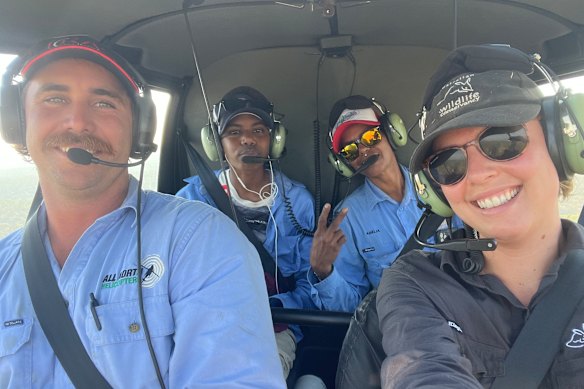
The job of finding Nabarlek was the ecological equivalent of finding a needle in a haystack, she says.
They were located at Yampi Sound Training Area, a vast Kimberley wilderness area identified as one of 20 priority places in the federal government’s Threatened Species Action Plan.
Owned by the Commonwealth defence department, the training area can only be accessed by sea, air, or by making a rugged 130-kilometre drive from the port town of Derby.
A second Nabarlek population was confirmed around 170 kilometres away, an area also contained within the traditional country of the Dambimangari Aboriginal Corporation.
Until the recent discoveries, the Nabarlek has only been recorded from a handful of mainland Kimberley sites and from five offshore islands. Potter says small populations appear to have withstood extensive wildfires on Augustus and Jungulu, two large uninhabited offshore islands at the southern end of the Bonaparte Archipelago.
Potter says the mainland Nabarlek DNA will be compared to the island populations.
“We think that feral cats and fire might be getting them on the mainland, so it’d be great to have more funding to learn more about this animal.”
The species was once thought to have lived widely across mainland northern Australia but in recent years has been rarely seen in the Northern Territory.
The Nabarlek’s total population is uncertain, but according to the International Union for Conservation of Nature Red List of Threatened Species, mature individuals are estimated at just 5000 to 10,000 animals.
“Our rock wallabies are distinct species among global mammals,” Potter explains.
“And Nabarlek are unique among Australian rock wallabies because only they can continually grow their molar teeth. As far as we know, Monjon don’t do that.”
Dambimangari traditional owner Inga Pedersen says Nabarlek are part of the ecosystem.
“Every animal has its own song and story, they might be small, they might be big, but they all play their part in keeping Country healthy,” she says.
“We heard that the Nabarlek didn’t exist anymore on the mainland, so it’s good to know that they’re there, it shows their Country is healthy.”
Potter says finding out where Australia’s tiniest wallabies live is a crucial step in their conservation.
“Other than intrinsically caring about the wildlife we share the planet with, they have a role in the ecosystem so we should be protecting them.”


