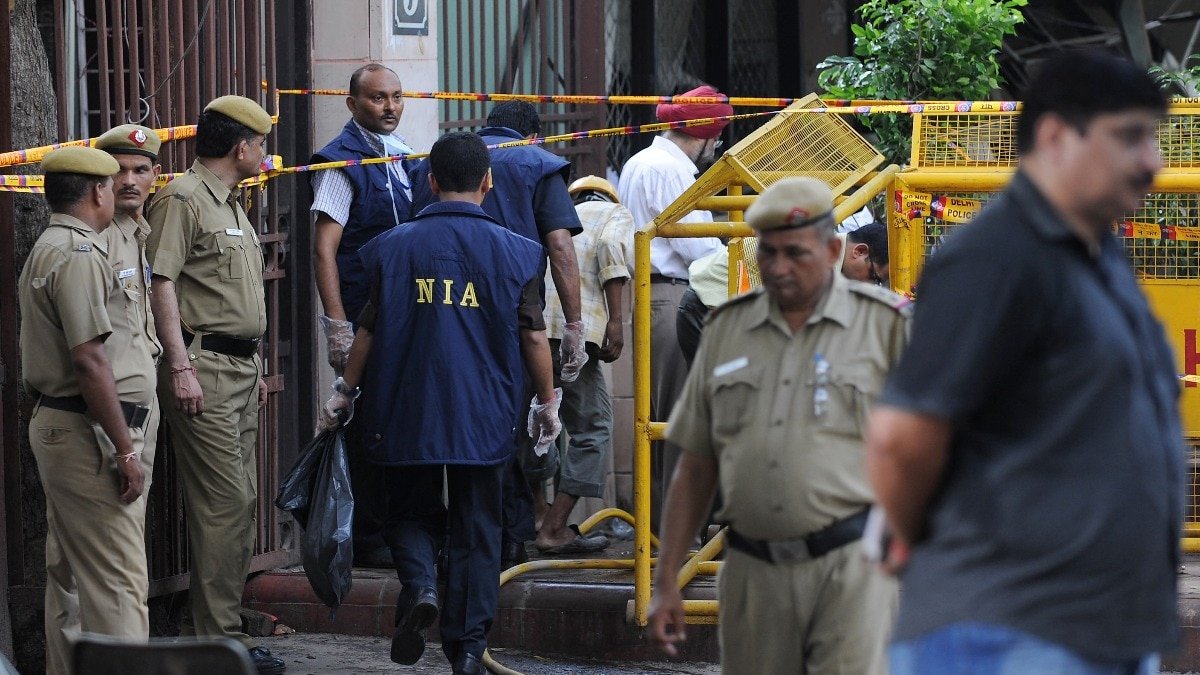
Source : INDIA TODAY NEWS
The National Investigation Agency (NIA) has intensified a wider crackdown on radicalisation and cross-border terror conspiracies spanning several states and has now detained the imam of a mosque in West Bengal’s East Burdwan district over suspected links to a militant network. The developments are linked to the agency’s probe into Imam Mahmuder Kafila (IMK), an alleged offshoot of the banned Jamaat-ul-Mujahideen Bangladesh (JMB).
advertisement
On Tuesday morning, NIA officials detained Piyar Mohammad Sheikh, imam of the main mosque in Palishgram village in East Burdwan’s Mangalkote, and brought him to the police station for questioning.
Local sources told India Today that Sheikh resides in Kulut under the Manteswar police station area and has been serving as the imam at the Palishgram mosque for nearly three years. Investigators are understood to be examining his alleged links to an incident in Guwahati, Assam.
During the operation, the NIA also seized a diary and a mobile phone from Sheikh, according to sources.
Sheikh Golam Mostafa, a local resident, said an NIA team arrived at the mosque in the morning and took the imam away. Officials were subsequently questioning him at the police station.
LARGER CRACKDOWN ON TERROR NETWORK
The detention came amid a larger NIA operation targeting alleged networks involved in radicalising vulnerable youths and establishing links with extremist organisations.
Separately, the agency arrested six people in Assam’s Barpeta district for their alleged involvement in “jihadi” activities and attempts to radicalise young men for recruitment into Islamic fundamentalist organisations.
The NIA began searches late Monday across areas under the Howly, Barpeta Road and Sorbhog police stations.
Three people were arrested from the Sorbhog area, two from Barpeta Road and one from Howly. Those arrested were identified as Faruk Abdullah, Zakir Hussain, Chandbar Ali, Mustafizur Rahman, Yakub Ali and Rakibul Islam.
The agency seized documents and electronic devices, including mobile phones and a laptop, during the searches. According to officials, the accused allegedly had cross-border links with IMK, which the NIA describes as an offshoot of JMB.
Among those arrested, Mustafizur Rahman, who owns a clothing store, had earlier been arrested by the Assam Police Special Task Force in March and released on bail three months later.
NIA personnel subsequently arrested him from his residence. Rakibul Islam, who runs a poultry business in Arunachal Pradesh, had returned home around 15 days before his arrest.
Islam’s father, Ali Mahmud, claimed that an NIA document alleged his son was associated with a group called “Purba Akash” or “Eastern Sky” on Telegram.
The latest action is part of searches at 16 locations across Assam, West Bengal and Kerala. Ten locations are being searched in Assam, five in West Bengal and one in Kerala in connection with the alleged IMK-linked cross-border terror conspiracy and radicalisation case in Assam.
The operation follows an NIA chargesheet filed about three months ago against 11 accused persons.
The accused were booked under provisions of the Bharatiya Nyay Sanhita, 2023, and the Unlawful Activities (Prevention) Act, 1967, before the NIA Special Court in Guwahati.
According to the agency’s investigation, IMK was established by senior JMB member Imam Mahmud Habibullah to advance the banned organisation’s ideology in India.
The NIA has alleged that the network sought to expand its presence in West Bengal and northeastern states, including Assam and Tripura, through clandestine meetings, religious indoctrination programmes, extremist literature and digital platforms.
The agency has identified Nasimuddin as a key figure spearheading IMK activities in Assam and Jagir Mia as its alleged leader in Tripura. Investigators have also collected documents, electronic devices and digital records as part of the probe.
With the latest arrests, searches and the detention of the Burdwan imam, the NIA investigation is expected to focus further on the alleged network’s cross-border connections, recruitment and radicalisation mechanisms, and the extent of its activities across eastern and northeastern India.
– Ends
With agency inputs
SOURCE :- TIMES OF INDIA