source : the age
It required the biggest manned police operations in the state since the late Queen Elizabeth’s Perth visit in 2011, but inside the Land Forces Expo at the Perth Convention and Exposition Centre this week, most exhibitors were spruiking how they could remove people from modern battlefields.
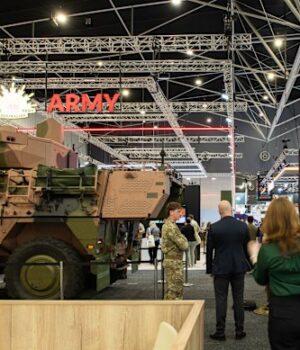
The most eye-catching of the nearly 1000 displays at the controversial event were the metal giants like the Australian Army’s imposing 40 tonne Boxer Combat Reconnaissance Vehicle or Thales’ Bushmaster Protected Mobility Vehicle.
Nestled between those armoured beasts were models of some of the world’s deadliest ordinance from defence giants like Lockheed Martin and Rafael Advanced Systems, but you couldn’t walk five metres without overhearing someone mutter something about drones, autonomy or AI.
The push to equip armies with drones has been accelerated by the war in Ukraine and recognised by the Australian Army which plans to spend more than $20 billion on drones and counter drones over the next decade.
“People in Ukraine talk about this, and people observing Ukraine talk about this but, in the context of one conflict, one war, I don’t think we have seen such a dramatic shifting in what it actually looks like,” Defence Minister Richard Marles said during a fireside chat with Chief of Army Lieutenant General Susan Coyle in Perth on Wednesday.
“What is going on in Ukraine today relative to what was going on in Ukraine back in 2022, it’s just a completely different thing.”
Sypaq Systems is heavily involved in the drones for defence uses, including its cardboard and rubber band flat-pack drones which were gifted to Ukraine to use in the war.
Sypaq chief executive Amanda Holt said warfare had undergone a drastic shift.
“War has always been a competition of attrition, really. Who has the deepest pockets? Who has the largest army? Who has the most weapons? Who has the most fuel?” she said.
“[Now] you’ve essentially seen the democratisation of guided weapons. That’s what drone warfare is.
“What used to be $3 million, 10 years to develop a very expensive, very exquisite, very high-precision piece of technology … you now achieve a very similar effect for an absolute fraction of the price.”
Holt concurred with Marles’ assessment that the Ukraine conflict with Russia had changed significantly.
“The first few weeks of Ukrainian invasion looked not that dissimilar to that type of behavior back in the 90s. Armoured vehicles, traditional infantry and long-range standoff weapons,” she said.
“Once a lot of that is consumed, what can you get your hands on?”
Holt said she couldn’t divulge the cost of one of her cardboard drones, but their price point meant her customers were happy to use them once.
Shield AI was another exhibitor spruiking the benefits of AI and autonomy to power missions and entered the Ukraine conflict.
Jack Waller, the company’s business development regional manager, said autonomy and AI-driven hardware was becoming necessary to work in environments where GPS use was restricted through jamming.
“It was a really challenging battle space, and I think a lot of companies that tried to help early on weren’t able to be successful,” he said.
“[We] sent people and personnel over to Ukraine to work with the Ukrainians to understand that complex battlefield, and we redesigned the platform so that it’s now able to operate in a contested and denied environment.”
When asked why Australia was pursuing the AUKUS submarine program at a multi-decade taxpayer cost of $368 billion when modern warfare was being pushed toward cheap autonomy Marles said his government planned to spend $22 billion on drone and counter drone technology.
He said Australia would need both.
“It is unthinkable that a three-ocean nation like Australia would operate without a long-range capable submarine and so we are going to need those submarines as we are going to need those autonomous systems,” he said.
After all the hype, was this actually Bland Forces?
About 10,000 people were estimated to have come to Perth for the Land Forces Expo, which was the first time it was held in WA and the first event since the Victorian expo in 2024, where protesters clashed with police.
The 2024 protests triggered an extraordinary response from the Cook government ahead of this year’s event, including $11.5 million for security and a controversial act of parliament giving WA Police powers to ban activists from entering a security zone around the convention centre.
However, the chaotic scenes in Victoria didn’t transpire in Perth.
The WA Anti-War Collective was incensed by the expo’s presence in Perth, as well as the extraordinary powers granted to police to run its security operation.
The group staged a peaceful march attended by hundreds through the CBD on Tuesday evening, which finished with no arrests or move-on notices issued.
Hundreds of police were stationed at the centre over the course of the three days and more were taking part in the operation remotely in operation centres around the city.
Greens MP Sophie McNeill, who attended the expo on Tuesday, said the $11.5 million spent by the WA government was a waste of money.
“We condemned those scenes in Melbourne. Melbourne is not Perth, and Perth is not Melbourne, as we have said all along to the police,” she said.
“But yet, still, they went ahead with this draconian legislation that has made it illegal under West Australian law to go and stand on that forecourt and say ‘warmongers not welcome’ here or ‘weapons companies not welcome here’.”
However, Premier Roger Cook defended the laws and the money spent on the security operation.
“I think it’s important that people have the right to protest safely and respectfully, and that requires being prepared for any outcome in relation to that,” he said.
“The operational matters in terms of community safety are for the police to call, but they are backed by a government that’s prepared to provide them with the resources so that they can assure that safety.”
The security impressed federal Liberal Senator James Paterson, who took to social media on Thursday to praise the Cook’s efforts – and urge Victoria’s government to adopt similar powers when the expo returns east in 2028.
 Hamish Hastie is WAtoday’s state political reporter and the winner of five WA Media Awards, including the 2023 Beck Prize for best political journalism.Connect via X or email.