

source : the age
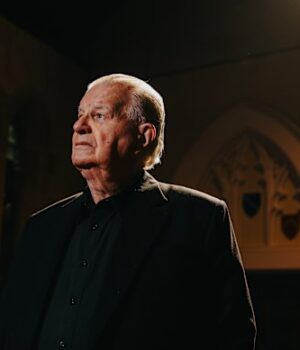
Reverend Bill Crews is accustomed to bad news. The Uniting Church minister, 81, has devoted his life to campaigning for worthy but unglamorous causes that pay little in the way of political dividends, including homelessness, youth disadvantage and humanitarian aid.
But Crews says nothing could have prepared him for the response when his wife Gillian Armstrong-Crews contracted hepatitis C through contaminated blood products in the early 1980s.
Armstrong-Crews received a tainted blood transfusion via the Australian Red Cross Blood Service, since rebranded as Australian Red Cross Lifeblood, while the couple was trying to conceive.
Soon after the transfusion, the usually energetic Armstrong-Crews fell into ill health, a mystery that baffled doctor after doctor who couldn’t identify the source of her malaise.
Finally, the answer came: it was hepatitis C, a blood-borne viral infection that can cause liver failure, liver cancer and death.
Crews remembers sitting opposite a barrister representing the Australian Red Cross Blood Service as he requested compensation for his wife. He alleged he was told to “bugger off”.
“I’m used to taking up causes and kind of putting it out there,” he said. “To have the response I had was just demeaning and shocking,
“Kick in the stomach doesn’t even go near it. They could have at least told us to bugger off in a compassionate way.”
Crews recalled the blood service was even aware of the name of the donor who had given his wife the infected blood.
Thousands of Australians were infected with blood containing deadly hepatitis C or HIV between the 1970s and early 1990s, primarily managed through the Red Cross or Commonwealth Serum Laboratories (CSL), then owned by the federal government.
The government has estimated the number of victims at up to 8000, while advocacy groups put the figure closer to 20,000.
A spokeswoman for Australian Red Cross Lifeblood said it recognised the pain, loss and hardship experienced by those affected, some of whom had tragically lost their lives.
She noted that Australia was one of the first countries to introduce HIV screening of blood donations in 1985 and hepatitis C antibody testing when it became available in early 1990.
“At the time, scientific and clinical understanding of the hepatitis C virus was still evolving,” the spokeswoman said.
In 2004, an Australian Senate inquiry recommended funds go towards helping infected people access health services.
But the report rejected a compensation scheme for sufferers, warning that it was not in their best interests.
The decision devastated Australian survivors, who point to compensation schemes that have been operating for years in a string of countries, including Canada, Ireland and Britain.
In 2024, a landmark British inquiry found that the use of contaminated blood products was the biggest treatment disaster in NHS history, was largely avoidable and that various bodies had hidden the truth, with elements of “downright deception”. A compensation scheme and a permanent memorial were established.
In May, Crews was a candle bearer at an international memorial service held for victims at St Paul’s Cathedral in London.
“It was very moving,” Crews said. “As part of the service they released thousands of tiny petals from the height of the great dome. It was like tears from heaven.”
For Crews, it was bittersweet to see compensation delivered to victims in England while Australia continued to do “effectively nothing”.
Crews, who will feature in an episode of ABC’s Australian Story on Monday night, said he has been pushing for decades and told his story “over and over” in Canberra, but the result was always a minimal response. “There’s a human face to this which is bottomless in sorrow, which has been ignored.”
The Australia Red Cross Lifeblood spokesperson noted that the Senate inquiry concluded decisions were made based on the best available evidence at the time by state- and territory-run blood services.
“The Australian Red Cross Blood Service apologised to people who acquired hepatitis C through blood transfusions in 2004, and that apology still stands,” she said. “Today, Australia has one of the safest blood supplies in the world through rigorous donor screening and blood testing.”
A spokesperson for Australia’s Health Department previously pointed to support measures for those affected, including a lookback program, hepatitis C strategy, subsidised medication, education and contributions to state and territory settlement schemes.
But Crews said that thousands of Australians had suffered a lingering and painful death while they waited in vain for justice, including some of his own parishioners.
Crews recalled that his Ashfield church was packed with people when he first held a meeting for victims in the late 1980s. “When we did the same thing 20 years later there were six people left,” he said.
Armstrong-Crews died in 2025 of unrelated causes. “For my wife, it wasn’t what she died of, but it didn’t help,” Crews said. “It weakened her whole body.”
Crews drew a direct line between the tainted blood scandal and the Jeffrey Epstein case, arguing that both featured a pattern of ongoing denial and obfuscation. “It’s Epstein writ large,” he said.
Be the first to know when major news happens. Sign up for breaking news alerts on email or turn on notifications in the app.


