

SOURCE :- THE AGE NEWS
London: As soon as Andy Burnham unveiled a modest plan to tighten Britain’s ties with Europe, his conservative critics went into conniptions over what they regarded as a national betrayal.
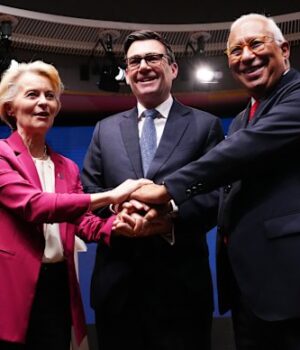
The sight of a British prime minister on a podium in Brussels, smiling alongside European Commission President Ursula von der Leyen and European Council President António Costa, seemed to provoke horror among those who feared their island nation would be ruled, once again, by bureaucrats in Belgium.
Burnham seemed happy over the past week to heighten the drama by pitching his EU deal as a major reset in the relationship with Europe. He warned about the cost of the 2016 Brexit referendum that set the country on course to leave the EU. He even suggested rejoining the union if the terms were right.
Nigel Farage, the right-wing figurehead who argued for Brexit and now leads the Reform UK party, declared that Burnham had betrayed the people who voted for change a decade ago. “We will have to obey EU rules, which basically means becoming a vassal state,” said Farage on Tuesday. “He has re-signed us up to parts of a political project he has no mandate to do whatsoever, and that’s the bit that makes me really angry.”
Conservative leader Kemi Badenoch predicted the new deal would cost too much and distract from bigger challenges. “While Andy Burnham flip-flops on the EU, he’s not focusing on the country’s priorities,” she said.
The arguments made Burnham’s reset look like a monster. In fact, his deal with Brussels was nothing like a “Brejoin” manifesto to reverse the referendum of a decade ago. So the sheer ferocity of the reaction highlighted the intractable problems within Britain in debating, let alone deciding, the reforms the country needs if it is to lift living standards for its people.
There was one simple truth in Burnham’s approach. “The Brexit we were given has not worked,” he said in the days leading up to his EU deal. “We have lost more than we have gained.” He could point to hard data to support his case.
Britain’s long-run productivity – an essential ingredient in national wealth – is forecast to fall by 4 per cent because of Brexit, according to the Office for Budget Responsibility, an independent government agency. It concluded in July that new trade deals simply cannot make up for the losses from greater barriers with the EU. (The UK trade deal with Australia, it says, adds merely 0.1 per cent to GDP over 15 years).
These sorts of findings can lead to predictable responses. Those who voted to remain are likely to endorse them, and those who voted to leave are likely to dismiss them. As soon as debate flares on Brexit, members of Britain’s political class tend to run for the trenches they occupied at the referendum a decade ago.
Distant from London, however, there are independent assessments of what has happened since that vote. Economists at the Stanford Institute for Economic Policy Research concluded last December that Brexit had cut Britain’s economic output by 6 to 8 per cent. Drawing on a decade of data, they found that investment and employment were both lower than they would otherwise have been.
The problem for Britain is that there is no simple way to undo the damage. It is not as if those who wanted to remain in the EU can point to a surging European economy and claim that Britain somehow missed out on the better times enjoyed in Germany, France, Italy or Spain.
“GDP growth in the UK hasn’t performed any worse than the EU average, and, on the whole, London has retained its position as a major global financial centre,” said the National Institute for Economic and Social Research in June. “Ten years after the vote, the UK still faces the same structural problems: weak productivity growth and an ageing population – as does much of Europe.”
While Britain certainly needs access to the EU and its 450 million customers, there is no sign that Brussels has a miracle cure for Westminster’s woes. The EU is burdened by complex rules and slowed by its need for consensus among 27 member states. A study by the University of Vienna, released on Tuesday, found that the volume of EU regulations and directives increased by 118 per cent from 2010 to 2025. It does not look like a growth engine that can save Britain.
Put simply, every big country in Europe is a land of higher wages and more generous safety nets than the rest of the world – and their industrial advantages are being rapidly matched by rivals in Asia, especially China.
The dire consequences for UK households were revealed in October when the government unveiled its latest budget. The Institute for Fiscal Studies issued an alert warning that the 2020s were set to be the worst decade for real income growth since the 1950s. The Office for Budget Responsibility found that living standards for all households would grow by just 0.1 per cent per year by the end of the decade.
Growth is the core issue, which explains why Burnham framed his EU reset as the best path to recovery. He told the British public the changes would expand the UK economy by up to 0.5 per cent over two decades. That would be worth up to £17 billion ($33.9 billion) a year.
So what, exactly, did he negotiate?
The pact was revealed with three parts. The first was to free up the flow of young people between the two sides, on the grounds that young Britons have paid a high price for Brexit by losing easy access to work on the continent. The terms were that 100,000 students from the UK could gain student visas for EU member states, while 100,000 from the EU could study in the UK.
A sticking point remains, however, and it is all about cost. The EU wanted its students to pay the same fees as British students, but this would require the UK government to subsidise universities. Right now, European students pay at least £10,000 ($19,000) more each year than British students for the same course. The Russell Group of universities, including Oxford and Cambridge, estimates that full subsidies would cost £570 million to equalise the fees. There is no deal, so far, on these financial details.
The second part of the pact cleared the way for “serious consideration” of linking the UK’s emissions trading scheme with Europe’s equivalent system, which could give companies access to a larger carbon market. The UK government claimed this would add up to £3.8 billion to the UK economy each year by 2040.
The third element sought to align more British food and agriculture rules with EU standards, removing some barriers to trade in both directions. Farm exporters would regain access to European markets for some products, while British supermarkets would gain easier access to European supplies.
British Meat Processors Association chief John Powell said this would cut costs for food producers. “For nearly six years, our industry has been battling a mountain of paperwork, unnecessary costs and border delays simply to trade with our nearest neighbours,” he said in a statement.
Food from Europe would ship faster, with less waste and less red tape, and therefore at a lower cost. One retailer, Morrisons, said this promised to ease pressure on food prices. Tesco, Aldi, M&S and others issued statements in favour of the changes.
The British government claimed the food and agriculture deal would add £5.1 billion a year to the economy, based on the cost to exporters of existing trade barriers like inspection fees. Critics, however, warned that it would mean losing control over food standards because the UK would have to align with the EU.
Would all this really add 0.5 per cent to annual economic growth over the next two decades? That was the very top of the forecast from the government’s economic officials. One line of the fine print enlivened Burnham’s critics: it said the youth mobility scheme would only add to growth in overall terms, not after accounting for net migration and the growth of the population. “So the impact on GDP per capita is 0.0 per cent at one decimal place,” it said.
This was hardly a Brexit reversal. For now, the actual gain is unclear. Burnham put a law to parliament on Thursday to go ahead with the new EU partnership, but the terms of the deal are yet to be finalised with Brussels.
If it goes ahead as announced, the reset will make trade between the two sides a little easier and will help young people get approval to study. But it will not remove the major barriers. At a time when concerns about migration are on the rise, it will not allow free movement across borders. It will not return Britain to the single market.
Rather than lowering the drawbridge between Britain and the EU, the Burnham plan simply makes it easier to cross the checkpoints at the castle gate. The moat is still there.
Burnham is clearly eager to go further, but he says that any plan to rejoin the EU would have to go to a referendum. That looks like setting up a contest at the next election, due by August 2029, in which Burnham campaigns for a new deal with Europe, while Farage and Badenoch have to defend Brexit. This may be smart politics when polls suggest Brexit no longer has the slim majority it gained in 2016.
Even so, political wizardry will not raise British living standards. Burnham’s manoeuvres will matter only if he can deliver real change that boosts growth. That remains a work in progress.
Get a note directly from our foreign correspondents on what’s making headlines around the world. Sign up for our weekly What in the World newsletter.
 David Crowe is Europe correspondent for The Sydney Morning Herald and The Age.Connect via X or email.


