SOURCE :- THE AGE NEWS
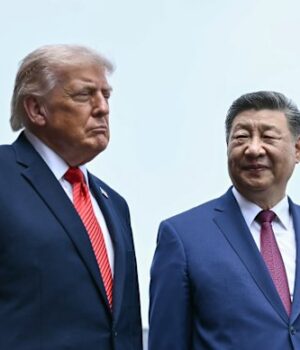
Beijing: When Donald Trump and Xi Jinping sit down at the White House next week, it will be against the backdrop of swirling calls from leading US artificial intelligence pioneers to “pace the frontier”.
That is, to slow down the freight train of frontier AI model development which some creators are warning is careening at such speed that is risks derailing and ploughing into humanity itself.
When it comes to the AI race, it’s a two-state sprint between the US and China. The rest of the world is largely resigned to watching from the sidelines and hoping these two powers get it right.
OpenAI’s Sam Altman – one of the new-age tech kings whose company developed ChatGPT – has suggested a Nobel Peace Prize could be in the offing if Trump and Xi strike an agreement on a safety pact setting some baseline standards for the AI race.
“I don’t think this is hard. This is like a one-page document,” he said recently.
Many China watchers agree that Beijing doesn’t see AI as an existential threat to humanity in the same terms as some in Silicon Valley, but it is increasingly concerned about the risks it poses for regime security for the Chinese Communist Party.
That view was distilled this week by China’s top spy chief, Chen Yixin, who published an article detailing risks including large-scale espionage, deepfakes, and attacks on China’s critical infrastructure.
However, analysts have low expectations that anything resembling a breakthrough AI agreement could emerge from the Trump-Xi summit.
“Right now, the US and China agree on two very important things – they don’t want AI to fall into the wrong hands, basically non-state actors. Number two, there is a shared concern about AI proliferation that becomes a biosecurity threat,” says Chucheng Feng, founder of the Beijing-based Hutong Research advisory firm.
But progress beyond a few basic points of alignment will be hampered by deep mutual distrust, he says.
“You’d be surprised at how difficult some of these engagements with China can be. One page might be really hard, actually,” says Ryan Fedasiuk, a former US State Department official, and now an expert on China-US AI policy at the American Enterprise Institute.
In Fedasiuk’s former government role as a technology adviser on the China desk, it often took months to negotiate single paragraphs on agreements. He says there are serious people in both governments trying to mitigate AI’s misuse, but don’t expect any kind of enforceable mechanism to emerge from the summit.
“With all of the trading barbs in public media, it will be a success for both sides to sit down and have a conversation about AI risk at all,” he says.
When the footnote to this period of humanity is written – and presumably there will be one, whether authored by person or robot – perhaps it will reflect the misfortune that this incredible technology has arrived at such a precarious moment in history, shaped by extreme distrust between capricious superpowers and led by men who place a premium on their own authority as they seek to bend the global order to their ends.
One has steered his country down an authoritarian path, abolishing term limits, and tightening control over Chinese civil society and the internet; the other has repeatedly marvelled at his rival’s iron-fist command while demonstrating a blase disregard for democratic norms that has disturbed US allies.
And yet, if the warnings around AI’s path to superintelligence are to be taken seriously, Trump and Xi are the men of the hour; such is the pace of this technology’s advancement that waiting for their successors is seemingly not an option.
When the two leaders last met in Beijing in May they agreed to set up an AI dialogue, but there has been no significant follow-through since then.
Meanwhile, the genesis of the latest AI safety debate – led by Dario Amodei, chief of Anthropic, a leading frontier AI giant alongside OpenAI – has also been met with heavy scepticism from both Beijing and the Trump administration.
It kicked off over the weekend after Amodei published a lengthy essay calling for US government regulation and industry-imposed safeguards to “slow the pace” of the AI labs to ensure humans remained in control – a position that was backed by Altman and Elon Musk.
Amodei also argued for tighter chip export controls and other constraints on China’s breakout AI industries to ensure any US slowdown didn’t give Beijing the upper hand, warning a Chinese lead would “pose grave danger for the United States and the world”.
It followed an earlier report released by Anthropic this month which claimed Chinese and Russian actors used its AI chatbot Claude to develop weapons software and espionage tools.
Trump rejected Amodei’s calls for a slowdown on the basis it would cede advantage to China, while the reaction from Beijing was also swift. The foreign ministry denounced Amodei’s pitch as “fearmongering”, while Chinese state media tabloid the Global Times called it a “Cold War script” aimed at curbing China’s AI development.
Feng says Beijing will see the timing of Amodei’s commentary as him trying to shape the narrative around the AI safety dialogue between US and China in Anthropic’s favour, positioning the company as the best hope for Washington to maintain its lead over Beijing.
“From Beijing’s perspective, that makes it very easy to interpret ‘pacing’ as containment dressed up as safety,” says Lizzi C. Lee, a fellow on Chinese Economy at the Asia Society Policy Institute.
This doesn’t mean Beijing will be unwilling to discuss guardrails, but it is determined to stop AI governance from becoming an extension of the US-led international order. As Trump has put it: whoever wins AI, wins. Many agree, which makes writing the rule book a core part of the fierce competition.
“That’s the real tension,” says Lee. “Who writes the rules, what risks get prioritised, and whether those rules constrain both sides symmetrically.”
Get a note directly from our foreign correspondents on what’s making headlines around the world. Sign up for our weekly What in the World newsletter.
 Lisa Visentin is the North Asia correspondent for The Sydney Morning Herald and The Age based in Beijing. She was previously a federal political correspondent based in Canberra.Connect via X or email.