

Source : the age
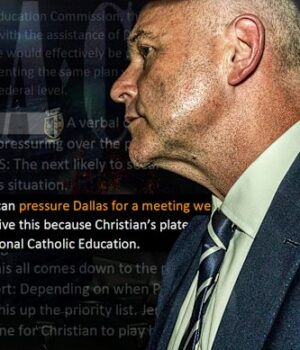
Catholic Schools NSW has sacked its chief executive officer Dallas McInerney after his damaging appearance in the witness box at the Independent Commission Against Corruption, as the Catholic Church seeks to insulate itself from a growing donations scandal.
Board members moved against McInerney on Friday morning as the corruption watchdog heard new details of an at-times comical campaign of surveillance and intimidation against the state’s police minister ordered at the behest of Sydney developer Jean Nassif.
The intimidation and smear campaign, which is unrelated to McInerney but being explored under the same Operation Rosny inquiry, included false assertions that cabinet minister David Elliott was having an affair.
The false claim emerged in part from surveillance undertaken by private detective Shane De Kauwe, whom the ICAC alleges was paid by Nassif. But the one-time Australian Federal Police officer made a series of errors, including monitoring a house Elliott no longer lived in.
“In hindsight, I probably should have taken more action against it,” Elliott told the ICAC.
“Is it morally reprehensible for somebody to monitor a cabinet minister based on gossip and innuendo and repeat it? Yes. But you can see by the fact that he was monitoring the wrong house, I probably had very little reason to be worried.”
Earlier, Catholic Schools NSW released a statement confirming McInerney’s contract had been terminated following his appearance at the ICAC on over the past two weeks.
The ICAC alleges McInerney potentially broke donation laws by directing hundreds of thousands of dollars towards a conservative Christian Liberal Party sub-faction known as the Reformers.
McInerney told the Herald after his sacking: “When the inquiry started, I said I would privilege the position of the company before my own. That is why I stood aside.
“I note the inquiry continues its important work, and we are months away from findings and conclusions.
“I will forever remain grateful for the opportunity to serve, and hope I have made some positive contributions along the way.”
Multiple people advised the school funding organisation to allow McInerney to resign, but the board decided to terminate his contract.
In a statement, Catholic Schools NSW said the ICAC inquiry was of “deep concern” to the organisation and its stakeholders.
“The board will work constructively … to ensure there is an externally conducted review of [our] operations,” the statement said. The organisation did not respond to questions about whether the review would be made public.
Michael Bezzina, who has been a director of Catholic schools in both the Sydney and Parramatta dioceses and now works as a consultant, said the allegations aired in ICAC had cast a shadow over the sector but McInerney’s sacking meant there was now a chance for a reset.
“I took from the communique from Catholic Schools NSW that there is a strong resolve to learn lessons from what has emerged during this terrible situation,” Bezzina said.
“Knowing the board chair as I do, I know she will certainly be pushing the board to make sure it learns from this.“
Independent Education Union of Australia NSW/ACT branch secretary Carol Matthews said she was not surprised by the termination.
“It is vital that government funding of non-government schools is used solely for the purpose for which it is intended,” Matthews said.
“The community must have confidence that public money is being used for educating school students and not for improper purposes.“
She said NSW law required “very close scrutiny of expenditure at the school level” to ensure funding was used for the benefit of students and the operation of schools.
“However, the legislation needs to be expanded to apply the same scrutiny to the bodies that receive funding on behalf of non-government schools,” she said.
Investigators claim up to $265,000 in schools funding was diverted to two companies, Beckington and JPG Advisory, via sham invoices. Beckington was run by Christian Ellis, a key figure behind the Reformers, as well as lobbyist and former political staffer Jeremy Greenwood.
The ICAC says Beckington and JPG did little or no work for Catholic Schools NSW, and the monthly retainers and sign-on fees were instead used to prop up the work of the Reformers.
The ICAC argues funding for the group between 2019 and 2023 ultimately benefited the Liberal Party and therefore constitutes a political donation. McInerney has repeatedly denied knowledge of such a scheme.
Catholic Schools NSW was formed in 2016 to replace the Catholic Education Commission after bishops at the time expressed a desire for a more “appropriate, efficient and transparent” administration.
McInerney’s role as a Liberal Party powerbroker was well known to the Catholic Schools NSW board as well as the Catholic Church and Archbishop Anthony Fisher.
McInerney was on Wednesday accused of destroying evidence that could be relevant to the ICAC’s Operation Rosny inquiry – a claim he denied.
The senior counsel leading the watchdog’s case against a group of conservative Liberal Party operatives was left dumbstruck when McInerney revealed he had performed a factory reset on his iPhone and iPad over the weekend while still sworn in as a witness.
McInerney claimed he erased everything on his phone because the National Australia Bank had placed a block on his main spending account due to a suspicious overseas transaction.
Elliott, the former cabinet minister, told the ICAC on Friday that the developer Nassif “went nuts” after Elliott campaigned against development in his electorate.
He said he was then tailed by private investigators, subjected to death threats and confronted by Nassif on two occasions.
In the first approach, Elliott said Nassif confronted him at Castle Towers and demanded to speak to him about his developments. Elliott said he told Nassif he didn’t speak to property developers.
Nassif then made another approach to Elliott at a pub in Parramatta, where he told the MP he wanted to introduce him to his daughter, and again demanded to speak with Elliott about development. Elliott says he refused.
Elliott said his chief of staff, Tanya Raffoul, was “threatened” by Nassif multiple times through the Lebanese community. Raffoul went to the same church as Nassif.
In one instance Raffoul was called into a meeting with Nassif, who claimed to have photos of Elliott. Elliott told the ICAC Nassif said words to the effect of “you’re going to have to spill your guts on him [Elliott] and we’re going to need you to resign and essentially turn on him, and that you know his career would be ending the next day”.
Elliott said he became aware there were negative stories about him being briefed to journalists while he was a government minister.
He said he formed the view Nassif was behind the campaign because “he had left a message on my mobile that he was going to get me”.
The inquiry continues next week.
Sydney’s best coverage of the ICAC inquiry
 Bevan Shields is a senior writer, and former editor of The Sydney Morning Herald.Connect via email.
 Jessica McSweeney is a reporter at The Sydney Morning Herald covering state politics and urban affairs.Connect via email.
 Alexandra Smith is a senior writer and former state political editor of The Sydney Morning Herald.Connect via X or email.

