Source : INDIA TODAY NEWS
India’s Chandrayaan-1 may have found the geological ghost of a gigantic impact basin on the Moon, not by seeing the crater itself, but by detecting the minerals that were blasted out when the ancient impact occurred.
Scientists from the Physical Research Laboratory (PRL), Ahmedabad, have identified a broad, circular distribution of the mineral orthopyroxene around Mare Australe on the Moon’s far side.
advertisement
They say the pattern provides spectroscopic evidence that a huge impact basin, known as the Australe Basin, once existed in the region but has been almost completely erased by billions of years of impacts, volcanic activity and geological evolution.
The finding, published in The Planetary Science Journal, comes from a fresh analysis of data collected by Chandrayaan-1’s Moon Mineralogy Mapper (M) instrument.
The idea is similar to investigating an ancient crime scene after the original evidence has disappeared.
The researchers could not simply point to a giant depression and say, “there is the basin”. Instead, they looked for the mineralogical fingerprints left behind by the impact.
When a massive asteroid strikes the Moon, the collision can excavate material from deep beneath the surface and throw it outward. Such material can form broad rings around the resulting basin. Orthopyroxene, a mineral associated with deeper lunar crustal material, can therefore act as a marker of an ancient impact.
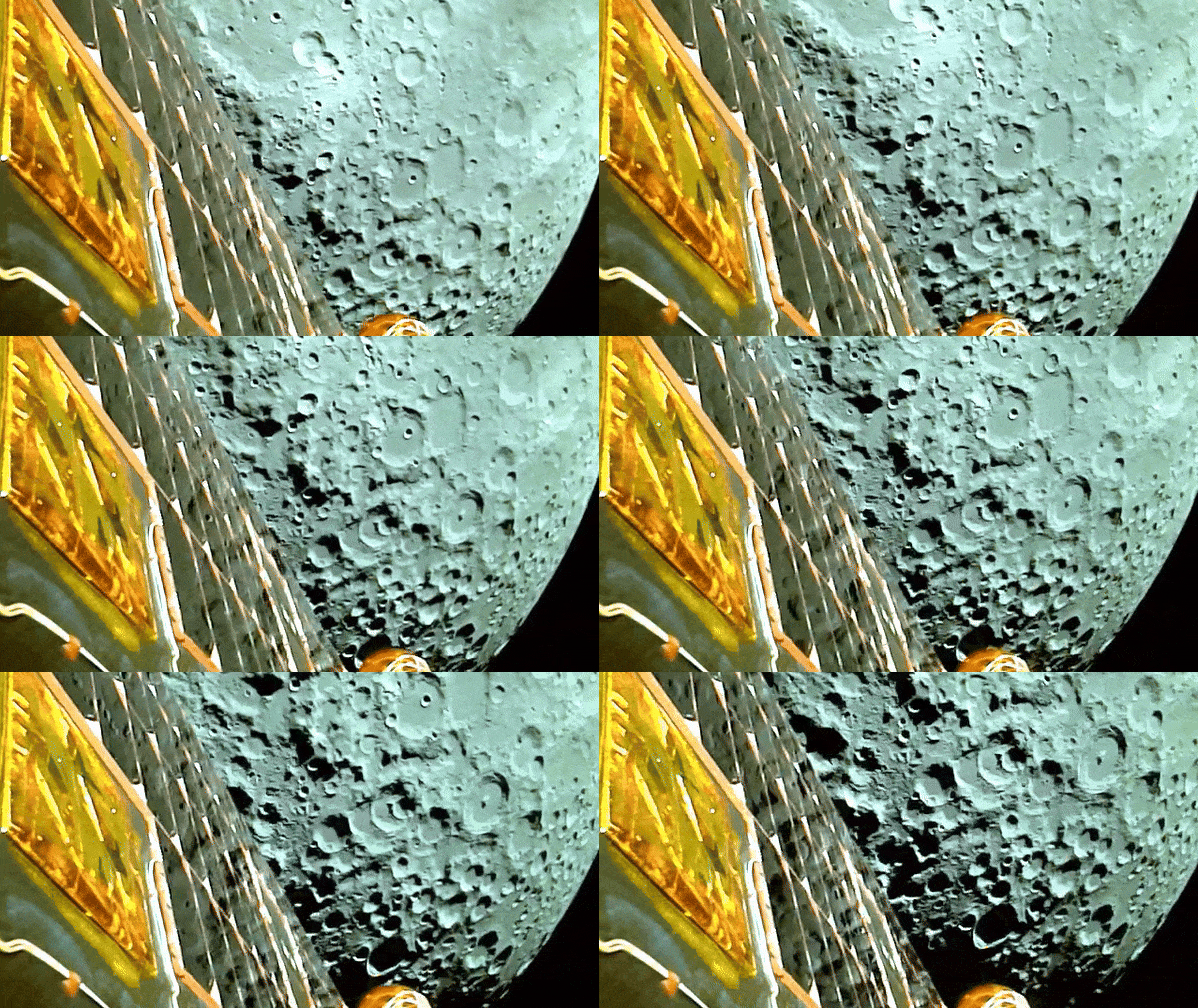
The researchers found that orthopyroxene-rich material forms a roughly circular pattern around Mare Australe, supporting the proposed location and extent of the lost basin.
The region is particularly intriguing because Mare Australe itself contains hundreds of basaltic patches arranged in a broad circular pattern, but lacks the obvious topographic signature expected from such a massive impact structure.
The study suggests that the region may preserve evidence of two enormous impacts. The older Australe Basin may have been followed by the formation of the approximately 880-km-wide Australe North Basin, further disrupting and burying the original structure.
Volcanic activity later filled parts of the region with basalt, adding another layer to the geological story.
The researchers also found that the Mare Australe basalts have an unusual mineral composition, dominated by low- to intermediate-calcium pyroxenes. Their characteristics could provide clues about the Moon’s deep interior and the conditions that existed during its earliest geological history.
Intriguingly, the researchers do not find the widespread deposits of purest anorthosite often associated with younger large lunar basins. This raises the possibility that the Australe Basin formed very early in lunar history, potentially during a period when the Moon’s crust was still evolving.
The study demonstrates how a vanished geological structure can potentially be reconstructed from its surviving mineral fingerprints.
In effect, Chandrayaan-1 has not photographed a lost crater, it has found its ghost.
– Ends
SOURCE :- TIMES OF INDIA